 4:46
A look at a long throw bass cab from Intimidation
Contents of the video
0:00 Similarity between a bass bin
Alright folks, in this video I'm going to show you the similarity between a bass bin and something that looks like that. That is known as a bugle. Alright, so how on earth is something like that similar to something like that? That by the way is from a company called Intimidation and it's known as the Sin Bin. By the way, follow the link in the description to all relevant information. So, I'll pause the camera and first of all I'll show you... Exactly what's going on inside a bugle. Alright, there it is. A bugle in all its glory and this is a proper real bugle because it's got dents in it. Right, what happens is you blow through there and the sound comes out there. Now, to make it very simple, what happens is you blow in here and let's say the sound is relatively quiet. Now if you notice, this is just one long pipe but it's curved
1:28 Let's imagine this is the bugle
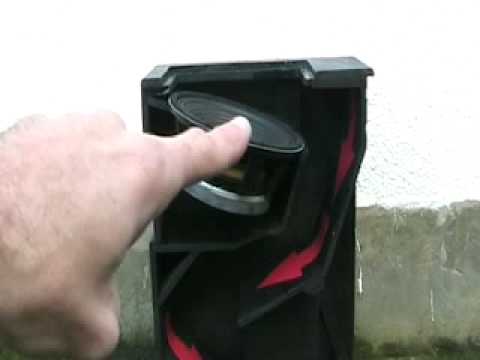
We move along the pipe, the pipe itself starts to get wider. Here if you look here where my finger is and it gets wider and wider till eventually it comes out as the horn itself. That's sort of classed as a horn. So what happens, put it simple again, quiet and it gets louder and louder and louder and louder and very loud. Now what I'm going to do is pause the camera And we'll have a look at that thing over there. Right, let's imagine this is the bugle. If we look here, we've got a small area there. You can see, imagine that is the top part of the bugle where you've just blown into. And if you notice there, we can see that's quite, there's not much distance between there and there. But as we move further down, the distance gets wider and wider and wider till
We get to this point here, from there to there, which is the opening. So what exactly is going on? Right, first off, what I want you to imagine is where my hand is now, there's a piece on top of there. So the sound from that driver won't go up that way. It's only got to go one way or it only can go one way and that is it follows these arrows around and pushes out. Now if you can see this area here where my finger is, now when this particular box is all in one piece the speaker on the top is secured into this area and this area here is almost like a sealed chamber. So theoretically no air can get in but also no air can get out. Now what happens when we get a big bass kick that part of the speaker will move up
3:28 It will move out of this area quite fast
What will happen for a split second, we'll get almost the equivalent of a tiny vacuum here. So what happens is the speaker is almost pulled back down. Now that's quite a good feature because it means in a sense the speaker itself will be more efficient. Now what happens here is the sound will travel up and like I said if you imagine my hand is there it'll hit the top plate but it's almost squashed. So, it will move out of this area quite fast. But also, while it's moving out of here, it's vibrating. Now, as it vibrates, the vibrations or the sound signals will get bigger and bigger until eventually it pushes out of there a lot louder than it would, let's say, if it was just forward-facing. Now, there are good and bad points and I can't have forward-facing and non-forward-facing speakers.
Is known as a long throw. So basically what that means, is that the sound will travel a greater distance. And again if you think about it, if we have a look at that. Why do you think people use bugles? Because they want the sound to be heard from a great distance. As opposed to say a forward facing speaker where you just have a box, empty box and the speaker about there, forward facing. There's also bandpass as well that I will look at in the near future. But anyway, hopefully you've got a tiny bit of an idea of what's going on in what is known as a long throw speaker. And like I said earlier, this guy is from a company called Intimidation. Alright, so hope that's been a help. Practice and enjoy.
This transcript was produced automatically from the audio of the video and may contain mistakes.





