 7:33
A look at a Mirror ball, an old school lighting FX.
Contents of the video
0:00 Ball side, mirrorball, framework
Alright folks, Jonathan here. Here's a question for you. What is this? That, ladies and gentlemen, is a mirrorball. What can we do with these? Let's have a look. Well, basically the mirrorball was one of the first ever lighting effects to be used in dance halls and for mobile DJs around the world. The beauty about the mirrorball is there's not really much that can go wrong with it. It's quite inexpensive and I'll tell you what, believe it or not, it is a damn good effect. Special for the beginning of the evening, or maybe when people are having a bit of a smooch, or maybe just in a corner somewhere where you want to give a nice sort of mellow effect. So what I'm going to do now, pause the camera and I'm going to show you the best optimum way to set up your mirror ball to get a good quality effect. Now then, you will need a mirror ball, you will need a motor that will turn the actual mirror ball, and you'll need something called a pin spot. I'll show you that very shortly.
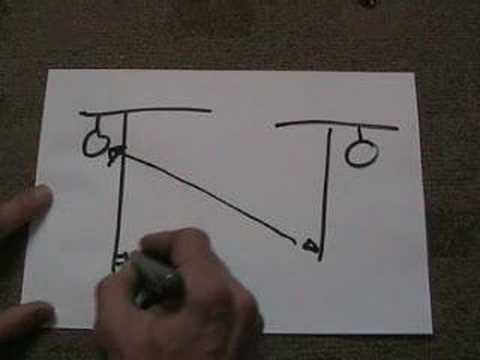
Okay, we're down to our pieces of paper. Now then, imagine, right, bearing in mind this isn't to scale or anything like that, and the cat at any time could walk over what I'm doing. Right, if you imagine here you've got a T-bar, like so. And there you go, it's quite happily sort of sitting there doing absolutely nothing at all. Now, this is what I've done in the past, okay? I've had, now not right on the end here, because of course if you haven't got anything this side, it could tip. So, about here, that's where your motor's going to be situated. And there's your mirror ball like that. Now, if you think about it, OK, you need to put some light against that mirror ball. Now, some people will actually have the light facing that way. Now, the way... There you go, there's the cat. Now, the way light works is what will happen is the light will travel that sort of direction, like so. So you'll get a good effect on the ceiling, maybe the walls, but you won't get anything down here on the floor. Now then, here's the idea, OK?
If you've got two T-bars, this is what I've done in the past and it works really well. Now let's say your DJ setup is there. What you need is, and again if you've got an actual framework, let's say for example you've got a framework like that. Now I want you to imagine two things. One is that that is a basic framework going around a DJ setup but also that could in essence just be two T-bars, the difference being If it was two D-bars, you wouldn't have that area there. Now then, this is what I've done. I've basically put one mirror ball here on that side like that and then I put another mirror ball that side like so. Now also, you've always got to bear in mind the idiot scenario and that is make sure cables are out of the way, people don't get in the way and the telephone's going but I'll answer that shortly.
2:59 The light from this one will hit
And the cat's jumping all over me, so I've just got rid of the cat. Now what you need to do now is, and this is what I've done, I've actually attached a pin spot here and attached a pin spot here. Now that pin spot isn't going to be pointing at that light and that one isn't going to be pointing at that light. That one is going to be pointing over there and that one is going to be pointing over there. So now the light from this one will hit... The underside. I haven't really got the angles right here, so what I'll do, if I show you here on this piece of paper. Right, let's try and get these angles correct. There's one there. There's another one. There's the pin spot. Sorry, there's the pin spot. There you go. The two mirror balls and then, if you imagine the pin spot here facing that way like that. And then the actual pin spot down here facing that way like that. Now what you've got is you've got the light going like so. And then here.
Going like so. Now that, believe me, is a fantastic effect and it looks absolutely fantastic. In fact if you're doing like a dinner dance or anything, you could have these on most of the night. You could have these on during the course of the people eating or maybe talking prior to them sort of having, you know, having a full-on boogie as it were. It sets a nice ambiance to the room. Really looks good. So what we'll do now is I'll pause the camera And we'll have a look at the actual effect we get from using a basic pin spot on what's known as a mirror ball. Hold tight. Right, here you go. This is known as a pin spot. Now believe me, it's exceedingly dodgy and it's not the sort of thing I'd take on the road anymore at all. And what you've got in there, you've got a mirror and just the other side of here you've got the actual lamp and then the light basically shines from the lamp, hits the mirror
5:20 What we'll do now, we'll pause the camera and I'll give you a demo
And points forward. The reason it's called an actual pin spot is because it will give what's known as a pin of light. It's a little bit like a laser in a sense, because a laser will give a true tiny thin point of light, whereas this guy here will give a point of light which is a lot broader, a lot wider. Now let's say from a distance of 10 metres, the light may be that sort of size on the floor. But it's not expanding quite considerably. So that's the beauty of it. So something like that, hitting a mirror ball will only hit the mirror ball and not the actual wall or anywhere around it. OK, so what we'll do now, we'll pause the camera and I'll give you a demo. And there's the cat again. Hello Madagascar. Now this guy here is the motor. What this will actually do, this will slowly turn the mirror ball
Maybe 4 or 5 turns per minute. That's 4 or 5 turns, 4 or 5 RPM, revolutions per minute. Now as you can see this one here is secured with some tape. The only reason it's secured with some tape is because I haven't got anything else to stick the damn thing up with so I highly recommend you do not do that. In fact don't do it because you're a monkey. And then that is attached like so. And excuse all the bits there. And then, of course, you've basically got your mirror ball. There you go. And that's it. Where else would you have a mirror ball but in the kitchen? I mean, come on. You know, let's be honest. Right, now then. I don't know if you can see, but if I point it in that sort of direction, you can see generally where the actual light will go. But as soon as I hit that mirror ball, bingo. There you go. That's the sort of effect. Now what I'm going to try and do is place it If you've got two or three mirror balls around the room, you can get a much better effect. So there you go. A bit of an insight into an old school sort of light that isn't necessarily old school. It's still damn good and does a damn good effect. So I hope it's been a help. Thanks for watching. Practice and enjoy.
This transcript was produced automatically from the audio of the video and may contain mistakes.





