 5:55
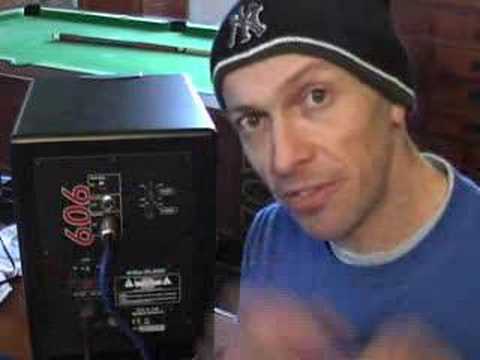
A look at the I key powerd studio monitors, M Series 606.
Contents of the video
0:00 A couple of people have noticed I've got these guys here
Alright folks, a couple of people have noticed I've got these guys here. Right, these are known as powered speakers. Now first of all, if you don't know what a powered speaker is, basically it means that it has an internal amplifier. In other words, you do not need amplifier and then a speaker. Everything is just inside the one unit. Now this guy here has actually got two amplifiers in it. It's got an amplifier for this speaker and an amplifier for the small little tweety thing right at the top. So what I'll do, I'll pause the camera and we'll have a look on the other side, hold tight. Right, I'll put all relevant links to the side of the video. These are the M-series and this one here is the 606. Now what we've got, we've got three inputs. We've got here an RCA input, we've got a jack input and we've got an XLR. Now ideally if you can, try and go balanced.
Basically, it means you will get a better signal. You've got a volume control here so you can have it as high as you want or as low as you want. But what I recommend with any powered speaker, this is my own recommendation, the worst thing in the world is to have your powered speaker, the level set really low because what will happen then, you will start to turn the volume on your mixer up and what happens, if you can imagine you've got loads of sound coming out of your mixer... And it's almost getting compressed in here because the volume isn't up enough on here. So ideally, you need to actually have the volume on this guy set relatively high. I mean, you can put it at zero. I generally put it about plus three dB. And then you can turn the volume on your mixer up, which means you should get a nice sound out of this guy. Right, also, you've got another button here, which is high frequency adjust. You can go minus two dB.
1:46 They're known as studio monitors
Now theoretically here, when you're on 0 dB and 0, you're near enough what's known as like a flat response. Now if I just wang the camera out. Now generally what you find in studios is when you have that remixer mixing the actual tracks, yes they will have quite large speakers either side of them, but also they'll just have quite small petite speakers. Now they're known as studio monitors. Now what they will actually do, they will give out what's known as a flat signal. It's perfectly flat. In other words if you imagine on your mixer... You've got the bass set at 12 o'clock, the mid set at 12 o'clock and the treble set at 12 o'clock. Now that is what a lot of, including these I believe so, powered monitor speakers will do. They will give you a proper true sound. In other words, if the sound, if the particular tune in the studio was made at a certain level and everything is set perfectly, then that is exactly what you will get out of these guys.
3:25 You have to take this off and just flip the switch across
If they're set level. Now, why do you need these or why would you want some powered speakers? Well, let's say for example, you're in a high rise building department, high rise buildings, you've got loads of people living upstairs, downstairs and in your toilet. The last thing you want to do is have huge massive speakers. So small speakers is ideal. Now just because they're small does not mean to say they will not push out a lot of bass. Put it this way, if I put these in or any powered speakers in a huge massive building like in a hall somewhere you wouldn't be able to hear them. But if they're in your bedroom you would be able to hear them, you'd get loads of bass and they would sound fantastic. So what I'm going to do now, and also just to let you know as well, you've got an on-off button here and what you can do again with these and a lot of other powered speakers
You can change the actual voltage from 110, 120 up to European 220, 240. So you have to take this off and just flip the switch across. So what I'll do now, we'll pause the camera and I'll give you a little bit of a demo of what they sound like. Hold tight. Right, here we go. I'm going to put a tune on for you. If you want to know the actual name of the track, look to the side of the video. And this one down here is 60 watts. They've actually got two completely separate amplifiers in there.
So there you go, a little insight into these guys here. And again, why would you buy something like this? Like I said, maybe you don't want to annoy the neighbours or maybe you just want a nice good quality sound. Alternatively, you don't want to buy an amplifier and all the little gubbins that go with it because basically with these, you could turn up your mixer, two CDJs, a couple of leads, bung them in the back of these and then bingo, you've got yourself a nice sound system. They are a very clean, clear, sort of precise sound. Now, someone who works in a studio will understand exactly what I'm all about. It's all well and good buying your normal average hi-fi speakers, but the trouble is with those is that, you know, they're hi-fi. There is a definite difference between your general sort of run-of-the-mill hi-fi speakers and proper studio monitors, alright? So, a little insight into these guys here. Look to the side of the video, like I said, for all the descriptions and gubbins. Practice and enjoy.
This transcript was produced automatically from the audio of the video and may contain mistakes.





