 7:53
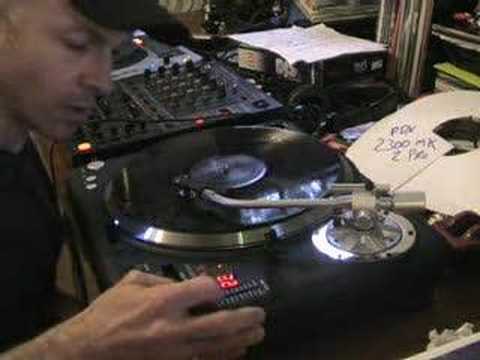
Demo of the Vestax PDX2300mk2 pro vinyl turntable
Contents of the video
0:00 I've been asked to give this guy a demo here
All right folks, Jonathan here. I've been asked to give this guy a demo here. It's the Vestax PDX2300 Mark II Pro. A couple of nice features with this. One, it's got a nice readout here so you can, if you can see there, you can basically see whereabouts you are in the mix as well. So it's visual as well as, you know, you're having to hear. You've got a nice little thing here which is a little bit like a joystick. What you can do, We'll increase it by 2%, but then we'll also speed it up by 50, slow it down by 50%. So I'll give you a quick demo of that. If you play the actual records, you can hear. That's minus two. That's plus two. To minus 50. And that's plus two. So again, something like that is quite good because let's face it, you're fine-tuning that mix. You're just nice trying to...
He's trying to tweak it. And of course, the trouble is nowadays, you know, they make turntables and the torque is that much on the actual platter. In other words, what torque is, it's basically how powerful the motor is. And of course, like with the likes of the SLs, you know, you could tweak the actual platter a little bit and slow it down. But of course, DJs want a good startup motor. But of course, if you've got a good startup motor, it means it's more difficult to actually slow that platter down or speed it up with your finger. But with this little pitch bend, basically what it does, exactly the same as let's say spinning your finger on the top to speed that record up a tiny bit while you're trying to fine tune the actual speed or again putting your finger on the side here to slow it down. So you can do exactly the same using the actual pitch bend. It's got the same features as well as the other Vestax turntables. You've got speed adjustment start and speed adjustment break. So in other words if they're set
In one direction, as soon as you press start and stop, it can start really quickly and stop really quickly. And then dependent on how much you fine tune these will be of course dependent on if you want it to start straight away or... So, usual things in the back. You've got phono straight in and you can actually change the phono plugs. A lot of turntables nowadays, what you find is they're actually hardwired into the back. Yes, it's good because you never leave, of course, you're never going to leave the actual phono cables at home. But the bad point is with the likes of those turntables, and that is eventually when they start to fray at the end where you put them into the back of the mixer.
3:06 I'm going to give you my honest opinion how it feels, the pitch, etc
Of course you've got to cut them off and you've got to re-solder new ones, at least with I suppose this kind of thing. You know, if your phono leads start breaking all you do is you buy new ones. Right, what I'm going to do now, I'm going to give it a bit of a demo and I'm going to do a bit of mixing with it. So I'm going to just position the camera slightly differently and then I will give it a bit of a demo. I'm not going to use my headphones, I'm going to have a bit of fun and I'm going to give you my honest opinion on what I think it's like to mix with. Bear with me.
Alright folks, the tracks I'm going to use is Michelle Miggs and JJ featuring Jojo Haley, friend of the blues. And also one of my favourite artists which is Kashmir from the 12 inch LP, it's track entitled Only For You. Alright, so again, I'm not going to use any headphones. We'll give it a go and we'll see exactly what it's like to get it in beat, etc. Now, I'm going to give you my honest opinion how it feels, the pitch, etc. So we'll start this one off. It's not bad actually, to be quite honest. What it has got as well, a feature on the top, is other turntables, they've got a fine adjustment on the back of the actual weight. A small wheel and that will just maybe fine-tune the weight, you know, give you a few extra grams, a few less grams. With this guy here what you've got on the top is you've got this appliance here and this basically you can move according to how much more weight you want on it. You can basically fine-tune that weight on the end of the styli and let's have a look. That seems pretty cool. It seems to lock alright anyway.
Construction-wise, it's near enough the same as the other models. The cellar in the background. Again, you've got the ultra pitch, so we'll just quickly try that. Let's bung that on there. Yeah, basically, the ultra pitch will do plus and minus 50 exactly the same as the actual pitch bend. Like I said, you've got this little sticky-out bit here, and you can wang that forward, and then as soon as you take your finger off it, I'm not going to rate anything, I'm not going to say it's better or worse than any other turntable. That's not what I'm here to do. I'm basically here to give it a demo and tell you what I think. For a DJ turntable, I think it's pretty good. My main feature, of course, the main feature for any DJ, and that is, of course, the pitch control. I mean, if the pitch control's crap, there's no point buying it, is there? And in my eyes, the pitch control is fine. So I hope that's been a help. Thanks for watching. Practice and enjoy.
This transcript was produced automatically from the audio of the video and may contain mistakes.





