 8:11
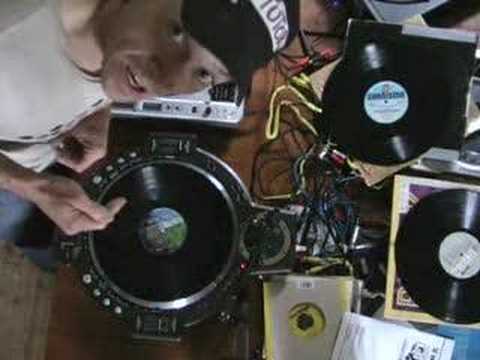
Demo of the Vestax QFO LE from a mix DJ's point of view.
Contents of the video
0:00 This from a DJ mixing point
Alright folks, Jonathan here. Now I've been asked to give this a bit of a demo, OK? It's the QFO-LE from Vestax. Now then, before trying to make this off look like a complete and utter wazzock, very quickly, I'm not really a turntablist so I'm actually going to look at this from a DJ mixing point of view, OK? Now then, it does have pitch control. If you can see here, it's got this sort of, it's a little sticky out bit and it's just below the actual platter. From this point, okay, up to the right-hand side, it will go plus and minus 60. But then also, it'll go plus and minus 60 the other side as well. I'll just give you a quick demo of that, so we'll start it up. It slows down. Now, one good point about that, and that is, of course, from a turntabler's point of view, dependent on which way you want to actually put this.
Of course you've got, almost like you've got a mirror image of a pitch control. And also here you've got start-stop, you've got your 33-45, you've got your reverse dial as well, so for example if we whack that into reverse, and you've got court lock. So you've got, let's stop that, so you've got both on exactly the same side. Now what I do like about this, okay, and that is this particular unit has got a mixer built in. I've got a CD player here. Now again, you don't have to have a Pioneer CDJ, it can be a Vestac CDJ, it could be a Denon, a Numark, any CDJ turntable, it doesn't have to be this particular one. Now what I've actually done, I've wired this guy directly in, I know that sounds absolutely bizarre, but I have wired this one...
Directly into here, and then what I've done, I've just gone straight out of this into an amplifier. So okay, I haven't got any bass, mid or treble, but let's say if I didn't have a mixer and I just had the bare essentials, CD player I could make some music and also you can mix with it because you've got a headphone input here which is quite cool. Now again, you've got two volume controls. The volume control on this side is utilised for let's say the turntable and the volume control on the other side is utilised for the CDJ. So what we'll do first of all, I'm going to give my mad demonstration of a bit of scratching that's probably absolutely rubbish but I'll give you a general idea. We're not looking to see how good or bad I am. Well, yes, alright, we're looking to see how bad I am because I'm terrible. But what I'm going to do now, I'm going to give a demo and see how good it is in relation to that styli, the needle staying where it should be. In other words, when you move the actual record back and forwards, you know, is it going to jump? So what we'll do, we'll start it off on the outside. Send it down a bit.
3:15 Work
I'm really going to give it some stick now. Now that's not bad at all actually, now it has got crossfade on it as well, so you can actually do cutting and scratching using the crossfade which is here, and then you've got two levels of volume controls, one let's say can be for your line input, and the other one can be for the actual platter itself. Now what I'm going to do, I'm going to utilise it with a bit of mixing. Now the only thing I will say about this, and that is it's not the best thing in the world. For an actual DJ who wants to do beatmixing, because the pitch control is here. This will speed it up and slow it down. Now, it does work, alright? I'm not saying it doesn't work, it does work. And what I will say is that it will work if you give it time. In other words, if you practice with it, you'll get used to it. But in my mind, it's not as good as, say, a small little pitch control for a normal turntable. But at the end of the day, if you want to buy a turntable for mixing purposes...
4:39 One of these as opposed
You're not going to buy one of these. These are mainly for turntable lists. So what I'm going to do now, I'm going to set this and we'll have a little bit of a jig around and mix it. Okay, so the track I've got here now is Josh Wing, size 9, I'm ready. It's a bit of a classic actually. Good for a turntable list. I mean, why maybe look at one of these as opposed to a normal turntable? Well, a normal turntable, you've got to have a mixer and yes, all right, admittedly, you've got to have an amplifier, etc. But with this guy... Because it's actually got a headphone socket inside it as well, you don't need a mixer, you don't need an amplifier and basically all you need is one of these guys. You can stick it underneath your arm and take it anywhere because you can have a practice with it. You don't need to take loads of gear with you. Just use this. Alright, admittedly if you want to hear it loud you've got to have an amplifier. Well you've got to have an amplifier with anything.
But anyway, right, now then, from my point of view as in a mixing DJ, I'm looking at this and I'm trying to look at it from a turntablist point of view. And I think it's a nice piece of kit, okay? Now then, anyway, a small tiny insight into this, right, it's the QFOLE from Vestax. What I'll do, I'll wang that a little bit forward like that and you can have a bit of a closer look. There you go. I mean, it looks quite nice. Now also from a constructive point of view, there we go, let's move that around there. It's, I mean it seems well built. You know, I don't think it's going to fall apart. I mean there are bits that are a bit plasticky etc. But what the heck? I mean at the end of the day as well, the bits that are going to start falling apart eventually, possibly, but again it's going to happen with any mixer or any turn, well when I say turntable, I suppose yeah, turntables because your pitch control is going to end up being knackered after a while. But the bits that are going to wear away on these guys is of course the actual pots or more commonly known as the volume controls or crossfade.
But again, the beauty about them, you can change them. You just unscrew, take the old ones out, put new ones in. So there you go. I mean, a very quick insight into this guy here. QFOLE. Alright now, thanks for watching and again, leave your comments and if you've got one of these, alright, and you can use it a lot better than I can, then post a video response underneath this one. Practice and enjoy.
This transcript was produced automatically from the audio of the video and may contain mistakes.





