 5:11
Reading the wheel: major and minor by feel
On YouTube this video is called DJ HELP WITH MIXING IN KEY! mixedinkey Video 2
What this lesson teaches
The second video in his series on the software, and the one that explains the diagram everything else depends on.
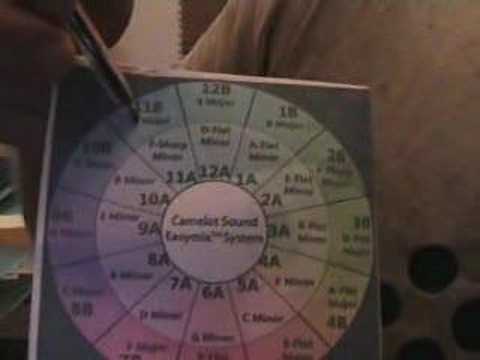
What you are looking at
A circle with twenty-four positions. Twelve numbers, each appearing twice - once with a B on the outside and once with an A on the inside.
B is major. A is minor. That is the whole notation.
So a track might be 8A or 8B, 12A or 12B, and every piece of music in the world lands somewhere on that wheel.
Telling them apart by feel
This is the part that makes the system learnable by somebody who has never read a note, and it is his best contribution to it.
Take a track you love and ask what it does to you.
Does it lift you? Euphoric, bubbly, happy, up - that is a major key, a B.
Does it float? Chugging along, low but not depressed, carrying you rather than lifting you - that is a minor key, an A.
Most dance music is in minor keys, which is why so much of it has that quality of moving without celebrating. The euphoric moment in a trance record is very often a shift towards the major.
The moves the wheel allows
He builds this up across the series, and the three compatible moves are worth having in one place:
Same position. 8A to 8A. Identical key, and they will always sit together.
One step round. 8A to 7A or 9A. Neighbouring keys share most of their notes, so the change is smooth and the energy barely moves.
Switch the letter. 8A to 8B. These are relative major and minor - the same notes arranged around a different home - so the two are compatible and the feel changes noticeably. This is how you brighten or darken a set without changing anything else.
Anything further round the wheel than one step is where it starts to clash - and deliberately jumping two is a technique in its own right, covered in the next lesson.
And the pen
It is tied to a speaker with a piece of string, because it is the only one in the house and he has threatened his entire family, including the guinea pig, if it goes missing. The series is made at a kitchen table and that is part of why it works.
Contents of the video
0:01 Second video in a selection I'm doing on a program entitled Mixed In K
Right folks, second video in a selection I'm doing on a program entitled Mixed In Key. Now first of all I want you to have a look at that. Secondly, I want you to have a look at that. That is a black pen. That's the only one I actually found in the house and it's attached to a stringy bit and the stringy bit is attached to that speaker there. The reason it's attached is so it doesn't go walkies. I've told the entire family... If that goes walkies, I will personally circumcise the lot of them, including the guinea pig outside. Just kidding. Alright, take a look at that. I don't know if you can see first of all, hopefully you can, but you can see B's and A's. Now, the B's are known as major keys, the A's are known as minor keys. What is a major and what is a minor? Well, first of all, in the UK, especially in Wales, we used to have loads of minors that used to...
1:49 Edg music will have the minor keys
Here's the deal. I want you to pick out your favourite track. Not now, later. I want you to have a listen to it. Now first of all, does it make you feel euphoric? Does it build you up? Does it make you feel high? Or does it bring you down? Does it make you feel low? Does it make you just feel as though you're chugging along? Well here's the deal. The ones that are very low and make you feel a bit low, not necessarily depressed but just, you know, you're chugging along, you're just quite happily floating along with the music, quite often will be known as the minor keys. As opposed to the ones that make you feel euphoric and jump up and happy and just bubbly, they are the major keys. Edg music will have the minor keys. Someone's going to probably put comments saying, oh I've got loads that are major. Right, fair enough. But then quite often you'll find the likes of The Funky House and The Soulful Stuff are major keys. Alright, let's have a look at this guy again. Now, basically this is how it works. Let's say for example we have a track and it's a major key. Let's say it's this one here, 11b.
Now we could go and play another track that's 11b straight after it, and another one, and another one, and another one. But after continually just doing this all the time, the crowd would enjoy what you're doing, but you wouldn't be taking them on a specific journey. So maybe go down here to the next key, to 10b, and then to 9, 8, 7, and you can carry on going all the way around. 10B to 11A Maybe you can get away with it if you're just mixing the actual beats, but you can't go from 10b to 9a or 10b to 11a. In other words, you can't go across because that's when you start getting clashes in keys and it sounds rather dodgy. So, 10b to 10a, then maybe 11a, 12a, but then from here you could go to 12b.
3:40 I hope you get the general sort of idea

I hope you get the general sort of idea. Now this is what I've done. I got the program up, I bunged a load of tracks on there and I got the actual keys. Now what I've done is I've sorted through those tracks and I've got a few keys that are very close together like on this scale here. Now hopefully in the next video, and I'll put it underneath here, I'm going to do a mix and I will show you How I constructed it. I will also show you the names of the tracks to the side of the video and I'll actually show you the keys in relation to this, so it'll give you a general idea of what you can do. Alright now why do you want to use this? Well let's face it if you've got an absolutely vast record collection or CD collection like me and let's say you're in a club environment or anywhere and you need to get a track out ASAP
And you've just got to dive in there and grab something. Well, of course, the trouble is, unless you know your tunes, and a lot of DJs do know their tunes, if you don't know your tunes as well as you should do, then you can just grab a track that is an appropriate, in inch I say, an appropriate key, bung it on, and then at least then you know there will be a continuity with the music. Now, alright, this is video number two. Hopefully we're going to do a whole bunch more, and like I said in the next one... Hopefully we'll get that mix underneath here. Practice and enjoy. Thank you.
This transcript was produced automatically from the audio of the video and may contain mistakes.