 9:06
Checking a second-hand turntable
On YouTube this video is called dj tutor advise, Buying a second hand dj turntable
What this lesson teaches
Most second-hand advice is about haggling. This is about knowing what you are looking at, which is the part that actually saves money. He demonstrates on an SL-1200 Mark II and says so, but nearly all of it transfers to any direct-drive deck.
The principle first: use it before you buy it. Take records, play them, move everything.
Start with the pitch, using the dots
This is the test to learn, and it is the one most buyers do not know exists.
The rim of the platter carries rows of small dots, and there is a small lamp beside it. The lamp flickers at mains frequency rather than shining steadily. When the platter turns at exactly the right speed, each flash catches the next dot in the position the last one occupied - so the row appears to stand perfectly still. It is a stroboscope, and it is measuring the deck against the mains supply rather than against anything inside the deck.

So, in order:
Pitch at zero, on 33. The relevant row of dots must sit still. Not nearly still - still. Any slow drift means the deck is not running at the speed it claims.
Move the pitch slowly down. The dots should begin creeping towards you, smoothly, and travel faster the further you go. Smoothly is the word that matters.
Move it slowly up. The same thing in the opposite direction.
What you are watching for is wobble - the dots surging and hesitating rather than moving evenly, or jumping as the fader passes a particular point. That is the pitch circuit failing, and he is unambiguous: walk away, or use it to drop the price.
This matters more than anything else on the deck, because a pitch fader that does not track smoothly makes beatmatching impossible in a way the buyer will blame on themselves for months. And it is invisible - the deck plays music perfectly.
He prices it honestly. A replacement fader is about fifteen pounds if you fit it yourself; a hundred or more at a dealer. Either a bargaining chip or a reason to leave.
Then the mechanical checks, in order
The platter. Put a hand on it and rock it gently. Creaking, grinding or play means the bearing has had a hard life. This is worth caring about even if you never scratch, because a worn bearing only gets worse, and anyone leaning on one side of the platter accelerates it.
The headshell mount. Fit a headshell, lock it, and try to move it.
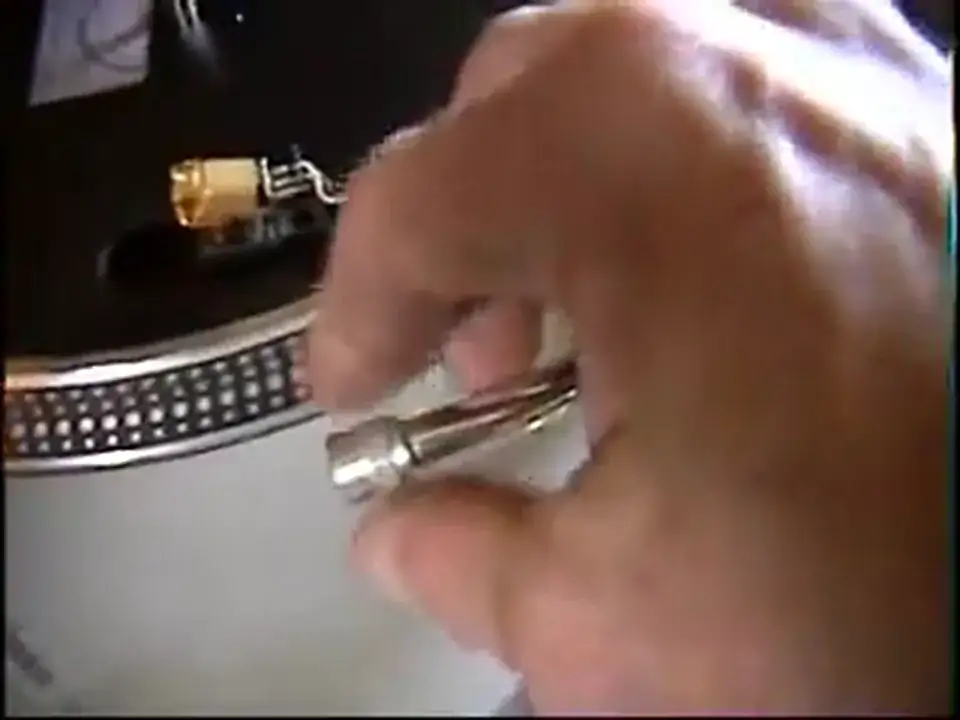
If it shifts, the collar has worn from years of headshells going on and off. The consequence is specific: the stylus no longer meets the groove square, so the two channels are no longer balanced and the record wears unevenly.
The tonearm lift. Up should be quick, down should be slow and damped. A lift that drops the arm is a lift that will one day drop it onto a record.
The tonearm bearings. Hold the arm and shake it very gently. Any vibration, play or looseness is worn bearings - the one fault on this list that is both expensive and unliveable.
Screws, everywhere. Top plate, underside, and under each foot, which unscrews. A hole with no screw in it means somebody has had the deck open, and you want to know that before you pay.
Taking the platter off
Worth doing, and easier than it looks. There are two holes in the platter: index finger into one, thumbs either side, and lift straight up.
Underneath you are looking at the other half of the motor. Check the magnet ring is unbroken and clean, check the rubber ring is still properly bonded to the platter rather than peeling away, and check there is no debris sitting in the well.
Then the spindle. A little vertical movement is normal and fine. Side-to-side movement is not - if it rocks laterally, the bearing is on its way out.
And the small thing everybody forgets: the 45 adaptor should still be sitting in its recess.
Contents of the video
0:00 Finer points about buying a second-hand

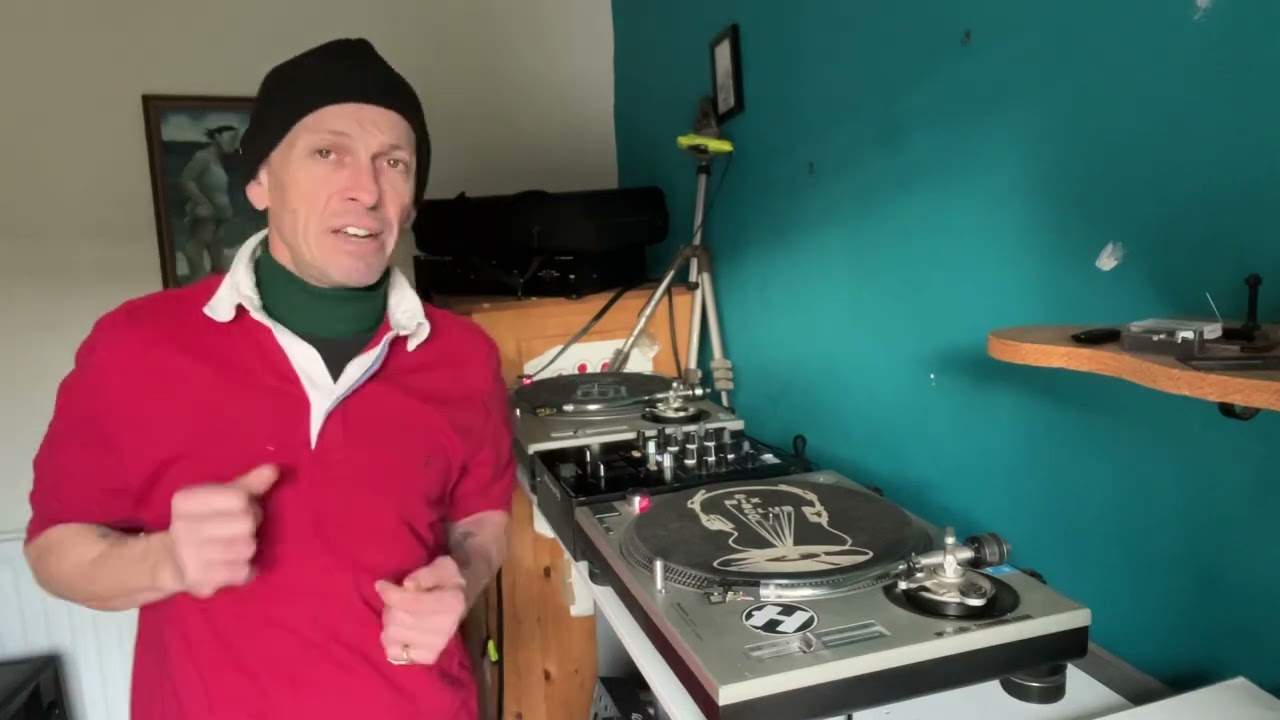
Right folks, on this one we're going to look at the finer points about buying a second-hand turntable. I can only describe the SL1200 Mark II because that's the only one I've got, but basically most of the principles will work. We're looking at pitch control, the platter, the arm, etc., etc. Right, okay, what do we do? Make sure again, like with a mixer, you need to test drive them. In other words, use them, okay? Don't abuse them, but just use them. Take a few tunes and have a little spin with them. First and foremost important thing is the pitch control. There's no point buying a turntable where the pitch control does not work. So I'll show you now how to make sure your pitch control works perfectly. Okay, first of all, make sure it's dead centre, it's on the green. When it's on the green, it's on 33 there, it should run at 33 and a third RPM. That's 33 and a third revs per minute. This will turn around...
1:42 Moving towards you, very slowly
33 and a third times, likewise with 45. When it's on 45, that means that this top will turn around 45 times per minute. OK, what do we check for? We're on 33 or 45, it doesn't matter. Can you see the centre circle? When that's in the green, the centre circle should stay exactly where it is. It should not move at all. What you need to do then, check that first, that that is stationary. Moving towards you, very slowly. I have not got my hand on the pitch control now. I have just moved it, like you saw earlier, away from the centre position and I'm watching that move. If, from the centre position, it starts to do this, wobbles, then that means the pitch is on its way out. So buyer beware. I would personally not buy that turntable. Now what I'm going to do now is I'm going to slowly move the pitch control.
Down, okay? We'll take the camera across here. Right, I'm slowly moving the pitch down and you should be able to see that centre circle move faster and faster towards you. Now that to me says this pitch is okay because it seems to be moving correctly and it's not wobbling. Only me, I'm wobbling with the camera, okay? So if, for example, at some point while I was slowing it down, it was doing this... That would say to me, not the sound, just the actual movement here, that would say to me that the pitch control isn't working correctly. Now the same applies when you increase the speed. Take it away from the centre very slightly, look over here and then it should do the opposite. It should start moving away from you. This particular pitch control here, as I bring the speed up, it's not perfect so I possibly have to at some point in the near future put a new pitch control in here.
Okay, so as I increase the speed again it starts moving away, gets faster and faster as the pitch gets faster and faster here. Okay, and again while you're doing that make sure... It's not moving, wobbling. That is the first and foremost important to check on on your turntable. If the pitch isn't working correctly, two options. One is to walk away or the other one is to get them to lower the price because one of these for you to fit will cost you £15, $20. To take it to a reputable dealer it can cost about £100, £120, $130. So buy beware. The platter. Okay, put your hand on it. Give it a bit of a wobble, okay? You may find it may creak and make noises. If it does, it means it's had a hard life and the internal workings here may be a bit starting to wear away, okay? Now that's quite important because a lot of mixers and scratch mixers, they do give a lot of pressure on this side, okay? So you don't want to get into position whereby there's one millimetre difference from this side to this side. There could be a problem there. Also the head shell. Take the head shell off, okay?
4:21 Two screws underneath here, okay, may be wearing away
Right, what I will do now, I'll lock that in position. Now this guy here holds the head shell on. If this has had a hard life, in other words lots of head shells on and off, on and off... Two screws underneath here, okay, may be wearing away. That means that this bit here could be loose. When you put your head shell on, the head shell could move. If the head shell moves when it's in place and locked, that means buy beware, okay? Because it basically means when the needle is on the record, it may not be square on the record, which means you haven't got a true stereo sound. Okay, here, take this off. Now what we'll have to do very quickly, we'll have to put this back on here.
To just get the weight correct, your lever to put the arm up. Make sure that works properly and down. When it goes up, it should go up quickly as you can see. When it goes down, it should go down slowly. Also, the locking mechanism here. Check when you put it forward, it locks in place the arm and all of the armrest. When you put it out of the lock position, you should be able to move this up. There are some ball bearings, okay? Now quite often what happens is these guys here will start to wear away, alright? So what you need to do is hold the arm and just shake it a little bit. Now if you can feel a bit of vibration, alright?
It means that these screws and the internal parts here have started to wear away or, you know, just be careful. That has to be, when I say solid, yes it has to be loose and freely moving but check it, feel it, it's got to be solid. It has to... Someone has opened this up and not put it back correctly. Take the feet off. The feet will just unscrew, OK? I can't do it, I'm afraid, because I'm holding on to it. Now, under each foot you'll see more screws, so make sure they're in position as well, OK? Now then, I'm going to try and do something here that's a bit... Not dodgy, but it's difficult, so I have to put the camera there. I'm going to take the platter off, OK?
Now, I don't know if you can see, but there are two holes in the platter. What you need to do, put your index finger...
In the platter, thumb either side and you lift. Now there you go. Platter comes off. Now what have you got there? That is a magnet. Make sure it's not broken in any way. Make sure it's in good condition. Make sure the rubber all around there is in good condition. What can happen is this rubber here can sometimes come away from the underside of the platter. Make sure it's perfect. It has to be 100% perfect. Also here. Make sure this is basically the other side of the motor. Make sure there's no rubbish or bits inside here, and this bit, the spindle, make sure it will wobble, that's fine, OK? But make sure it doesn't move. If that wobbles either way, as opposed to... It's got to wobble up and down, but if it wobbles left and right and this way, that means it's on its way out. Again, more screws. Check that the screws are all in position.
If there's a hole without a screw, alarm bells. Again, it's only a small point here, but this guy here, that's a circle centrepiece to go in here for your old 45s. Make sure that's there as well. Now, again, there's so much more to discuss about buying turntables, second-hand turntables, but first and foremost, check your pitch control, make sure that's working perfectly. Check the arm, make sure the arm doesn't wobble. When you put your head shell into that little compartment, make sure the head shell doesn't wobble a little bit because if it does... Thank you for listening. Bye-bye.
This transcript was produced automatically from the audio of the video and may contain mistakes.
This video is part of
Related videos
-
WHY Vinyl and WHY Is Now the Time to Go Old School
He admits at the start that this one might annoy people, and some of it should be argued with. The practical half is excellent. The claim…