 8:53
GEMINI GX-1001 Powerd Speaker, Video demonstration
Contents of the video
0:00 It's known as a powered speaker
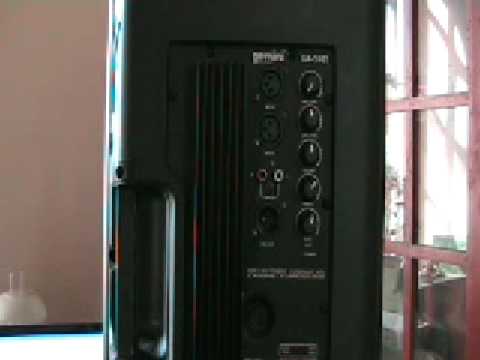
Alright folks, video demo on this guy here. It's known as a powered speaker. It's from a company called Gemini. It's known as the GX-1001. We've got a 10 inch bass speaker. That guy will produce the bass sounds, some of the mid and then here we've got a 1.35 inch compression driver. That will produce the high frequencies, the hand claps, the really high sounds that you would hear in music. What I'm going to do now is pause the camera and we'll have a look at the back. Right, what I'll do first of all, I'll explain about all of the dials, what this is for and then once I've done that, I have a close-up so you can see individual dials. Now we've got here, we've got mic level, line level, volume, treble, bass, mic in, line in, line out and these guys here are also line in. Exactly the same here but of course different plugs. Now first of all, mic in, mic level.
Well, theoretically, you don't necessarily need two of these if you just want to use something like this. In other words, if you've got a microphone and a microphone lead and you just want people to hear you a lot louder, you can have a microphone in your hand, a lead, plug the lead in here, use mic level and you could use a speaker like this for basic PA purposes. In other words, so people can hear you a lot louder. Line in. Now if you imagine on the back of your mixer, quite often mixers will have something known as a balanced XLR output. So what you can do, you can go balanced out into line in. Now let's say for example you've got four of these speakers to either side. What you can do, you can go line in and then you can use this line out to go to your other speaker. So this is what you'll do, you'll go from your mixer into line in and then you'll go from line out
If we imagine then this is the next speaker, you'll go from line out into your next speaker into line in. Don't go from line in into line out using the same cable because theoretically you won't get anything at all. Now line in here is RCA so this is quite cool. I do like this feature on these speakers because it means that you can go from your mixer and 99.999% of mixers And DJ related mixers have got these plugs. These are known as RCA, so what you can do, you can go from your left output, master output into left here on one speaker and then you can go from right output on your mixer into right onto your other speaker. Now this guy here, this dial, very important, line level. Now that is not, it should not be classed as a volume control.
2:50 On the other hand this guy here is the volume
This guy here serves one purpose and one purpose only to increase or decrease the line output, the signal from your mixer. So in other words don't class like I said earlier, don't class it as a volume control. From your mixer you don't get a lot of volume, you get just a signal so that's there to increase or decrease the signal from your mixer. On the other hand this guy here is the volume. Now this here The first step is to increase or decrease the volume from the amplifiers from this speaker into, in turn, into the speakers themselves. Treble will increase the high frequencies, that in turn will increase the sound that will come from the high speaker, from the compression driver. This guy here, bass, that will increase or decrease the bass sound. Now very important again,
4:15 A red LED with clip next to it
All of these are exactly the same. When you move them clockwise, it will increase whatever the dial is for. When you move them anti-clockwise, it will decrease. That is exceedingly important. Power, we've got a green LED. When that's shining, it basically tells us the unit's on. And still, this is vitally important. A lot of people don't recognise this and just class it as a flashy light. But we've got there... A red LED with clip next to it. Now when that starts to flash, that should tell you that the amplifiers inside are starting to work at their optimum level. So in other words, if that say flashes occasionally, that's near enough okay. If the clip light, the red light is on continually, then you start to need to do a couple of things. One, either move the volume slightly down
Maybe also start to move the line input down, the line level, or if you want to, it could be because you're pushing too much bass into the unit or maybe too much treble. So if anything, ideally you shouldn't really have the click light coming on at all. So what I'm going to do now, pause the camera and we'll just have a run down. I'll show you these guys. Before I do that, there's this thing here. Now this is known as a heat sink. Now this guy here is attached, if you can see it's at the back of the unit but this guy here is attached to the amplifiers inside the unit. Now what happens when amplifiers start working and start producing that sound through the speakers, the amplifiers will start to get warm. Now all this is here for is to help move the heat away from the amplifiers so try not to cover that over.
6:20 Non-powered speakers, increase bass, external
Right again, just to give you an idea of size, sometimes it's quite difficult to explain. That is a basic CD, so one, two, three. It's roughly about in a sense, you know, three or so CDs high and across, one, two, just over two. Right, what I'm going to do now is give it a bit of a demo. By the way, the track you're listening to is from Enzyme Blank and I'll put a link in the description so it'll take you to the website and the name of the tune as well. What I'm going to do now is give you a bit of a demo. Again, it's very difficult to sort of get a true idea of the sound because of course you're listening to it from here into the microphone onto the web etc. But what I will do, I'll increase the bass, the treble, give it a bit of a run for its money. So here we go.
Alright, let's turn this on. Right, I've turned it all the way down using the volume control. What I'm going to do, I'm going to turn it up on the volume control, then I'm going to increase the treble, increase the bass, decrease, etc. Now because it has got a 1.35 compression driver, the treble, the high frequency is very, very bright. It's sort of in your face, so you may find... www.ellaskins.co.uk Powered speakers. So again, with these guys you do not need external amplifiers. Very quickly, with non-powered speakers you will need an external amplifier. So again, if you've got non-powered speakers and a mixer and you can't understand why you're not getting any volume out of them, you need an external amp. Thanks for watching. Practice and enjoy.
This transcript was produced automatically from the audio of the video and may contain mistakes.





