 7:22
LaserWorld PM-1300RGB. A look inside and in action
Contents of the video
0:01 What you're looking at here is a laser from LaserWorld
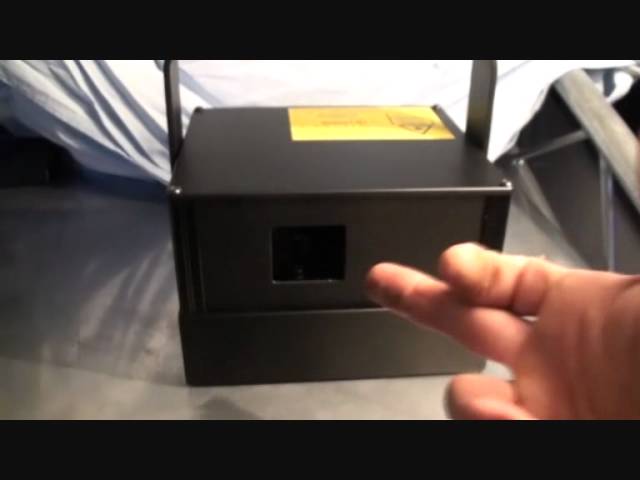
Alright guys, what you're looking at here is a laser from LaserWorld. Now this can only be described really as a wolf in sheep's clothing. This guy here, the model is the PM-1300 RGB. 1300 is for red, green, blue. PM is pure micro series and the 1300 is the output. This guy here will do anything from 920 milliwatts up to 1.3 watts. Now 1.3 watts in audio isn't that much, but 1.3 watts in laser power is astronomically bright. Now I'm going to pause the camera and I'm going to take the top off here. If you have a unit like this, do not open your unit up because there are no user serviceable parts inside these lasers. If you do open the units up, there is a very good chance you'll void the warranty. Right, here we go. We've got three laser diodes in this guy. There's one there, one there and one at the top there. Now, a lot of lasers you buy today, a lot of the parts are made in the likes of China. Now, the laser diodes in these guys are made in Switzerland by LaserWorld.
1:49 The bottom area is for cooling purposes
One key factor when determining if you're going to buy a laser or not is internal workings. How are the internal workings going to last, let's say, in a club environment after about six months or a year? What these guys have done is they've got a sealed unit on the top and then under here we have the heat sinks and you can see three small fans. So the bottom area is for cooling purposes. And the top area, where all the laser components are, is completely sealed. So you can have this in quite a smoky environment and you're not going to get any residue from smoke machines or anything like that. So we're looking at an item that doesn't need much servicing at all. Key feature on the back are the analogue dials, X and Y axis.
4:51 We'll have a look inside the unit again
And we have red, green and blue dials to increase or decrease the intensity of the laser beams. Now these are analogue dials, most of the units will have DPL. In other words, it's either on or off. You can't increase or decrease each laser beam. It's either on or it's off. Then as the cool air passes through here, what happens is that will pull out the heat from these fins. Of course then what happens, cool air goes in, warm air comes out, of course dispersing the heat from the laser body itself. Right, if you've got a laser at home and you're finding that maybe one of the laser diodes is starting to lose its intensity, it might not be because the laser itself... Right, we'll have a look inside the unit again. We've got these guys here. Now those two are the scanners. Now they're 50k scanners. A lot of modern day fast lasers will have say 20k. These are 50, so a lot faster. You can see here there's one and two mirrors. the crossfader and hot cues. To each other is then in turn dependent on the image. So this is why we can get so many different kinds of images. And of course, this is why the images are so perfect because of the scanners.
This transcript was produced automatically from the audio of the video and may contain mistakes.





