 13:12
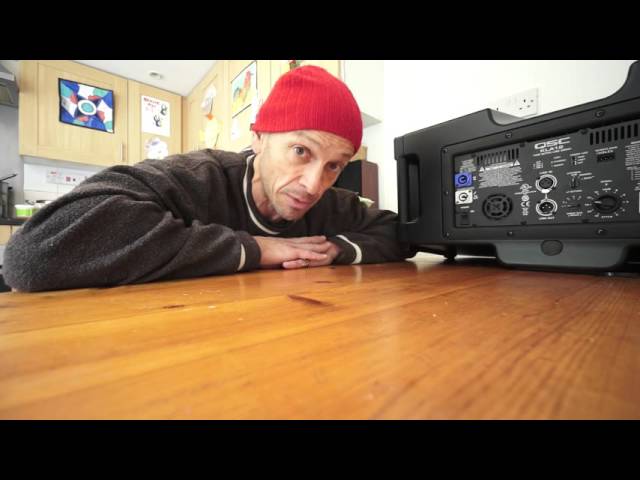
QSC KLA12 Active Line Array Powered Speaker System
Contents of the video
0:00 It's a rather nice cab
Right guys, I'm back from the BPM show NEC 2015 and my voice is very slowly coming back to me. Now this is a very sort of, not in depth, but short video on the series or series from QSC known as the KLA series. This one here is the KLA-12. It's a rather nice cab. It's known as Line Array, I'll go into that in a little bit, and it is powered. You have a 12-inch driver and also a 1.5 CD horn. CD is short for compression driver. That gives the high end, the really sort of high frequencies down to sort of let's say upper mid and then the 12-inch will take over from the upper mid and give you upper mid down to bass. Anything from 44Hz, which is really, really low. That's excellent, especially for a 12-inch speaker. Up to 20kHz, so the 20Hz really hurts. The HZ is your low frequency, so if you looked at a DJ mixer, you have bass, mid and treble. Pretty much the bass is from the big one. And then you've got a little bit of the mid in between the two of them, and of course you've got the high end from your CD horn.
Now then, I'm going to have a look at the back of it and then I'm going to give you a little bit of info on Line Array. It's fantastic stuff. OK, so let's turn this around here and right, the back. So without going into great detail, there it is. It's powered, so you've got a fan there for cooling purposes. You have what I love. Which is your input and your output for your power. Now I hope to God I never forget them, but if you do forget them, you can't start plugging a kettle lead in here. So why this? Well, speakers quite a few years ago started having what's known as speak-on connectors in them. So that was the, not the power, but that was the signal to the speakers from the amplifier. Now speak-ons were great, far better than jack or XLR, excuse me, simply because
2:46 That and think it's stuck
The general public couldn't pull them out. You could very easily pull out a jack, very easily pull out an XLR cable, but a speak-on is slightly more difficult because you have to push in and twist. So imagine this, you're at a gig and your powered speaker is ticking away nicely and some idiot comes behind it and pulls your kettle lead out. That's not very good, is it? But these, fantastic, because you push in and you twist. I've explained it to you, I know how to do it, but luckily the general public will have no idea. They'll look at that and think it's stuck in there, someone's put super glue in it. Don't do that. Okay, so we have line in and line out. That will go from your mixer. It will not go from your amplifier because the amplifier is internal. The amplifier is 1000 watts which is a lot of power.
This here is a setting for depending on how many boxes you've got, so you can go from one through to five. So why? Why not just go up one to the other, one to the other and so on? Well these are intelligent speakers and they need to know exactly how many cabs connected together so you will get a better quality sound. And I will explain that when I talk a little bit about line array. The next one here is deep, normal or sub. So we can have a nice deep sound. We can have normal which you could if you wanted to as well. I think you could use it for a wedge monitor but maybe you just don't want to have loads of bottom end. Maybe you just want a set of these by themselves and you want to crank them up and not have a load of sub coming out of it. Set it to normal. Alternatively, if you click it to external sub that means that you have an external sub connected to this
Which means the lower frequencies will be removed from this, letting the bass cab do all of the low frequencies. And here's, this isn't technical, but if you can remove loads of bass from your mid and top cabs, you will actually get better fidelity of sound because the bass speaker isn't working as much. Therefore you will get more of the good quality sound coming through instead of your speaker moving so much and it loses a bit of just some of the colour of the sound. I don't want to get into that too much at the moment. I want to talk about line array. Okay, so what is line array? Have you ever been to a big concert? I mean, you know, we're talking about Glastonbury and places like that. And you look either side of the stage and you've got loads of boxes all over the place but they seem to be just facing the band and the drummer and the singer and you're wondering why aren't they facing me?
5:06 Crane or some form of framework
Well, then look to the right and the left and look at the crane or some form of framework and you'll see all these things dangling from the sky. It looks a bit haphazard but believe me, they're very safe. Well, that is your line array. Now, some of them will have bass cabs attached as well, but most of the time the bass cabs will be on the floor. If you happen to be very lucky and close to the stage, have a look and you'll see loads of rather large boxes booming at you. They will be the bass speakers. The ones though hanging are known as the line array system. And what you tend to find if you look at them, they don't hang straight. They'll sort of start straight but then they'll turn like that. So why do they do that?
If you think about it, you've got loads of people in the back who want to hear the sound. That's that lot. And you've got a few people a bit closer, a bit closer and a bit closer until eventually there's you stuck right at the front. Here you are at the front and you want to hear it as well. So this is how Line Array is configured or set up. It's set up so people at the back can hear the sound and people closer to and of course then people right next to the stage can. But Line Array is very clever because what it does is you have what's known as long and short throw speakers. Now, long throw speakers will throw the sound out further. Short throw won't throw it as much. Now, the high-end kit, the people setting up the speakers will set it so the ones probably at the top will be able to throw the sound further than the ones down here.
7:18 QSC have done pretty much exactly the same thing with the KLA-12
Why? Well, there's no point having long throw if the speaker is within, say, 10 metres of you and there's no point having short throw if the speakers are high up and they have to push the sound 100 metres away. That's very logical, isn't it? Well, it should be. And again, it's exactly the same procedure with... If you look at the size of the cabs, they may have... 8-inch speakers in there, they may have 12, they may have sometimes 15, but generally they're quite small speakers because they're more efficient and they can push out more mid instead of the bass because the bass will be on the floor. Now QSC have done pretty much exactly the same thing with the KLA-12. Get that right? KLA-12. Just got to check and make sure. But what QSC have done, and these cats have been around for quite a while,
Is they've brought the price back bracket to to pretty much the run-of-the-mill pro dj now note i said pro dj i didn't say beginner and i didn't say high end because they're still quite expensive so why should you consider line array well let's face it you're at a gig and you need to push that sound out big time now a normal 15 and horn will do it a normal 12 When you look at cabs like this, you're looking more high-end, more top quality. There is a lot of work gone into units like this. They haven't just taken a speaker from that company and they haven't just taken a 12 inch from there or a high frequency from there and they've thought well let's just get loads of parts and make an amplifier. QSC have dedicated themselves to getting all of those bits together and they have built
The cab around the bits they have made sure that every single bit works perfectly in tandem with every other item the box is tuned you know i plugged these in earlier on and i can only describe the sound as warm very bassy and rather loud and i can't see myself ever turning this up in the house otherwise i will be forcibly removed by the police who live about 20 miles away Because they'll probably hear it, it won't be the next door neighbour, they'll be deaf. So with this system you can pretty much have anything from one to five cabs and of course because it's line array you're going to have that sort of curve. If you have a look at the curve of the cab you can see that you've got a nice angle there and if I just move that screen so I can see what I'm doing.
B, down, locks it in place. Okay, and so, I mean what we've got here, hold on, I've got to work, sorry, it's really difficult to do this with one hand there. Alright, so what that means is that these cabs, if I put another one on the top, will lock in place. You can also use this on a tripod as well. So if you wanted to, if you wanted to, you could just turn up your gig and have one on a tripod either side. And away you go. Now, I have not used these yet at gigs. I intend to very soon. I can see me using two of these quite happily for 100 people and it would be rather loud. I will probably take bass cabs as well just in case because, alright, let's say they do work for 100 people, fine. But what I don't want to do is I don't want to let them struggle. I would prefer to have these working at 40%.
10:46 I'll give you an analogy first
Ticking over nicely, giving me a good fidelity of sound instead of thrashing them at 80%. Now also, going back to Line Array, why do these companies have so many of them either side? What's the point? And why aren't they... Well, alright, yeah, they are loud. But why isn't it that they're distorted and they're like just full on? Well, isn't it better? Now I'll give you an analogy first. Here's the analogy. Imagine you've got a Mini and you've got a Porsche. Your Mini is travelling at 80 miles an hour for five hours. Your Porsche is doing the same speed for the same amount of time. Now, the Porsche after five hours is going to be like, well, is that all you've got? 80 miles an hour, I'm bored. The Mini, an old Mini by the way, very old, not a new one, is probably going to be struggling. So let's take that analogy to line array. Imagine having a group set of line array either side
And the audio technician is thrashing that at 80 or 90%. Well, the speakers are going to start to just struggle maybe. But your ears are going to start to ring because you're not going to get good fidelity of sound. You're not going to get a good sound. But if you've got a lot of speakers and if you run them at say 20, 30 or 40%, not only is the sound going to be better, but... The cabs are going to be able to handle that for far longer, giving everyone no tinnitus, no problems with your ears, but more importantly, giving the audience and the band as they want a good quality sound. So that's what QSC have done. They've made sure that if you do run these at a good audio level, you not only are going to get good quality sound...
The public are, and also they're going to highly commend you for not having their ears ringing at the end of the night. So here we go, the KLA-12 from QSC. I will put a link in the description that will take you directly to this cab, and I will be using this in quite a few of my gigs from however long, alright? So practice and enjoy, and if you were at the BPM show, it was good to see you. If you weren't, you missed one heck of an event. Practice and enjoy. Thank you.
This transcript was produced automatically from the audio of the video and may contain mistakes.





