 38:05
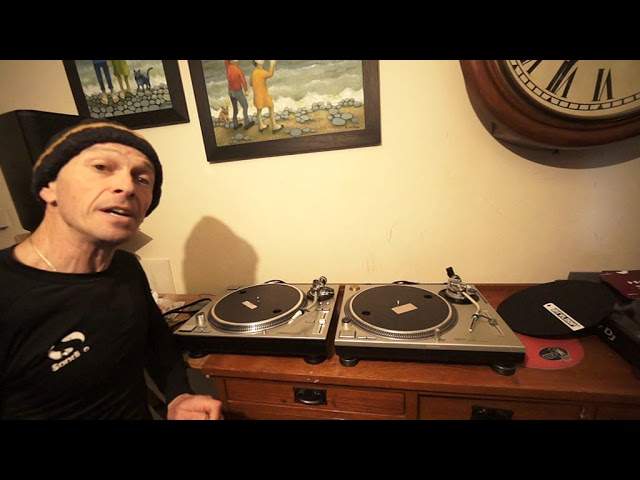
Reloop RP7000MK2 Side BY Side Technics SL1200MK2 Vinyl Turntables
Contents of the video
0:01 I've been DJing for quite a long time actually
Right, I'm quite excited and happy to do this video because being in the industry for quite a while, I've got quite a bit of knowledge on vinyl turntables. I've been DJing for quite a long time actually. Before CD players, laptop and controllers, all you had was vinyl turntables. And even before I had a set of Technics SL1200, I had some dodgy belt-driven decks that jumped all over the place and... It was a bit like being on a boat, especially when people were dancing because you're trying to hold everything and stopping the needles jumping and the records jumping and God knows what. But of course, if you could afford, which eventually I was able to afford a set of Technics, I was in heaven. So this video is going to be quite in-depth, believe me. Now, I haven't got these two turntables plugged in, there's no need, but I have used them both.
I have used this one here from ReLoop. This is the RP7000 Mark II and over here there is the Technics SL1200 Mark II. Both are direct drive which means that the top of the turntable itself, the platter, is half of the motor. Without the top it ain't gonna go anywhere. There's no actual moving parts. Well, there is. There's the top of the turntable But you don't have a motor attached to a belt that then in turn is attached to the turntable because the turntable itself at the top is part of the motor. This is the direct drive philosophy and I believe the only reason Technics ruled the DJ industry for many years because they had the patent on the direct drive turntable. So... Right, let's get straight down to it. Now here is a turntable from Reloop, RP7000 Mark II, direct drive. Over there is the industry standard Technics SL1200 Mark II. Of course, it has been superseded by other models from Technics, but that is one of the most sought-after turntables because it's the original sort of club deck.
In other words, during the 80s, if you were booked to work in a nightclub and you turned up with your record and you went into the DJ booth and you saw a couple of Garrard belt-driven turntables, you had pretty much all the right in the world to turn around, go home and demand all your money back. Because they were pretty much like the Pioneer CDJs that you would expect to see in most nightclubs now. But I want to give you an analogy first of all, and I need you to bear this in mind through this video because it's hyper important. Let's say you have oodles of money and you're a classic car fanatic. In other words, you've got an old school BMW or an Audi or an Alfa Romeo and you have a mechanic with you at all times, alternatively a Porsche, but they are old versions, old models from the 70s and 80s.
3:15 It's getting more and more difficult to find the parts
Now, even though they may be classics and they're hard to get, they're very expensive, they're also very expensive to fix and to find parts for. Now that is the same with the Technics SL1200 Mark II because they don't make them anymore. So it's getting more and more difficult to find the parts. So by definition if you want to buy a Technics SL1200 Mark II there are still brand new ones around I'm sure. In sealed boxes, but you're going to pay a premium for them. Not only that, if something goes wrong, you're going to pay a premium for the parts. On the other hand, the reloop, relatively new turntable and parts should be relatively inexpensive because they're still about. So you must think about that. So the analogy there.
You're driving around in your two-year-old car and all of a sudden the engine falls out. Well, you can go and get another engine from like the shop down the road. On the other hand, in your prized 35-year-old BMW and the engine falls out, walk away. Right, so let's have a look. Now, the Technics there, slip mat, look at that, classic Mokham slip mat. I'm going to take the platter off and there is... half of the motor now that is just a magnet uh it's a i believe it's an electromagnet so as soon as you put the power on of course that turns uh so that is what the platter looks like on a technics sl 1200 mark ii and let me just make sure i've got i don't like putting my back to the um camera but i've gotta sit that on correctly again when placing the platter on a turntable
You don't want to put it in any angle whatsoever. The best way to do it is have a bird's eye view straight down and place it directly on top, not at any angle. Take the slip mat off the ReLoop. Now this is a standard slip mat with ReLoop and that is a nice slip mat. It's firm, very thin and I've given it a go and yes, it definitely does slip. I'm going to take the platter off the ReLoop now and there it is, pretty much exactly the same. But the only difference here is that the top of the ReLoop, the 7000, is very flat so there's a slight difference there. Underneath the Technics you've got a plastic cover with all the internal workings whereas on the ReLoop you haven't. You probably do have to go underneath and start pulling it apart which I am not going
6:30 In other words, in every minute, 60 seconds, the turntable will turn a
On top of the deck, so I will have the camera closer very soon. So what I'll do, I'll give you a demonstration and then afterwards I'll put the camera closer to both turntables. Now then, if we look at the reloop, on the left hand side we have our on-off, start-stop and we've also got a reverse button. Now we do not have that with the Technics. Pretty much exactly the same here, we have on-off, start-stop, 33 and 45. At very much exactly the same position, but what the Technics doesn't have and the Reloop does have is 78 RPM. So first of all if you press 33 and a third, okay, bear that in mind because what that means, 45 and 33, 78, it means the revolutions per minute, RPM. In other words, in every minute, 60 seconds, the turntable will turn at either...
33 and a third revolutions in a minute, 45 revolutions in a minute or 78 revolutions in a minute on the RP. On the other hand, on the Technics, it will only do 33 and a third revolutions per minute and 45 revolutions per minute. So, do you want to go 78? Well, for effects, maybe yes you do. Now, the rear loop also has a reverse mode. Press the reverse button and it will start to go backwards. Now, having used that, it is spot on the money. It's very fast. You don't have any lag. It doesn't sort of seem to slow down and then go... It's almost like it's turning stop and reverse mode. So there's a lot of power in this motor. In fact, there's more power in the reloop than there is in the Technics, which I will explain very shortly.
So that is this area here. Now a lot of DJs who do scratch turntablism like to put their decks in what's called battle mode. So what we do is we turn the turntable 90 degrees so now the head shell is away from you and if I do that with the Technics, which of course I can do, what we have here is another difference. With the Technics, we have got a small compartment there where you'll have your centre part for, for example, 7-inch singles. If you've got the centre missing out of 7-inch single, you place that on the spindle, place your piece of vinyl with a larger hole, let's say, in the middle, and then that, of course, would fit over the centre part. If you have, for example, An RP7000 on my right hand side and one on the left hand side over here, and a mixer in the middle. It means that I have actually got start stops very close to the middle, or should I say very close to the mixer itself. So instead of reaching over...
9:36 Again, mixer in the middle
And reaching over, they are there straight away. So again, mixer in the middle. If I did only have the one start-stop on the right hand side, I'd have to go directly across to the right. On the other hand though, with the deck on the left hand side, it would be very close to me. So instead what they've thought is, well why don't we have two start-stops? So they're going to be right next to the mixer, which is a great feature for scratch turntablists. So I'm just going to move that back. Now, something here as well. Let's imagine you're in a room and you don't have much space. Then by all means set your turntables up in battle mode for any reason. But if you are generally a house drum and bass mixing DJ and you're not really into turntablism I would say you're a bit of an idiot if you put them into battle mode because you're there and you're trying to select
The speed and you moving your arm back, just there. This is how they should be if you're a DJ who likes to do basic mixing. If you look in any nightclub pictures from years gone by, very rarely will you see decks that way as I showed you earlier on in a normal sort of nightclub unless of course you are a hip-hop DJ. Right so that's that. Now on the techniques and this is... This is one of those things that annoyed me. I had to change it about two or three times and I mean, it was like, I'm just, I'm going to have a week off now not to go on holiday, not to go shopping, but to change the pew light on the Technics SL1200. Now there it is. Press it down. And press a small little button to the right of it and it pops up. And a brand new Technics, it was quite good because it just slowly rose. Press it down but the older it gets it seems to be a bit wobbly and you know sometimes it shoots up and sometimes it comes halfway up and says sod you I just want to stay there and you have to pull the damn thing up. That's not the bad part. The worst part is when the light goes out and it stops working. Now that is a tiny little bulb.
12:24 The RP7000 Mark II has got one of those
You'd think, no problems. But to change that bulb you had to completely pull apart the entire turntable. It was an absolute bloody nightmare. I hated it. Got to the stage where it was like, well what's the point? It was actually far better for you just to put a torch there or just leave it instead of spending about five years changing it. But guess what? The RP7000 Mark II has got one of those. Look at that. Now, that is its pew light and it's a basic RCA connection and all I'm going to do, I'm going to plug that in there. Now, how genius is that? Because if it goes wrong, what do you do? You take it out. Do I want to fix that? No. Probably the best thing to do is to throw it away and get another one. Alternatively, you might be able to unscrew that, but to be quite honest, for the sake of X amount, get a new one. So look at that. That is genius. Pop it in there and you can also turn it in any direction you want, whereas the Technics, it was facing in one direction and one direction only. So that's a big thumbs up.
Definitely for the RP7000. Right, so I'm just going to put that... No, in fact, I'll leave that there for a bit when I do a close-up. Now, I'm going to take the arms off both of the turntables. I'm going to lift the armrests up and just move the entire arm of the deck into the centre so we can now have a look at the pitch area. Now this is where it gets quite interesting because the Technics has plus and minus 8%. That is it. Also what it has is when you put the pitch into the centre position, it clicks into position. Now that... Excuse me. No, I'm fine. I suffer a little bit from asthma and I've just been on a bike ride and it's great because I'm coughing up all the shit. There you go. Before you ask.
I know, okay, calm down. Right, so the techniques. When you put the pitch into the centre it clicks into position. That's because there's a tiny little metal ball attached to or and behind that is a spring and a slot. So when you get to the centre position the little ball just lodges into that slot and the spring keeps it in place. So what you've got, you've got this sort of awkward part in the centre where if you've used Technics before and you're in the mix and you're fine tuning it and you find that the track you're mixing in The position of the pitch is directly at the centre, then quite often you had to either slow down or speed up the track that was playing so you could then beatmatch the one that you're bringing in in a position where it wasn't close to the centre because sometimes it's very awkward to get that at a precise let's say BPM. On the other hand with the RP7000 we don't have that. It is just a smooth transition
15:51 For all the idiots out there, including me
All the way from plus to minus 6%. But also what they've got is a reset button. So anywhere, any position that the pitch is in, you can just press that reset button and it will go to the original speed of the deck, whether it be 33 and third, 45 or 78. So that is a great feature. Which is towards the minus position, we have two buttons. Plus and minus 8 and plus and minus 16. So it's a little bit like a CDJ which quite often you have 6, 10, 16 and wide. Whereas here you have 8 and 16. So that means you can increase or decrease by 8% or 16%. So for all the idiots out there, including me... That's what it is. Thank you. Thank you for telling me. I'll just tell myself now. Okay. It means that if you've got a track that's 100 BPM and you're at 8%, you will increase it by 8%. So the track will no longer be at 100 BPM. All the way up here, it will now be at 108 BPM. Move it away from you and it will now go to 92 BPM. Now that is exactly the same with the Technics, but that's where the Technics stops.
On the other hand, the 7000, you can reduce it by 16. So you get to 88, no sorry, 16% plus 116. Take away 16 from 100 is, oh my god, my maths, 84. Yeah, thank god for that. 84 BPM, right, 84 and 6 is, yeah, 84. Ah, sorry, right, should have learnt maths, shouldn't I? Yes, okay. Right, so again, a great feature, but... A word of warning here, now this is the same with the Technics and the same with the 7000. In fact, this is a word of warning for any vinyl turntable that you use. When you're doing a mix, if you are going to start mixing tracks in above or below about 3%, then you need to watch your keys because you will start increasing or decreasing semitones. Thanks for watching. First of all, what is talk? Let me explain it in, I suppose, an easy way of understanding. Let's imagine you are holding onto a rope and the other end of that rope is someone on, let's say, a go-kart. And they're trying to pedal away and you're holding that rope and you're stopping them from moving away. Now, there's a lot of force with them...
19:07 One amount of torque
Pulling and you're pulling, you're trying to pull them back. So if you imagine if the Technics was on now and I had my finger on the turntable with the motor trying to turn, I would be pulling that back. I'd be stopping it from moving and I would need a certain amount of force to stop that from moving. So based on the power of that motor... Would also be based on, or shall I start again, based on the power of that motor would mean I would have to put a certain amount of pressure on the side of the turntable to stop it from moving. So if the motor wasn't very powerful, I wouldn't have to put much pressure on the side of the turntable. On the other hand, the more powerful the motor, the more pressure I'd have to put on it to stop it from moving.
One amount of torque. You can't increase or decrease it. On the other hand, you can with the 7000. So we have two dials. I will explain about the one on the right in a bit, but the one on the left is for your torque. So why would you want that? Now, again, I've been using turntables for a very long time and with the reduced amount of torque, that would be great. For DJs who like to mix house music and techno and trance, in other words you're not a scratch turntablist, you just like to do these puristic mixes for seven hours long playing house music. Now a lot of DJs what they will do is while they're in the mix and they're moving the pitch Let's say they want to slow the track down a little bit. Now you know on CD players you've got what's known as pitch bend, a plus and a minus. You press the plus and the track will seem to speed up a little bit but as soon as you take your finger off the plus it will go back to its original speed. Alternatively if you press the minus it will start to slow down.
22:03 I would be then turning the torque dial more towards 3, 4, 5 o'clock
While you have your finger on the minus button, take your finger off, it will go back up to the original speed based on where the pitch is. This is sort of the same here because with a low to medium torque setting what you can do is you can put your finger on the side of the turntable and again there is a technique to this and while you're doing that you're actually starting to slow DJ tutorial by Ellaskins, The DJ Tutor I hope you get that. But let's imagine you're a scratch turntablist DJ. I would be then turning the torque dial more towards 3, 4, 5 o'clock. Now what that will do, it will increase the torque. So going back to our little guy on a go-kart and you're holding the rope, he's on a go-kart but he's no longer using his legs.
Thank you for watching. The talk setting of the Technics, that's it. You put it on the high one and it's like, my God, what's going on here? This is all bloody steroids. So it's great for scratch turntablists simply because needle on the record, you're holding the record. The worst thing in the world, which does happen depending on humidity and the, for example, the slip mat you've got, but quite often with a lot of other turntables, including the Technics, you put your hand... On the Rekord, which is on top of a slip mat, the platter starts to slow down. But it does not with the 7000 because there's that much torque there. It's like, is that all you've got mate? Give me some more. So, a great feature. Now, on the 7000 also we have a brake adjust. Now what that will do, and again this is only the first video.
On the 7000 we have the brake adjust. Now this is a great feature for example if you want to press stop and have the record just slow down naturally, like so. So with that dial set to the seven o'clock position You press start, it will start straight away. You press stop, it will stop within less than a second. The more you move that clockwise, when you press stop, it will start to slow down slower. So, let's say for example you turn that all the way to the 5 o'clock position, you press the start-stop or you press start-stop once the deck is already, of course the deck's already going, and then it's almost like, if you can imagine, here we go, it's an example. A 1, 2, 3 o'clock, 4 o'clock rock, a 5, 6, 7 o'clock... Right, yeah, I hope you get that. Okay, so there. Do you know I love doing this? Oh God, I am nuts. I know, don't care. I love it. Right.
25:27 God, they are so similar
Right, so let's have a look. I'm going to put the little tone arms down, put the locks on the actual arms themselves and take off these counterweights. Right, so Technics will be on the left, sorry right, which is your left, left, right, oh right, I don't know, you're looking at me and I'm looking at you. Right, that is the Technics counterweight and that is the counterweight... For, that's right, yeah, that's it, yeah. Technics and... God, they are so similar. No, no, no, no, no, hold on, no. Shit, that's right, yeah. That's the... I took those off there, yeah, so that's right. Technics, counterweight and the RP, they're pretty much identical. There's practically no... In fact, I can't see any difference at all. No, can I see any difference? Absolutely not at all. Except one is slightly bigger, but...
Very little difference. Okay, so let's put those back on there like so. Turn them on. Also as well, just to let you know, you can see a bunch of numbers here. Just make sure that the numbers are facing towards you, not the other way around like that. Okay, so I'm going to put that on there. Now, both of the turntables, the housing for the arm, the actual design... is very similar, whereas the Technics is more a dull sort of silver look. The 7000 is more of a machined shiny look. It looks a little bit more plush I'll be honest with you, but from a workings point of view they're both identical. It's a similar construction, similar design, but again Best thing to do is if I put the camera a little bit closer later on, then you know, you yourself, you can have a closer look and you'll see that there is actually very little difference. Now on both decks there's a small lever just to the right of the counterweight and the idea there is you move the lever
28:16 We'll have a quick close-up, so let's just turn that around there
And then you're able then to increase and decrease the height of the entire tone arm housing. Now there's good reason for that. That's because, for example, different slip mats are different thickness and the objective is to always make sure that the tone arm itself is level with the platter. So the platter's flat, the tone arm should be like that. You do not want... Then we'll have a quick close-up, so let's just turn that around there. Now the Technics has an internal wired in RCA, there's also a small lead there which is your earth cable. Now have you ever set up a set of turntables or been to a gig and great light show, great mixer, couple of Technics, great PA but all you can hear is this...
This humming sound is probably because they've forgotten to plug in the or plug the earth cable into the mixer. That's very important. That will stop any humming, any background noise. So with the techniques what I have found, I'm sure people will agree, is that over time Your RCA cables start to not wear away but they come loose and maybe the left side you've got to fiddle it in with a mixer and, you know, it cuts in and out. That's because over time the cables inside here probably just wear away and you lose connections. Whereas the RP, it comes with, guess what? It comes with one of these, which is... An RCA to RCA attached to it is an earth cable, so this is a great feature. What this means is that you know what? You can plug that in, plug that to your mixer or vice versa and if something goes wrong with this, well it's no big deal. You just get another RCA cable and get a small tiny thin cable which can be used for the earth and you're good to go. So that is a great feature.
Now also with the Technics it does have, like the RCA cable, it has an internal power cable. Now personally I've never had any problems with the power cable but maybe if that starts going wrong the only way of fixing it is definitely not if for example you have a problem here or there, not to cut it and just like gaffer tape it up. Very dodgy. No. What you would have to do is just... Oh, look at this! Bare wire. Don't slap me, please. You'd have to unplug the entire deck and wire it in. Whereas the 7000 has got... Yeah. It's a figure of eight. OK, so... Right. I'm going to leave it at that. Okay, you've got here the connection for the Earth RCA and also at the back here there is a small area where you can set the power supply but I would have thought that would already be set based on the country you're in. 240 or 115 volts. You do have similar with the Technics but you lift the platter up and there is a switch in there.
31:30 Turn the Technics around
But if you bought the Technics from your local shop down the road, I wouldn't mess with that because by all rights it should be set anyway. Right, so I'm going to turn this around now. Turn the Technics around. Sorry, RP around. And now I'll turn the Technics around. There you go, right. Okay, so let's take the camera off the stand and let's have a closer look. Okay, so both of them as well have got... What's known as Concord cartridges. Now, I would highly recommend you get these sorts of cartridges because if you buy a box standard head shell and then attach let's say an old-school Stanton cartridge 500 AL or something like that what you've got to do is you've got to set up the first of all you've got to fit the cartridge also make sure it's in the correct position
And there's a lot of faffing around, whereas Concord style cartridges like this, all you do is you plug it into the head shell and it's all set. So great. All right, let's just take that off there. Thank goodness I've still got the plastic cover on. I recommend you do that actually while the turntable isn't being used. As you could see then, it just hit the side of the turntable. And what you don't want to happen is accidentally do that and then damage the needle, also known as the styli because that's a small tiny diamond attached to a very very thin piece of metal. If that bends it may still work but you're not going to get true good fidelity stereo sound. Okay so here's our reset button and if you look and listen nice smooth action techniques
Let's just move that off there, lift that, have a listen. You can hear that click, OK? I mean, don't get me wrong, Technics are great turntables, but they are kind of old school now. That is old school. This is new school. This is something that, again, is built to last. Now, with the Reloop RP7000, like the Technics, it is not a toy. It's not... Reloop haven't thought, let's just design and make a turntable and hope for the best. No, there's a lot of thought gone into this. It feels solid, it's chunky, it's heavy. Like the Technics, it's a piece of metal. It's not a little piece of plastic and a couple of shiny bits and sod it. No, it's solid. It's absolutely solid, robust. Okay, so if we have a look at the...
34:23 Have always asked me, what are these for here?
Top of the arm, you can see there, it's pretty much exactly the same as the Technics. And again, start-stop, same with the reloop, but of course we have reverse here. Now people have always asked me, what are these for here? Now when this turntable is turning, if you can see where my finger is, we have a small dot A large one and two smaller ones at the top. So basically what this means without going into great detail, when the dots in relation to the dots here are stationary it means that you're going at a certain percentage of plus speed or minus speed so for example The lower dot, when that's stationary, you've actually reduced the speed, the RPM by 3.3. The second one from the top, you've increased by 3.3 and the one at the top, you've increased by 7.2. But the middle one, the big one, when that is stationary, you are at the original speed based on if you're 33, 45 or 78. Okay, start stop.
Nice good feel to them as well. Very similar. Again, the actual platters themselves, they are almost identical. But there's good reason for that because it's a vinyl turntable. Records are round. You're not going to get the top of a turntable that's square. I don't think so. Maybe someone would make one but it would look a little bit silly. Alright, so there you go. There is a comparison between the two decks. So I'm just going to put the camera back on the stand and go back to my first explanation. So you've decided to get yourself a classic car and you want to get yourself a classic BMW and you want to drive it around every day and you want to impress the neighbours. By all means, do it. By all means, carry on. It's going to serve you proud. But bear in mind that if something goes wrong, it's going to cost you a lot in parts. Bearing in mind that if something goes wrong and you need a certain part, you may be finding you're sitting around waiting for a long time to get that part because there may be very few around. Now let's put that analogy on the Technics. It's a great turntable.
It works, but if something goes wrong, for example you need a counterweight, you need the tone arm, you need the pitch control, you may find it's very difficult to get the parts or they may be very expensive. On the other hand, the RP7000 Mark II It's still around. It should be quite inexpensive to get the parts. And it is pretty much exactly the same as the Technics, except it does have more modern-day features, alright? Now, thank you for watching. If you want any more information on both of these turntables, there will be links in the description. So, yeah, big it up! And wiki-wiki, keep that vinyl spinning. Practice and enjoy. Thank you.
This transcript was produced automatically from the audio of the video and may contain mistakes.





