 5:58
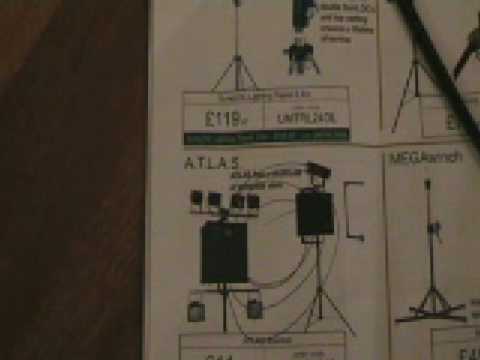
The A.T.L.A.S from ULTIMAX For the Mobile DJ Roadshow.
Contents of the video
0:00 This metal thing here
Alright folks, I want to show you this metal thing here now. It's from a company called Ultimax. Now first of all what I've done, I've got a CD in the corner and that is a 12 inch single just to give you an idea of size. But what is it? What does it do? Well before I explain what it is, what it does, let's have a closer look at it. Right, it's actually for a speaker tripod. The top of the tripod where you would normally attach your speaker, that would fit through there enabling your speaker to sit just above there. Alright, let's have a look at that area over there, hold on. Right now this bit is not rocket science at all. At the end of the day some people will use full range speakers, maybe 10 and horn, 12, 15 and horn. So of course logically if you look at this area here, from there
To there, you've only got a certain amount of space. So, I'll just move the camera so I can see what I'm doing. So basically what we've got here is we can increase or decrease the space. Simple, isn't it? Alright, and of course, one of them, plug it in the hole, and try and pick this damn thing up. One of those things just secures it in place. Right, let's have a look at it now with a speaker on it. And guess what? There's a light on the top as well. Let's have a look at it from another angle. There you go. Now I actually requested that they send me some of these because I think it is such a wicked idea. Now, without going on and on and on, sometimes the most simplest of ideas work absolute wonders. I mean, alright, what have we got? We've got a basic speaker tripod.
2:03 You know, how do you attach a light onto the top of there?
Now, if you are a mobile DJ, you'll know exactly where I'm coming from. You know, how do you attach a light onto the top of there? Gaffer tape or goodness knows what. Bad idea. But, here we go. Straight up, around, you've got a light on the top. Now just pause the camera a second. Again, like I've said in many videos, this is punk TV, so excuse the scribble, that was me going, yeah, I like that. Alright, so here it is. And what you can do as well, you can attach a bar across the bottom so you can have some lights there. Bar across the top, you can have some lights on the top. At the moment, as you can see, I've only got one on the top. That's it. Now, the only... I'm not saying it's a downside to this. Not at all. But what I will say, and I've got to emphasise this, if you're going to have something like this with your speakers, it is vitally, and I mean 1000% vitally important.
You make sure, you make sure again and then you check it again that this unit is not going to get knocked over because a couple of things will happen. One is that someone's going to fall into it possibly and they're maybe going to hurt themselves and also not only are you going to start to break your speaker, maybe your tripod but you're going to knacker a whole bunch of lights as well. So vitally important if you're going to have something like this on and with your roadshow Make sure you set it up out of the way. In other words, you've got to look at the idiot scenario. When you're working in a mobile environment, at the beginning of the night, everyone's happy and fluffy and very few people are drunk. By the end of the evening, everyone's falling over each other. So always be wary. Right, here we go, the attachments. And like I said, it's such a simple design. Yeah, it's fantastic. OK, two screws there, hold it in place.
4:00 Logically, this guy's got to be a lot higher
We move around like so. Now that's what I showed you earlier on. And of course, 15 inch and a horn. So logically, this guy's got to be a lot higher. And then to the light at the top. So there you go. So even without the bar, you know, you can get one light at the top. Now, I'm six foot tall, OK? And where do I come to this? Hold on a second. Look, I'm about there. So you're looking at eight foot high. And of course, again, where lights are concerned, the higher you can get your lights up, the better, in a sense, the better light show you'll get because you'll be able to cover a wider area over the public. In other words, if you've got lights at this level, the lights are going to shine at people's heads and that's about it. The higher they are, and of course, let's say for example, that's a 45 degree angle, what's going to happen? You're going to have the light shining
Over people's heads, and of course, if you think about it, if they're here, and you've got loads of people in front of the speakers, then the light is not going to go so far. Up there, the light's going to travel one hell of a greater distance. Right, there you go, it's known as the... Right, as an afterthought, I thought, how about putting a smaller speaker on? Because not everyone's got sort of 15 and horn. So this guy here is a 10 and horn. And I've kept, what I've done, I've kept the same distance to the light. So there you go, there it is. I'll pause the camera and we'll have a different angle. It's pretty neat. There you go, it's known as the Atlas. What I'm going to do is put a clickable link in the description. Big shout out to you guys, alright, nice one. Practice and enjoy, thanks a lot.
This transcript was produced automatically from the audio of the video and may contain mistakes.





