 6:42
The Citronic Tamar Twin Turntable from the 80's
Contents of the video
0:00 I had to use some dodgy belt drive decks which are absolutely atrociou
Alright folks, Jonathan here. Now a while ago I did a video on the basis of how to mix without touching the platter. Now the reason I did that video is because when I started DJing I didn't have the joy of having some perfect good decent brand new turntables. I had to use some dodgy belt drive decks which are absolutely atrocious. Now then, the reason I started learning just to use the pitch control was because like I said in that video if I If I turned the actual platter too much or tried to slow it down, it would basically either spin really fast or just slow down and just stop. So of course I just had to learn how to use the pitch but the pitch was terrible so I had to practice and practice and practice. Now guess what? I've actually got behind me near enough the exact set of turntables that I started on. Now what we'll do, I'll show you exactly what it is and then I'll give you a demo.
It may be a bit of fun, but at the end of the day it'll show you because if you think you're having problems out there with the kit you have got now then believe me when I was in your shoes I probably was in a worst situation because in the late 70s early 80s we didn't have fantastic kit. Nowadays even the worst kit in the world is a lot better than the stuff we had then. So take a look at this. Right, now then. What do you think about that then? This is basically an all-in-one setup. Now, it's a Citronic setup and in the centre here, quite often you would have had a cassette deck. Not a CD player, not an MP3 player, not your mixer, you would have had a cassette deck. Now, all this is your mixer. Yes, that's it. And that's one turntable, that's another turntable.
2:24 Disc, which would be that disc there
There's absolutely no pitch control whatsoever. I'll just explain that in a minute. Now basically you had microphone inputs here, or when I say microphone inputs, sorry, all your knobbly bits for your microphones. Now all the actual inputs are underneath here, just along there. As you can see I've got headphones in at the moment and that's just going straight into the amplifier. Now here we had auxiliary. Now that could be a cassette player, basically. Disc, which would be that disc there. Disc, which would be that disc there. Now notice, no crossfade. So, you just have to do that. That's it. Now these here, when you press that, you watch. That would stop. Press it again, like so, so it lights up and bingo, it starts off. Now the same applies on this one. Press it and that guy stops. Press it again and off it goes. And then here you had cue, like so, tape here, tape player,
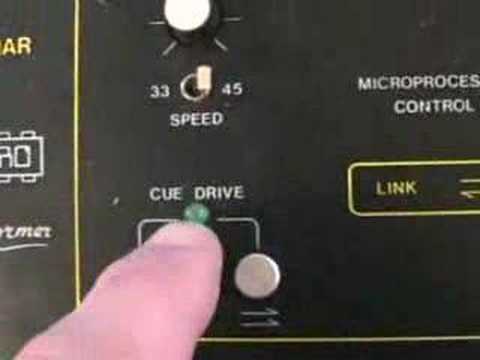
And then here you had your actual outputs. Now that was telling you how high the actual output was into the speakers. There is your phones, your actual volume control, SM, stereo and mono, bass, treble and level, your master output here. Now this is the interesting bit here because these were the pitch controls. There you go, pitch 3345. Cue drive, now basically because the actual platters were so wobbly, what you could do, you could put the needle on the record and you could move this like so. If I stop that now, if I press these, if you watch now as I'm pressing, you may be able to see just off camera, in fact if I do this, if I put that piece of paper on there like that, then you'll be able to see as I press the one button like so,
3:48 You can see the actual turntable moving
You can see the actual turntable moving. So that basically enabled you to cue up the record, like so. And then exactly the same applies the other side. Right, now here's the fun bit. I'm now going to give you a demonstration on how I used to have to mix. And this is atrocious, but there you go. Alright, so we'll pause the camera and we'll give you a demo. By the way, just look to the side of the video for all relevant information. And yes, I'm going to use some headphones. Oh my goodness, right, here we go.
Believe me, it was good fun. Let me just put that down. It was good fun but it was hard work because the pitch controls here are absolutely terrible and these turntables are what's known as belt drive. In other words, there's a motor about here. Now, the motor is attached, there's a spindle on the motor and then you have an elastic band that actually goes around the platter and around a tiny little spindle at the top. And check this out. If you think your bits of kit are bouncy, how about that? You see, this is what we had to put up with a long time ago. Anyway, thanks for watching. Bit of insight. I mean, it's all about fun, isn't it? So practice and enjoy.
This transcript was produced automatically from the audio of the video and may contain mistakes.





