 5:15
tt-m1 Digital vinyl simulator for the turntabalist/DJ
Contents of the video
0:00 It wasn't magic, it was down to a TT-M1
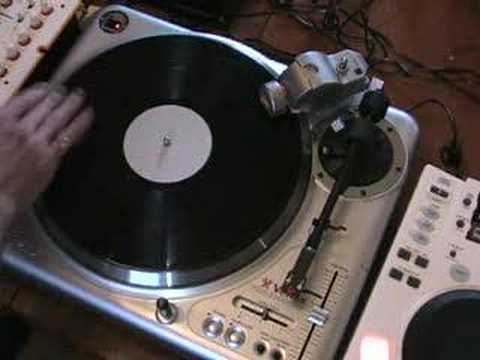
Alright folks, in a previous video you saw me scratching and then all of a sudden I took the needle off the record, carried on making a funny noise. It wasn't magic, it was down to a TT-M1. It's basically a digital vinyl simulator. You've got this guy here, that's what it is. That will attach to Vestac's new Markle Technics. Goes in then to the CD player and then you have the music in the CD player and basically what it does is it means that you've got a hands-on approach with vinyl directed into the CD player. Alright, so what's happening is basically the CD is in here, the music is in here and then as the music plays you are basically in control of the music via your turntable. Now then, the one top of the range good point about this and that is that if you are a vinyl DJ and you swear by vinyl and you like the touch and the feel of it
1:57 I'll give you a demo here
These things here are slowly getting better and better on CD players. You know, they're getting the actual platter, the area where you put your hand on and you can scratch and slow and speed it up, slowly getting better. Being a DJ. Now then, the beauty about this is as follows, right, if I just position it so you can just about see the CD player and you can see the piece of vinyl. Now then, the volume's up on the mixer, if I start that vinyl and just put the filter off, OK, what I'm doing, if you can see, I'll just move the camera over a little bit I think so you get a better idea of where my hand is. Now what happens is as this piece of vinyl moves like so, the wheel here is moving also. And then what happens then is the movements from this wheel go into the TTM1, straight through into the back of the CD player and then that in turn tells the CD player what to do with the CD, the piece of music that's playing. So I'll give you a demo here.
3:16 How many turntablists sat there?
Basically what it does, there is a lot more to it than this, but the one benefit I can see that will possibly outweigh anything, and that is for the turntablist, in other words, the guy who likes to use vinyl. We buy, I mean, I'm not a turntablist, but I do a little bit of scratching, mostly around the lower regions of my body. We won't go into that. But anyway, think about it from this point of view. How many turntablists sat there? Have got two of their favourite records, their battle records, and they're continually using the fresh, the ah, the sh, all those sounds, the samples. Now then, if you can get yourself a CD, which I'm sure there are with those samples, you bung it in here, you put any piece of vinyl on there, and basically what you're doing is you're still using those samples, okay? In essence, what you could do, you could have a couple of CD players, one either side with your battle breaks in.
You could get through to those samples and then you could scratch away. Now, the reason I'm saying this is because you could scratch for the next 20 years with that fresh sound. And there's one thing that will never happen. It won't wear out. Because, I mean, I've been there. You've got that frr, frr, frr. And as soon as you hit the frr, you start getting that sound. But after about two months it's going to be frr, frr, frr. And you start to lose the quality of that scratch. Using something like this, you're never going to do that simply because you're using the CD player and the piece of music in here and you're just incorporating using the piece of vinyl, any vinyl. You can have a house record on there, it doesn't really matter. So I do like the idea of this guy here, right? I'm only just starting using it so as I get better at it, which is highly unlikely, but as I get better at it and start to find out a few more features, I'll be telling you as well, alright?
Thanks for watching and don't forget, practice and enjoy! Nice one, cheers.
This transcript was produced automatically from the audio of the video and may contain mistakes.





