 7:41
Video 2, FX on the DJM-600, The Delay.
Contents of the video
0:00 First of all, what on earth is delay?
Alright folks, Jonathan here. Now this is video number two in a selection I'm going to be doing over a period of time, bear with me, on effects. This particular video we're going to be looking at the DJM600 and we're going to be looking at an effect called delay. Now then, first of all, what on earth is delay? I mean, what does it do? I mean, you know, how do you explain delay? Well, this is it. Now, delay is similar to an echo. First of all, an echo. What is an echo? If you don't know, now then, I'm here, the camera is there. Now, basically what happens is if you imagine the camera was a complete big wall and I said oi, now what would happen? My sound would travel from my mouth, it would hit the camera, the wall, whatever, and then it would come back to me. Now, the sound that actually comes back to me is the echo. That's what an echo is. Now, a delay is very similar but it's not the same. Right, I'll explain.
Now then, I will say, oi! Now then, that sound again, like the echo, will leave my mouth and it will hit the camera. Now then, OK, it'll come back to me, but the time it takes that sound to go from my mouth to the camera is the delay. Now in other words, I'm standing here, I go, oi! Hits the camera. Now maybe it takes a millisecond. To hit the camera. But, if I move a little bit further back and I go oi, it's going to take a millisecond and a little bit extra. And if I move further back again, it's going to take a millisecond and another millisecond. Now that is the delay. It's almost like a way of explaining, well it's the time in between me going oi and that sound travelling to you. OK, right now let's have a look at this guy here and the delay. Right, here we go.
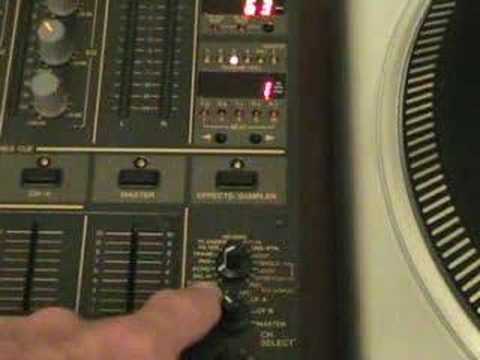
Right, let's look at the basic functions of this mixer. Bearing in mind this is a DJM600, OK? Now this little knobbly bit here that lights up, basically when it's lit up and it's not flashing, nothing's working. You press that and it flashes. That means everything or whatever function is utilised here, it basically means it's working. As soon as you press it again, it's not working. This guy here, the level depth. Now what that does, when it's on to maximum, it means that if we're on delay, echo, pan, reverb, whatever, it basically means that that particular function will be used to its fullest extent. On that dial here, when it's at 5 o'clock, sorry, it's at maximum, and you go all the way through to minimum, which is 7 o'clock, that means it's at its minimum effect.
2:29 Longer, away camera, needle record
Now the time here, basically what that will do, you will also, in a sense, this is almost like, with regards to the delay, this is basically making the day delay shorter or longer. In other words, if we imagine a room, I'm here and there's the wall, and I go oi, now the delay is quite short, but when the actual, if you imagine now this room, Tongue twisted here. If we imagine now that that room is getting longer and longer, of course the delay is going to get longer and longer as well. So basically where we're turning this particular dial here, we're almost making that room get longer and longer. If you saw earlier on I moved away from the camera. So if you imagine here When that is set to 1, that was almost when I was very close to the actual camera. And as I move this dial and we go through the scale here, that was, if you imagine now, I'm moving away from the camera. So that's the easiest way of explaining that. The next one up here, we've got 1, 2, 3, 4, basically one channel, 1, 2, 3, 4. So in other words, if we want to utilise the effect on this channel...
We'd set that to number one, we want to utilise the effect on channel two, we'd set it to channel two accordingly. And then of course this here is all the different functions that we're going to be going through in other videos and at this one at the moment we're going to be looking at this guy here, Delay. Right now let's give it a bit of a demo. The track we're going to be using is Freaks the Creeps Get on the Dance Floor. Now what we're going to do, we've got that at one, okay? Now I'm going to move the actual camera So we want to see, actually hold on if I just go out again, what I want to show you as well is I want to show you the actual styli on the record. This is quite important because I'm actually going to take the styli off the record and it's still going to work. I've just got to pause this because the battery's running out, excuse me. Right then, thank goodness for that. Right, what we'll do, we'll put the needle on the record and we'll give it a demo. Here we go.
Right now, then you watch this, right? We'll press that. It's on minimum. Take the needle off the record. Nothing happens. Right, check this out. But it's a maximum. Take the needle off the record. Nothing happens. That's because we're only on one. Now then, watch. We're going to make that room a lot longer. Let's put it to say about 300. Now all of a sudden, the room that we're in, or basically, let's say I was at number one. And of course there was no delay. Now I'm, let's say, about 100 feet away from the camera. Now watch. There you go. Did you notice I took the needle off the record but we could still hear the music? Okay. Now let's say we're going to move even further away from the camera. Let's go to 900 and we'll do it again. Even more. And there's even more of a delay. And again. There you go. And again.
5:50 Let's get to its fullest extent
Let's get to its fullest extent. Now in future videos I'm going to show you how we can use this actually in the mix. Right, you're probably still wondering, well I don't really understand delay. Now then, I'm going to give you a quick demo and an explanation, alright? Now hopefully this should straighten up a few things. Now bearing in mind, hopefully in the near future I'm going to be giving you an actual demo in the mix and showing you how you can use delay in a mix. Right, bear with me. Right, now let's say for example now we are not in a room but there's some chap on a hill and he's like a mile away, okay? Now let's say all of a sudden he goes, Oi you! Come here! Now because sound travels not as fast as light what happens is that sound will leave his mouth and it will be travelling through the air and then all of a sudden it'll reach us. But...
We can, let's say if we had a telescope, we could actually see him saying, Oi you, come here! But we can't hear it. But what would happen, that sound would be travelling through the air and then would reach us maybe two or three seconds later. Now you imagine, all of a sudden now, we're looking through that telescope and I'm going to put the needle on the record and that guy is saying, Oi you, come here! Sound's travelling through the air. It's travelling. There you go. And it's caught up with us, okay? Now that is basically what we're looking at when we look at something called delay, alright? Now I hope that's been a help. Any comments, post them underneath and as usual, practice and enjoy.
This transcript was produced automatically from the audio of the video and may contain mistakes.





