 6:19
Ableton Live Video 4 Creating a Basic Dub Step Beat at the Dubai DJ Academy
Contents of the video
0:00 We're with Ed Lewis from the Dubai DJ Academy
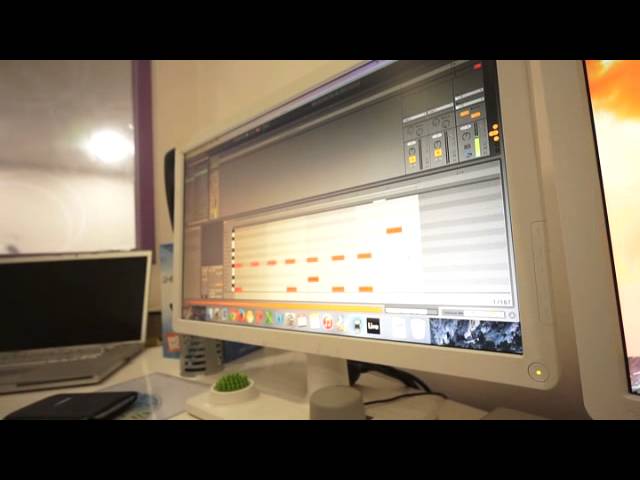
Alright guys, we're with Ed Lewis from the Dubai DJ Academy. He is the tutor that will teach you how to do a bit of music production. We're using Ableton Live. This is video number 4. In video number 1 he formed a house beat. In video number 2 we took that house beat and changed it into a hip hop beat. In video number 3 we took the hip hop beat and changed it into a drum and bass beat. Is that right isn't it? Yep. And now in video number 4 we're going to turn the drum and bass beat down into a dubstep beat. Again, these are all kind of very basic beats and wouldn't necessarily be exactly the sounds that you would use but hopefully you get a good idea of what the rhythms are behind each beat. So our drum and bass beat at the moment is at 160 beats per minute and sounds like this.
Okay, so dubstep is actually at 140 beats per minute. So I'm just going to pull it down to 140 and it's rigidly at 140. You know the other genres we've looked at are often across a wider range of tempos or speeds whereas dubstep is pretty rigidly at 140 beats per minute. So I've just slowed that right down from the drum and bass beat so let's hear what this sounds like at 140 beats per minute. Okay, now for this I think I'm still going to leave this kick drum as it is. The major difference with dubstep is where the snare drum lands. So far in all our genres the snare drum has landed on beats 2 and beat number 4. Now in dubstep the snare drum lands on the third beat.
2:09 Yeah, I think very quickly I'm going to interject here
And there's usually only just the one of them. Yeah, I think very quickly I'm going to interject here. When you played that earlier on it did sound sort of quite fast but now just changing that one snare it'll all of a sudden make it sound slower but what will happen is it's almost as though you've turned it from 140 and it will more sound like 70. Exactly yeah, it'll sound half speed. So if you think about 140 beats per minute other genres of that kind of speed are things like psytrance which is a very, very fast and hard form of trance. Whereas dubstep it's incredibly slow and liquidy in a way.
And that's because of this half time snare. So I'm just going to mute the hi-hats so you can hear the kick and snare by themselves.
There we go, it's the same BPM and then you just have...
Exactly, so let's open up those closed hats.
Now you often as well in dubstep get something called triplet rhythms.
So let's put in a triplet rhythm over here at the end.
4:58 Great alright, again you are part and parcel of the Digibyte DJ Academ
And that's it, kind of a very basic dubstep rhythm. Great alright, again you are part and parcel of the Digibyte DJ Academy. What can you teach people? We can teach you how to make any music that you feel you want to make. We've got several modules and we usually kind of introduce people in from the DJ courses. So the first module of our course is how to re-edit and do remixes in Ableton. We also will show you how to create a DJ set in Ableton Live, how to sequence it. Moving on to module two then we create a whole track that you can call your own from the ground up. And then going on from there we start delving into things like sound design, synthesis, some of the more higher end things and you know if you want to have a look at Ableton for live performance
Even getting into Max MSP if you're crazy enough to do so. Right, that's completely above my head. That to me sounded like some sort of Ferrari you buy. Have you ever seen the Ferrari Max MP? No never seen it, never heard of it. Alright Ed pleasure, thank you very much for practice. And enjoy. Thank you John.
This transcript was produced automatically from the audio of the video and may contain mistakes.