 8:49
Speaker placement in a hall or gym
On YouTube this video is called Advise on Speaker set up in a large room/ hall/ gym
What this lesson teaches
Prompted by an email about a large hall, and it answers a complaint that is almost always a placement problem rather than a power problem.
The complaint, and why it is usually wrong
People in big rooms conclude their system is not loud enough.
His response: often it is not the system, it is how you set it up. A rig that fills a function room can sound thin and distant in a gym, and no amount of gain fixes it, because what is being lost is not level - it is treble.
Get them up
The first and most important thing, and he says so explicitly when he ranks his own advice at the end.
A speaker on the floor, with a crowd in front of it, loses its high frequencies into the crowd. People are efficient absorbers of treble. The result is a muffled, bassy sound that carries nowhere.
On tripods, with the horn at or above head height, the high frequencies travel over the top of the crowd and down the room. Same speaker, same amp, dramatically more reach.
His stick-man drawings make the geometry obvious: sound aimed into a wall of backs goes into the backs.
Angle them in
Second on his list.
Speakers pointed straight down the room fire at the back wall, and the sound comes straight back at you. That is both a muddy room and a feedback risk if a microphone is involved.
Instead, angle them inwards at a slight angle, so the two speakers cross over the dancefloor. You still get some reflection, but far less of it, and the energy is directed at the people rather than at the architecture.
There is a second benefit he notes: once the floor fills, the sound is aimed more at the crowd than past it.
Put the bass cabs together
The same coupling point as the two-way lesson, applied to a room.
The instinct is one bass cab under each mid-top, four or five metres apart. Better: both bass cabs together, in front of the DJ console.
Two reasons. Bass is omnidirectional - nobody in the room can tell which side it came from, so splitting it buys you nothing. And two cabs side by side couple, producing more output than the same two separated.
He also points out that in any big nightclub the bass cabinets are frequently nowhere near the mid-tops - under the stage, along a wall, wherever they fit - precisely because low frequency does not need to be co-located with anything.
Horn loading, briefly
The last idea, drawn rather than demonstrated.
An ordinary cabinet has a driver firing directly out of the front. A horn-loaded one puts a flare in front of the driver - large on the treble, and sometimes on the bass as well - which couples the driver to the air more efficiently and throws the sound further.
So for distance, horn-loaded cabinets do what more watts cannot: they put the energy where you aimed it instead of spreading it everywhere.
Worth recognising on a spec sheet when you are hiring for a large room.
His own ranking
At the end he picks the two that matter out of everything he has drawn:
1. Get the speakers up, head height or above. 2. Angle them in slightly.
Both are free. Both can be done with equipment you already own, in two minutes, before anybody arrives - and between them they will make more difference to a big room than any purchase.
Contents of the video
0:01 Another video on speaker setup
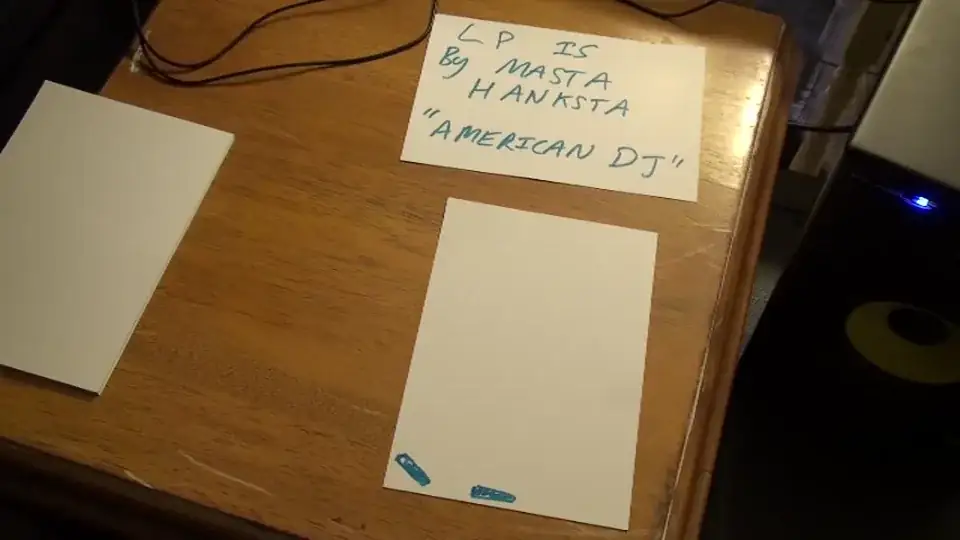
Right folks, another video on speaker setup. Now I had an email from someone and they were a bit concerned about setting up speakers in large halls or let's say for example a large gym. Now if we imagine, you know, there is the room, that's the gym. Now theoretically, you know, in your school, your college, your gym should be that sort of shape, square, oblong, but always they're bloody big and they've got high ceilings. So of course maybe... The speaker setup you have isn't sufficient, sufficient enough should I say, or maybe you're setting up the speakers incorrectly. Now quite often a lot of people think that the sound system they've got isn't loud enough. Well that's incorrect. It could be possibly because you're actually not setting it up correctly.
Like that. Now if you set those up on the floor in a big room like that, as soon as you get lots of people dancing in front of them, you're going to lose a lot of the sound. Mainly you're going to lose a lot of the treble because it's going to get muffled with the people dancing in front of them. So first things first, stick them on tripods. Like that. Now, let's imagine now we've got people dancing in front of them. I'm going to do my usual stickman. Alright, so instead of, let's say, previously, there's the floor, there's your speaker on the floor, and there's your stickman or woman like that, and then you've got loads of people like that, oops, like that. Now, instead, we've got the floor and we've got the people here.
2:04 Straight away, the sound is going to go above them
So straight away, the sound is going to go above them. Now that is very, very important for rooms like that, simply because now the sound will go above them and it'll be able to travel a greater distance. Now also, this particular chap enquired about bass. How do you get more bass? Now let's say, for example, you've got two bass cabs, so I'm going to put this in half. One there. And by the way, this is recycled paper, believe it or not, and one there like that. Now let's see, hold on, no, I'll do that slightly differently, sorry. Duh. Okay, let me put a line across there. Now let's imagine that is your DJ console, that is your speaker on a stand there, and that is your speaker on a stand there. Now let's say for example there could be 2, 3, 4 metres, 5, 10 metres in between those two speakers.
4:26 This is not a good idea, have them pointing that way
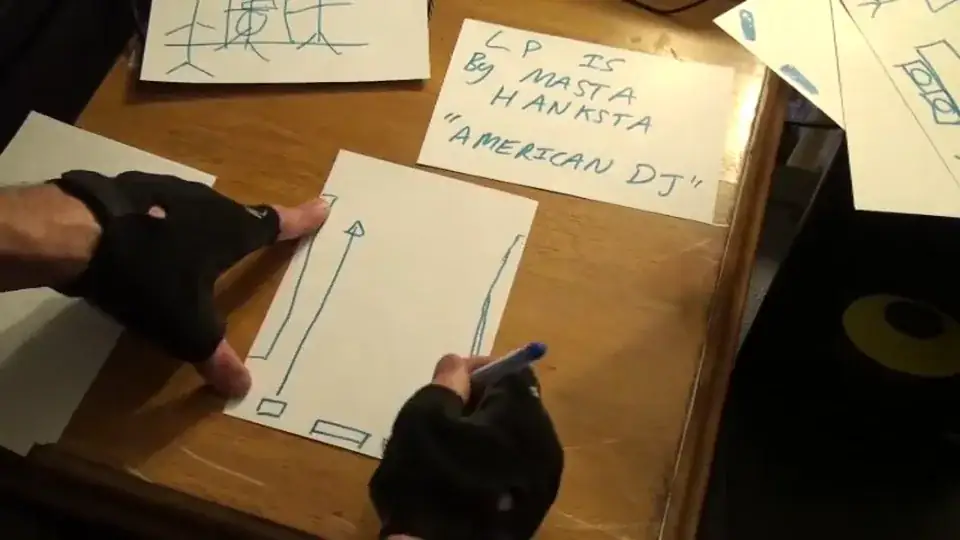
Is to put a bass cab there and a bass cab there. But, because bass is omnidirectional and also if you put bass cabs together you get more sound, what you should do first of all is, let's say again, there's your mid-top cab on a tripod like I did earlier on, on a tripod. Maybe what you need to do is in front of your DJ setup, put your two bass cabs together, like that. So there's your two bass cabs, feather apart. The DJ Tutor is available for purchase at Ellaskins.com All right, so there you go. There's your setup. What I'm going to do now is I'm going to show you how not to point your speakers. Now let's put one there and one there. Now this is not a good idea, have them pointing that way. All that will happen is the sound will hit the back wall, come straight back at you and it will bounce. Now using this technique, it will still bounce a tiny amount but not as much. Okay, so again, here are our seats or maybe one side. There is the DJ setup. What I'm going to do now is I'm going to now face the speakers like that.
So now what's happening is the sound is going that angle, like so. Now also because bass is omnidirectional you can put your bass cabs sort of anywhere. So what I would tend to do is maybe put the bass cabs just together, maybe this side, two bass cabs there or alternatively maybe put them there. If you go into any big nightclub You'll find that the bass cabs aren't always underneath the mid-top cabs. They could be absolutely anywhere in the room because the bass will travel. Now also, if you want to take it to the next level, and again I have done this before, but the more videos we can do on this the better because it's giving you guys all more information. A normal stereotypical speaker. Let's imagine we cut a speaker directly in half. So let me get a quick box, what can I get? Alright, hold on. Let's imagine that there is a speaker. Oh shit. Right, there is the bass speaker and there is the treble speaker, like that. What I'm going to do now is I'm going to imagine I'm going to cut that in half. So, what we would see is something like this.
6:26 We would see the treble horn and then the bass speaker like that
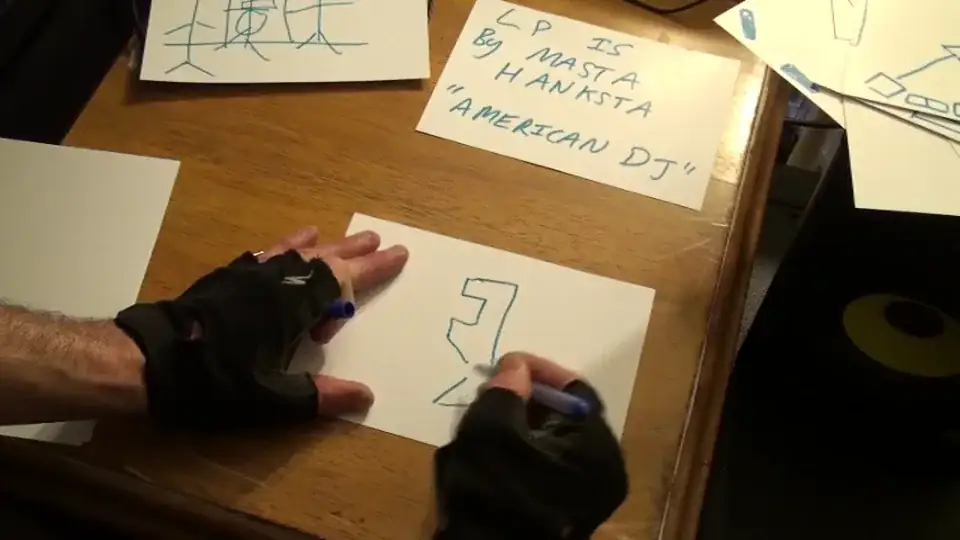
We would see the treble horn and then the bass speaker like that. So, oh, on a horn there, sorry, like that. So that's the treble speaker and that's the bass speaker. Now that's a normal forward facing speaker but what a lot of people do if they've got to say send a sound wave a greater distance they'll use what's known as horn loaded. So what you'll find is you'll have something that may look like this. You'll have the horn on the treble, which will be a lot bigger. And then also then, you may have a horn like so on the bass speaker. So that's the horn itself and then the speaker will be here with the magnets there. Now that will actually make the sound travel a greater distance. Alright, that...
He's a very, very rough kind of drawing. So, if let's say you want your sound to travel a greater distance, then you do need to use horn loaded, alright? What am I going to draw here? I don't know, I'm going to draw a face. A smiley face. There we go. Looks rather strange. So there you go. A bit more insight into setting up speakers. Now again, I would say out of all of these, all of that lot... The most important one by far is that one. In fact, there's two. That one and put another track on. That one there and also I would say that one. Make sure your speakers are high up. They don't have to be exceedingly high but if they're head height it means the sound will travel a greater distance and also
Have them facing in at a slight angle. If they're that way, the sound's going to go straight back and hit the two walls at the back. That way it's going to go across and it's going to bounce all over the place. Believe it or not, it's slightly better because once you get a load of people dancing here, the sound is going to be directed more at them. Hope that's been a help. And by the way, scratch dog. Practice and enjoy. Take it easy.
This transcript was produced automatically from the audio of the video and may contain mistakes.