 6:31
Beat juggling Tutorial,video 4( A few swear words!!)
Contents of the video
0:00 Is that here in the selection
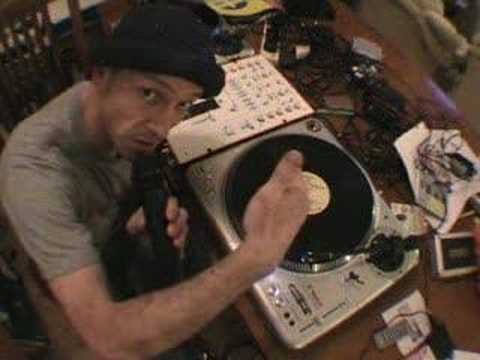
Alright folks, this is lesson number four for the turntablist. Now then, very quickly, what we're not on about here is hip-hop turntablism. What I'm trying to explain is that here in the selection of videos that turntablism isn't just for the hip-hop artists. It could be for anyone. Doesn't matter. If you like dance music, there's no reason why you can't just put a little bit of your wiki-wiki in what you're doing as well. Check out lesson 1, 2 and 3 first. Now very quickly just to let you know what the tracks are. The track on my left hand side is Armand Van Helden from 2 Future for You EP and that's 2 in number 2 future and then 4 number 4 you by itself you and then EP. It's Psychic Bounty Killers 2 featuring DJ Sneak and then over here we've got Robbie Riviera. It's the Funk Force Mix, the ultimate disco groove. Now then what I'm going to be doing is simply this.
I'm going to be letting both records ride together, and at some point I'm going to stop this one, just cut it back and forwards, utilising the volume control. Now then, to check out how I do that and why I'm doing that, go and see lesson 1, 2 and 3 on The Art of Scratching for the Complete Total Letter Beginner. Check out those and you'll see where I'm coming from. But what I'm going to be doing is then throwing the record back in, letting it play together while the volume's up. So really most of the time the volume will be up, the records will be riding together continually, okay? And then what I'll do, I'll bring the volume back down, just hold it, just move the, manipulate the beat, you know, back forwards, back forwards, or maybe bring the volume down, bring the beat back, volume up, beat forward, volume back, beat back, etc., like so, okay? Now a couple of pointers first.
2:21 First of all, you've got to make sure that they're in beat
If you're going to do something like this, ideally you need some records logically that work well together. These are the sorts of records that will work well together. And that is, let's say, the instrumental versions of certain tracks. What won't work very well together doing this is two records, let's say, that have got a lot of vocals inside them. Because again, you see, when you're going to be scratching with vocals and you have vocals over vocals, if there's too much, it sounds terrible. First of all, you've got to make sure that they're in beat. That's quite important, okay? Because the last thing you want to do is to have them, say, very slightly offbeat and what will happen then is if you let it ride by itself, or both ride together, should I say, then eventually they're going to gladder, which, well, terminology there is, you know, they start going bum, bum, ba-bum, ba-bum, bub. They will catch up with each other, of course they will, but then there'll be one beat behind, so it will sound...
Not so good. Right, now a couple of pointers as well, again, and that is simply this. If you're going to like go move the beat, okay, as I'm going to do, and then say you're going to leave it for say four or eight bars, you will always have to make sure that you've got your fingers on the pitch control just in case because there could be a possibility that you've thrown it in just slightly off. So even if you've got it perfectly beatmatched to begin with, it could be slightly off. Again, after you've thrown the beat back in. Okay, so always make sure that it's back in. On the other hand, if you're going to manipulate the beat and then let's say for example, you're going to only let it ride for about two or three beats and then you're going to do it again, let it ride two or three beats, do it again, let it ride two or three beats. If it is very slightly off there, it doesn't matter so much. All right? Right, let's give it a go. Okay, right. I hope you basically got the general idea what I was doing. Let me just stop it so I've got things in my ears. Right, basically what I was doing is simply this.
I had the one record playing, and then this one here, what I was doing, I made sure it was in beat first, for it logically, and then a bit of a scratch there, threw it in, of course it was still in beat. I was always listening because if it was slightly offbeat and I was going to let it ride for quite a while before doing the old wiki-wiki again, I'd make sure that I had my fingers on the pitch just to fine tune it. But if, let's say, I was doing the old wiki-wiki, scratching it, and then letting it ride for, say, one or two beats, you know, like... Thank you for watching. Well, leave a comment underneath this video because I always try and read all the comments. Well, I do actually. Some of them are very funny. Thank you for watching. I hope you've been helped. Practice and enjoy.
This transcript was produced automatically from the audio of the video and may contain mistakes.