 7:01
Beat juggling video 6, 1st video in using two turntables
Contents of the video
0:00 This is the next video in a selection we're doing on beat juggling
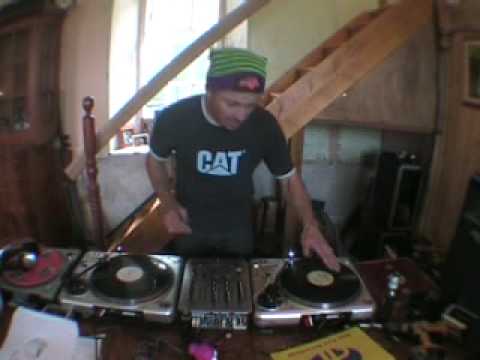
Alright folks, this is the next video in a selection we're doing on beat juggling. In all of the other ones, what we've been doing is just utilising the one turntable, the one on my right, whilst the other one has been playing just a basic beat. Okay, what we're going to be doing now is proper beat juggling whereby we're going to be using both turntables. Now then, I suggest you go and check out the other videos first. The whole idea of the other videos is basically what I was doing, I was just using The one turntable, but in principle you can do exactly the same with the other turntable. So in other words, in the first set of videos, from two to I think five, I was just using the one whilst this one was playing. But if you think about it, as soon as I take my hand off this one and this one carries on playing, there's no reason at all why I can't do a mirror image of what I've done on the right-hand side with the left-hand side.
Now in this video, what I'm going to be doing is I'm going to have the two volume controls all the way up on the actual mixer. The crossfade is going to be in the middle. Now again, I must stress, I'm not the best beatjugger in the world, okay? I'm going to give you a demonstration first and then I'll explain exactly what I've done. Right, two tunes I'm using. The one is Armand van Helden from the Two Future for UEP, Psychic Bounty Killers. And then the other one is, it's Robbie Riviera, it's the ultimate disco groove and it's the full force, sorry, funk force mix. Right, so first of all what we need to do is we need to get them in beat. So, we'll start this off by a bit of swearing in this one, I do apologise. The principles apply to beat juggling. Logically, where this is concerned, they've got to be relatively well in beat. Also, what is vitally important...
Is just as important as getting it in beat, as actually getting it in phrases or in bars. What I mean by that is, let's say for example they're both in beat, perfectly matched, but if one of them is slightly out of bar by say two or three beats, it will actually sound off. Now then, I think actually it's better I do the explaining first, but two lots of explanations. One is I do apologise... Because I'm by far not the best beatjuggler in the world. From a scale of 1 to 10, I'm probably minus 7. But what I'm going to be doing is simply this. Both records are going to be playing. The volume controls on both of the sliders are up. The crossfade is in the middle. Now then, what I'm going to do, I'm actually going to make sure that when I say the same sort of position...
As in, timing where the bars are concerned. In other words, one, two, three, four, one, two, three, four. In other words, they're both at one. Now what I'm going to do then is on the right-hand side, I'm going to stop, say that record at one, and I'm going to move it backwards and forwards. One, say a-wa, a-wa, a-wa, like that. And then throw it in. But if I do that, I've got to do exactly the same on the other side. A-wa, a-wa, a-wa, throw it in. And then the same with this side, awa, awa, twice, throw it in. The same with this side, awa, awa, throw it in. If, let's say, I was to do that, I know this sounds really funny, but it's the best way of explaining it, alright? If I was to do this, awa, awa, awa, three times, and then this one, awa, awa, twice, it would mean that that one will be one beat behind, okay? Now then, again, not perfect, but hopefully it'll give you a general idea, so here we go.
4:14 Exceedingly dodgy, but I hope it's given you a rough sort of idea
Exceedingly dodgy, but I hope it's given you a rough sort of idea. Now bearing in mind both volume controls were up, crossfaders in the middle. Now then, work on this sort of principle. They're both running together anyway. Now then, a good turntablist, a good beat juggler would be able to throw that in perfectly. And what you'll find is a lot of DJs are great with scratching and cutting with say the right hand or with the left hand. Some DJs are very good with both, so it's up to the individual. I find I'm better, if that's what you could say it is, I'm alright at cutting and scratching with the right hand, but the left hand isn't so good. So what I was doing there, I was utilising it like this, playing the beat. Now then, I was listening and I was counting. And then maybe throwing it in. But then the same on this side, getting it there.
There, like so. So in other words, the movement I was doing on the right-hand side was exactly the same as the left-hand side. So if I was going to do a movement like this on the right-hand side, I would do exactly the same on the left-hand side. So if you think about it, you don't have to just do oowa, oowa, oowa. On the beat you could do uh, uh, uh, uh, uh, bang, throw it in. But then, on the other side, uh, ah, uh, uh, uh, throw it in. Now to begin with, when you start doing this, it's better to do a mirror image. As you get more confident and you get better at throwing it in, then you can maybe do it twice here and once there and twice there, but then as soon as you've done that, you've got to remember to pick up the amount you've left off here. So two here, one here, two here. It means there's three more here you've got to do for them to get back in beat. I hope that's been a help. Thanks for watching.
Practice and enjoy. CatDog.
This transcript was produced automatically from the audio of the video and may contain mistakes.