 13:43
Mixing drum and bass
On YouTube this video is called Beginner Drum and bass DJ Mixing Lesson Using We Are 21 from Hospital Records
What this lesson teaches
He agrees with the premise - drum and bass is one of the hardest genres to mix - and then explains why in a way that groups it with several others.
The category
Broken beat. Drum and bass, trap, dubstep, hip-hop, R&B. All slightly more difficult, slightly more technical than house, techno, trance or electro house.
The common factor is the absence of the steady four-to-the-floor kick. The timing and the structure are still there - he is emphatic about that - but the thing that was handing you the pulse has gone.
A newcomer hears a mishmash of percussion going everywhere. What they are actually hearing is a pattern they have not learned to parse.
The two instructions
Listen for the snare. Two and four. That is the reliable landmark, because the kick moves around and the snare is what holds the pattern together. Find the snare, and the one is the beat before it.
Count in half time. Counting every beat at drum and bass tempo is unmanageable - you would go barmy, as he puts it. Count at half the rate and it becomes possible.
Both of these appear in the stage 2 lessons on counting, and the repetition is deliberate: this is where you apply them with two records running.
Why it is worth the trouble
Because the broken-beat genres are where the interesting rhythmic work is, and because the skill transfers downwards. A DJ who can find the one in drum and bass will never again struggle to find it in house.
One practical note
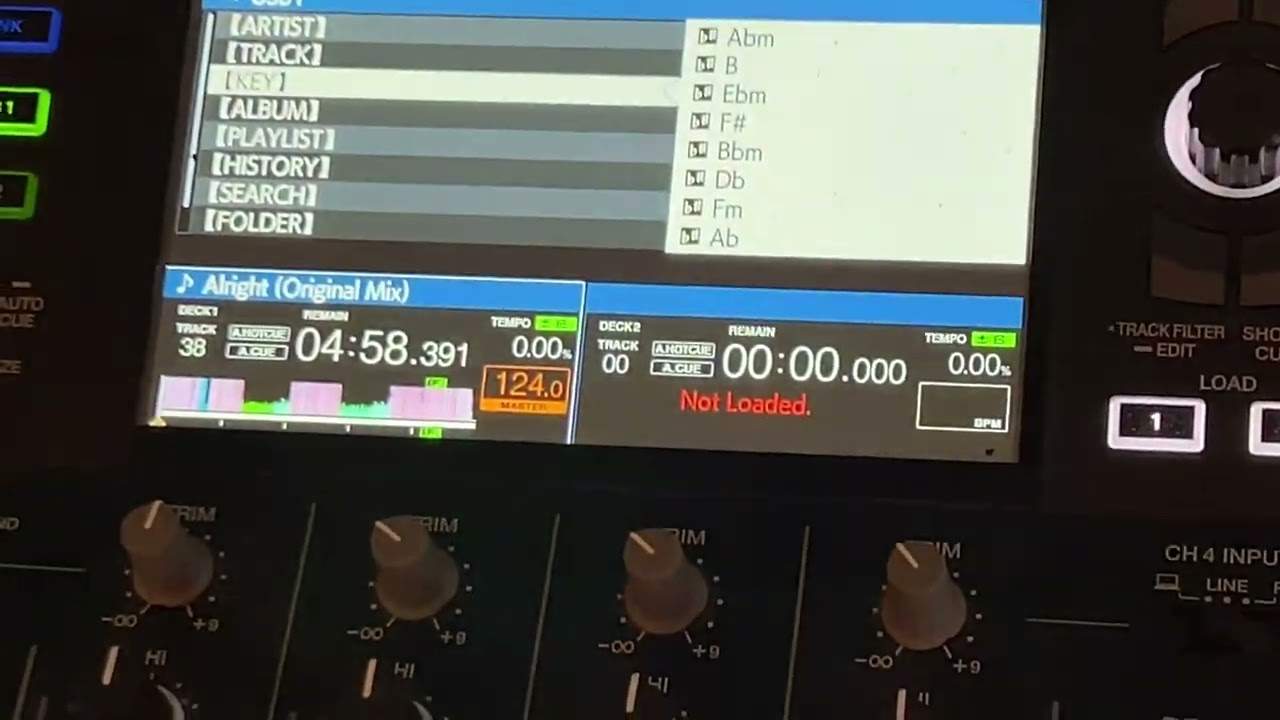
The displays will frequently disagree with you about the tempo - reporting half or double the real figure depending on how the software analysed it. Decide which convention you are using, apply it consistently, and do not be alarmed when a track shows 87 against another at 174. They may well be the same speed.
Contents of the video
0:00 Drum bass, listen, counting
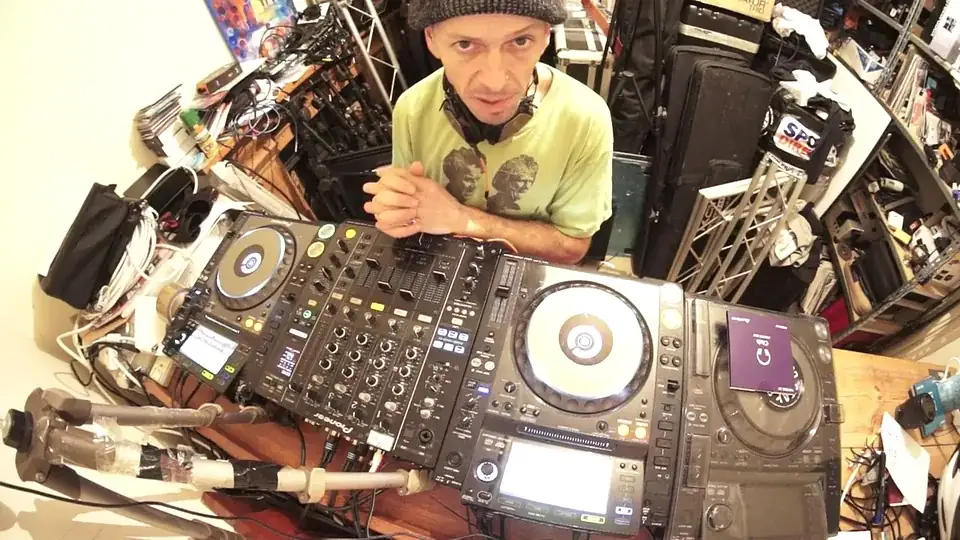
Ladies and gentlemen, a lot of people seem to think that drum and bass is one of the hardest genres to mix. And in a way it possibly is. Any genre that has a broken beat, drum and bass, the likes of trap, maybe dubstep, hip-hop, R&B, slightly more difficult, slightly more technical. It's not like house music, techno or trance, electro house where you have a steady 4-4 time. You do have that, of course you've got timing and structure with practically every single style of modern day dance music. But what you don't have with drum and bass is that one, two, three, four, that kick, that four to the floor sound. What you do have though still is structure. So, for example, someone listening to drum and bass for the first time with...
Maybe not a very good ear on working out phrasing and counting a bar, may listen to it and all they can hear is a mishmash and a wish wash of percussion going on everywhere. What do you listen for? Well as I've said in many videos in the past, you listen for the snare. That 2 and 4, 2, 4, 2, 3, 4. Now that's what you listen to or what you try and get your ear to listen to first. And then, of course, you've got to try and work out the timing. Now, drum and bass is very fast. So, you don't want to start counting 1, 2, 3, 4, 5, 6, 7, 8, 9, 10, because you'd just go balmy. What you do, though, is you count in half-time. Now, if you've got any likes of CDJs or controllers, you may find that you're listening to a drum and bass tune that sounds very fast, but why is it the BPM is so slow?
You know, I mean, the BPM on this track here is at, I've got it at 87.8 BPM. If we listen to it, this one track, this track by the way, is entitled Awakening and it's taken from an LP entitled We Are 21 and there are 68 mixed tracks from Hospital Records and believe it or not, 24 of them are actually like new releases. This track, along with some of the others I'm going to play from that twin LP which is released on the 27th January 2017 on Hospital Records. There will be a link right down there where you can get more info on the album and... When the time arrives, you can go down and get the damn thing because if you like drum and bass, it's shit hot. Oh, sorry, I shouldn't really say that. It's warm poo. OK, no, actually, it's very hot poo, which isn't nice because it smells. So back to the tunes. OK, so why is it that you're counting or the BPM is showing 87 and not like 6 million? Because it's a lot faster than that. Let's have a listen to this tune here.
3:08 Let's listen to the first sound
Now first of all, we've got a lot of melody going on there and there is a drum pattern in the background but for a lot of people it could be very difficult to find that drum pattern or for that matter actually hear it. So let's listen to the first sound. You've got a rolling kind of melody and also you have structure even in Okay, let's have a listen again from the beginning and let's try and work out if there is structure. So what I'm going to do, I'm going to start counting from the beginning and also I'm going to count how many bars we have before we have the next change. And then again before the next change, and so on and so on. And see if we've definitely got some form of structure. Even in the beginning of this track, before we have that definite kind of full-on drum and bass bang in your face. So, 1, 1, 2, 3, 2, 1, 2, 3. These are bars, 3, 1, 2, 3, 4, 1, 2, 3, 5. 2, 3, a change, 2, 1, 2, 3.
5:24 We've got four bars change, four bars change, four bars change, four b
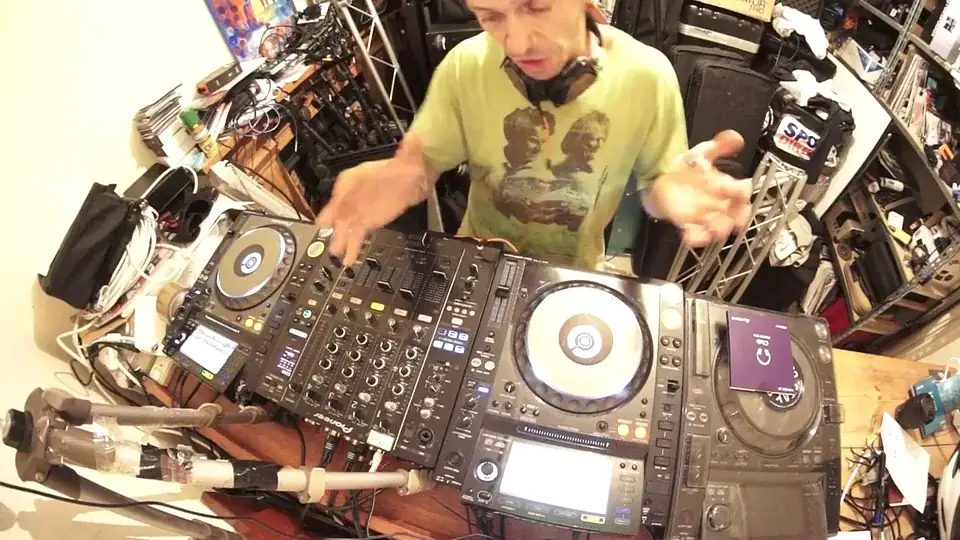
3, 1, 2, 3, 4, 1, 2. You can feel another change. 1, 1, 2, 3, 2, 1, 2, 3. 3, 1, 2, 3, 4, 1, 2. Another change. 1, 1, 2, 3, 2, 1, 2, 3. 3, 1, 2, 3, 4, 1, 2, 3. OK, so we've got four bars change, four bars change, four bars change, four bars change. Now, what the producer hasn't done is made it really difficult for the DJ or for that matter for anyone. He hasn't, or she I beg your pardon, been slightly ignorant there. They haven't decided, well you know what we're going to do, we're going to, I don't know, maybe do two bars here, one bar there and four bars there and we're going to make it really awkward for you. No! There is a definite structure in this track, from the word go to pretty much, yep, the word end, finish. Right at the end of that side. The right side is the end, the left side is the beginning, believe it or not. Right, so we've got that track, I've explained about the structure. Let's have a look at Storm Brew, which I think is one damn good tune. It is mental.
Now, let's imagine that we want to bring that track in at the exact point where the break comes in towards the end of the track here. So I wanna bring that track in to there. But what I don't wanna do, I don't wanna like sort of slowly fade it in Or I don't want to try and mix it in at that point because this track just... Crossfade. It starts there. Now, a couple of things I could do here. One, if I'm really quick, well, I can actually do this because I've been doing this for a very long time. But if I was really quick, if I was a beginner really quick, I could start it off and hope for the best that it beatmatches, but it might not. So how can I guarantee that track is going to be beatmatched?
8:24 Point A, which I've set a cue point here
Perfectly and i can bring that track in perfectly at that point let them both work together in time in phrase so as soon as that one drops out we get in with the um the break on track storm brew so very simple we form a loop so what i'm going to do now is i'm going to form a two bar loop so let's go to eight which of course is eight beats which is two bars Okay, right, sorry. So what we've got to do is we have to make sure that that track will start correctly at... Point A, which I've set a cue point here. There. So how can we do that? Well, very simple. What we do is we... I've actually got my legs like wide open here. It's a good job I do exercises and I can even go lower like that. That's beginning to hurt my crutchy ball bits. I do not want to hurt my crutchy ball bits. Right, so what I need to do is I can't now start that loop at any point before that break because if I do...
And I come out of the loop, I could be one bar too short, one bar too late. So I need to make sure I start that loop at the correct time before the end of that break. So let's imagine earlier on we were talking about the phrasing in this track was four bars, four bars, four bars. Well if that's correct towards the end, if we get to a new change and we have the beginning of a phrase that starts at four bars i need to start that loop after the two bars and then let it play and then if i do if i actually start that four bars before that break okay so i'm starting this four bars before that break finishes then i need to play that twice so i need to play that loop twice which of course will be once and twice so you're playing one two three four one two three four one two three four one two three four and then when it comes to the third time as soon as it starts to loop for the third time i need to come out of that loop because it's pretty much starting from the beginning if i let that loop play
11:09 Better start the loop, hadn't I?
A third time and then come out of it, I'm going to be two bars out. So this isn't rocket science. This is just like, this is very basic child arithmetic. So let's see if we can get that right. So let's go to my point A. I'm going to go back a bit. We'll sort of go to about there-ish. Right, so... I'm going to wait till I can hear a definite change and also I need to make sure that when I start that loop it is at the correct time in the phrasing so I know that if I start it at some point here, it's not going to be like at the fifth bar or the seventh or the ninth. It's going to be at the first bar or for that matter at the third. One, two and then three. 4. So, either start it at the first, so it's 1-2, or at the third bar, 3-4. Right. I'd better do this right, otherwise I'm going to look all right bloody numpty, aren't I? So here we go. Hold on. Better start the loop, hadn't I? Sorry. Here we go. Coming up to it. And... OK, so, worked. And...
I am by far the best drum and bass mixer in the world. In fact, my missus. Check out Sauce, Yvette Brooks, DJ Sauce. I will put some sort of a link down there because she does wicked drum and bass mixes. Alright, this one here is track number 23, Storm Brew. And what can I say? If you're into drum and bass, go and check out Hospital Records. And I must say a big thank you to Hospital Records for letting me use their tunes. This... LP is released on the 27th of January 2017. What a killer cut, practice and enjoy. Practice and enjoy, thank you.
This transcript was produced automatically from the audio of the video and may contain mistakes.