 8:45
DJ Demonstration How to Mix Old School Disco in to House Music
Contents of the video
0:01 What I'm going to do is play an old school tune
Alright folks, I've got a bit of a demonstration for you. What I'm going to do is play an old school tune. I'm going to form a loop in that old school tune, speed it up and bring in a new school track. So, two tunes I'm using is Rapper's Delight, Sugarhill Gang and then we have Collabro 8 which is spelled C-O-L-L-A-B-O-R number 8. Your love, love, it's the dub mix. So, first of all, one important factor when you're doing this sort of transition. Old school tunes, most of them, we're looking probably around about... early 80s, 70s, 60s and the like. The BPM will not be at a constant because they're done with real, you know, they're actually being produced or made by real people playing real instruments.
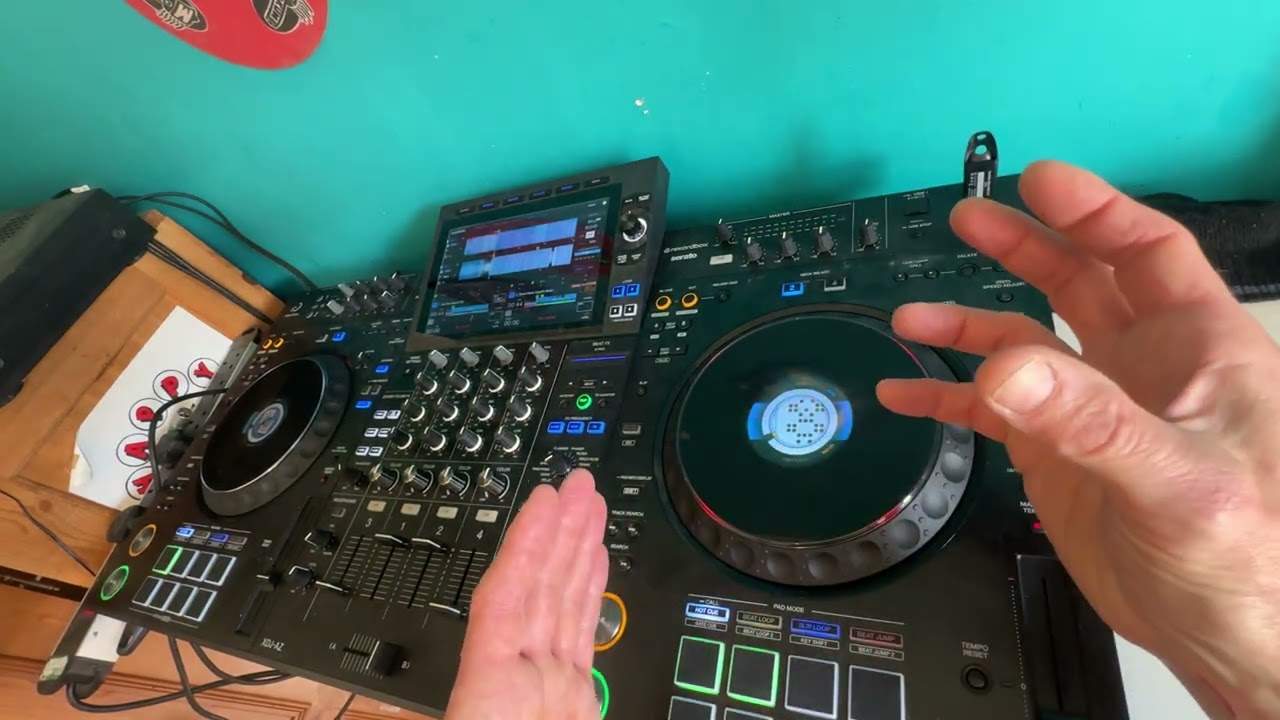
So, a certain track that you're using may start at 115 BPM. It may actually finish at 115 but it's highly likely it'll be 114 in the middle and then you'll get to 115.2, it might go down to 114.8. It'll fluctuate. So, it's very difficult to try and mix the track in. It can be done but you've got to be on the ball continually or use some form of PC program. This demonstration, we're going to use these hands and these ears and we're going to go to town and have some fun. Alright, Sugarhill Gang, Rapper's Delight. Let's have a listen to that track first. Here we go. Now, the pitch is at the centre point and this is the original speed of this track. So, first thing, let's imagine we have a track playing on this side.
What I'm going to do is I'm going to form a loop on the Sugarhill Gang or form a loop in the Sugarhill Gang track. So, let's play, press play again.
Now, actually, I want it without the bass line, just no bass line at all. Let's go back to the beginning again.
Here we go.
Two, three, four. That's off slightly.
2:45 Yes, everybody, thank you
That'll do. Okay. I'm going to set that on one of my hot cues.
Okay, that's set. Now, I've done that or I would have done that while the other track's playing and then all of a sudden you're going to bring in the Sugarhill Gang. So, yes, everybody, thank you. Whoa, whoa, whoa, in the house. All that.
Now, you're playing this. Okay. Okay. Of course, then what you do is you would find... So, this is your next track. So, that one's been playing. You're coming into the old school track. You've probably had another old school prior to this one. And away you go. Everyone's happy.
Now, one important factor as well is make sure for the next part you have the master tempo on or the key lock on because what you're going to have to do is speed this up. I said it here.
Okay. So, sorry. Let's go a little bit further on. We'll go to about sort of there.
Right. At this point, what I'm going to start to do is speed the track up.
I'm at plus and minus 16. I've hit my hot cue and I'm going to start bringing the house track.
It's so simple. There you go.
Okay. So, let's go through what happened. There was a track playing, an imaginary track playing on one deck while that imaginary track was playing. I formed a loop. But I, again, you're doing this on your headphones. Again, I did a manual loop. It might have been off very slightly. But again, if you quantize, hopefully it should be a lot better. But again, the trouble is when you're quantizing on old school tunes, quote me if I'm wrong here, it could slightly be still off because even in between every single kick there could be a fluctuation of 0.001 BPM. Who knows? So, my advice is something like this is good to be done on the fly with these and these. Formed a small loop, set that loop onto a hot cue. Then when this track was finishing, yeah, we bring the next one in.
Let it play. We've already formed the loop in a hot cue, so it doesn't matter. That's happy. It's sitting there. It's not going to go anywhere. When we come to the latter part of the track, I start to increase the speed. Now, one important factor here is you need to make sure that you check the BPM of the track that you're going to bring in. So, for example, the next track, 122. As you increase the speed of the old school track, you want to make sure that you make note of the BPM because you want the BPM of this one to match that one. So, bring it up, speed it up to, again, say 122 BPM and then you snap your cue in your hot cue. You snap your loop in. Ideally, you want to snap the loop in at the beginning of the next phrase,
Not halfway through vocals so it sounds as though it's fitting correctly into the mix. If you want to, your loop can play for a couple of times and then bring in your house track or the other song. Think about it, we've done it the one way but it can be done the other way as well. You got a house track, form a loop, slow it down, bring your old school track in. If you need any more info on this then actually what you can do if you're interested, I do Skype one-to-one lessons now. So, if you are interested in having personal lessons by myself, then check out in the description there's an email. It's practisingjoyatdj2u.com. Send me an email with your requests and your wishes and maybe we can hook up on Skype.
We've got loads of happy customers, so thank you very much for watching. Practice and enjoy. Thank you.
This transcript was produced automatically from the audio of the video and may contain mistakes.