 14:58
DJ Demonstration on a Pure Vinyl Mix with Technics SL1200MK2
Contents of the video
0:01 I'm going to take you through a vinyl mix
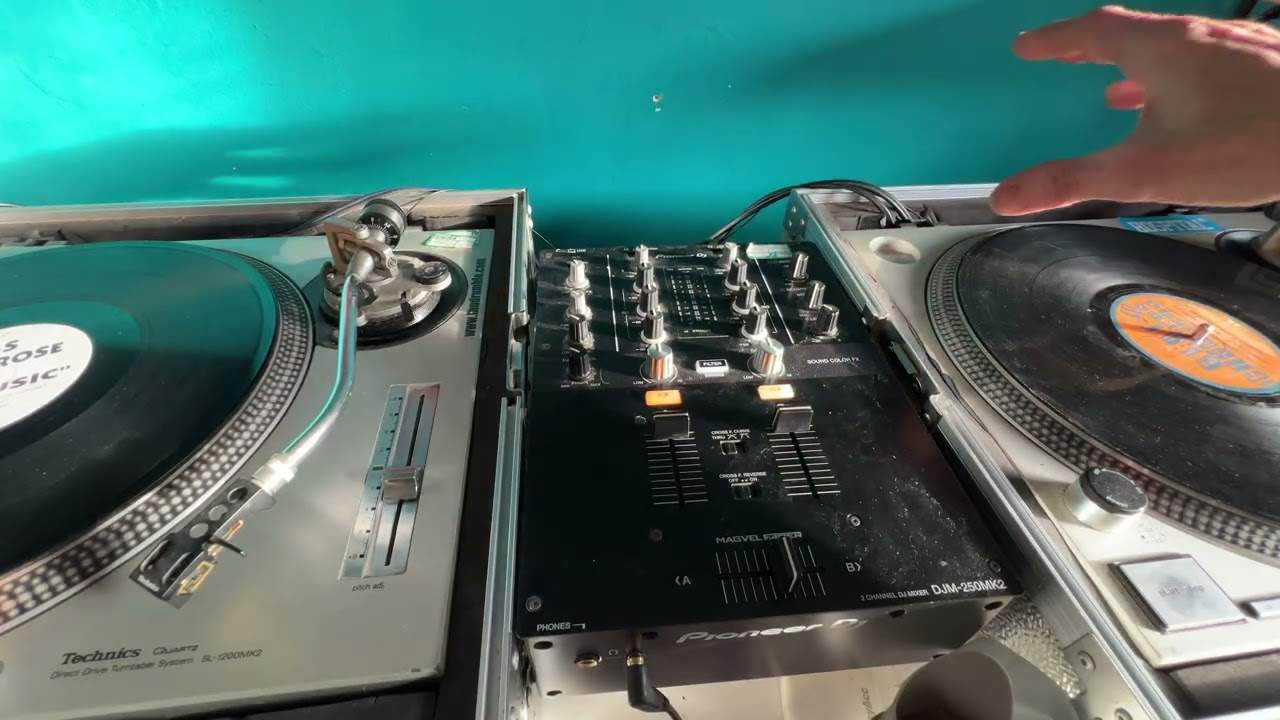
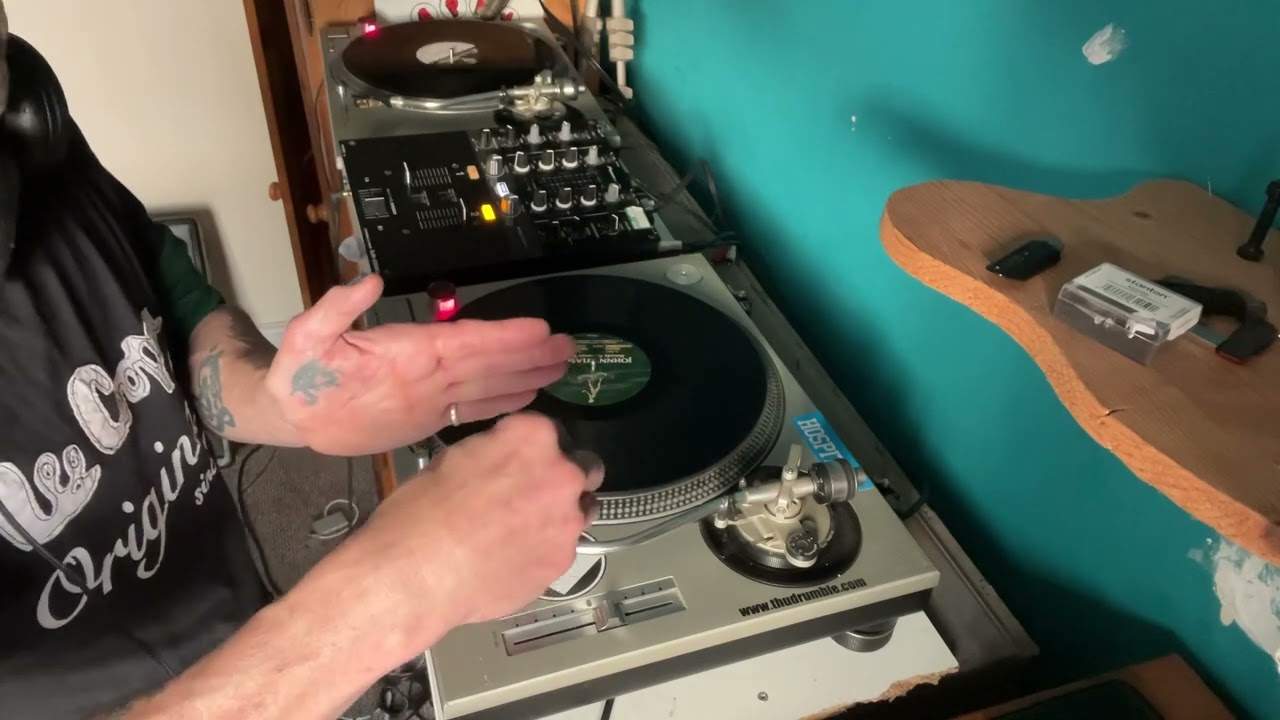
Right, ladies and gentlemen, I'm going to take you through a vinyl mix. So both pitches are dead centre. On this side here, I have Basement Jacks, Rezo Kane mix of Red Alert. On this side here, on Casual Records, Johnny Fiasco. I'm going to be playing a track, I think. It's a track entitled Futile, but I'm not sure because again, is this a side A or side B? Yeah, side A. So it's entitled Futile and we've got Symphonic Tapes, First Light and Kalimbra on the other side. And this is Casual K-A-J. 2-5-1. Okay, so let's just have a listen to the cuts first. Really nice kind of mellow vibe to this soulful as well. And then the other track, Basement Jacks, a little bit more sort of minimal Brazilian styling like this.
Okay, first and foremost, no screens, no laptop, no BPM readout, nothing like that. Very important with vinyl turntables. And that is your pitch, because when you start going above or below 3%, 3% of the original speed of the track, then, you know, you not only slow or speed the track up, but you start to change the actual physical sound of the music. So, you know, you're increasing, decreasing by semitone. So if I show you here, if I put the needle on the record, speed it up, not only is it faster. It sounds higher, as though it's been elevated there.
2:19 Of the vinyl
Now, luckily the two tracks are very close to the same BPM. Now, back in the day, what a DJ used to do or most DJs, they'd actually write the BPM on the cover of the vinyl. So at a glance, they'd be able to tell whether the two tracks were pretty close BPM. If they weren't, generally you'd stay clear of mixing those two tracks. Because. What you may have found is that even though they were the same key, if you then got them to the same BPM, they might actually end up being out of key then. And of course, even though they originally were the same kit, the original BPM, the producer made them when he finally got, finally got the mix, they could have been out of key. So this is why generally you did see DJs, you know, start off with a slow BPM slowly move forward.
So what they do, they work their way through the box. Maybe they wouldn't choose tracks right next to each other, because even though they were the same BPM or very close, they may not match harmonically. So you might have to flick through to get to the ones that harmonically match. But anyway, so what we'll do, we just put this on here. Okay, so the LEDs, I don't know if you can see there, hopefully you can. But it's sort of roughly, roughly sort of in the... ...the... ...amber. Now I don't want to go into the red, because red is dead, so let me just move it like that, hopefully you can see a little bit better. In fact, I'll tell you what, if I... Let's have a look. Okay. I'm going to do something very bizarre, anyone with...
4:22 Flip the crossfade over
...I forget what that thing is when everything has to be... What's going on there? Crossfade! Okay, hopefully you can see the LEDs now. All right, so let's get this one ready. Flip the crossfade over. Okay, so imagine that was playing and I put the needle in the record. So this is what you'd hear when the DJ was getting the record ready. Oh, jumped! Having the record jump doesn't necessarily mean that there's a problem wrong with the vinyl. It could be because the arm isn't set correctly. It could be indeed the vinyl. It could be because... There is so much of a big sound with the first beat that the actual needle itself, the diamond is shaking so much it could maybe just jump out of that groove. So very often you had to be really careful with hitting that first beat.
It also could have been possibly because the vinyl was not secure on the spindle, which meant that as you're moving the vinyl, it's not moving in a perfect circle. It's actually wobbling and that as well could jolt the needle out of the groove. So what I'm going to show you now is sort of like a live mix where I would be... What I'm about to do, normally you'd probably do on the headphones to get it in beat, but I'll show you how I sort of manually get that track in beat. So just let it play. Now I slowed the other side down because this side, was very close to the centre. I will explain in a bit why I did that. You're moving the thing tiny amounts now, really tiny amounts. Notice that the LEDs on the right hand side
7:27 Scale of 100%, a lot
Are a lot higher to the ones on the left. Bring the needles off the records. A lot of that could be down to the overall recording level of the track itself. Because what you have to remember is, if we look at a scale of 100%, a lot of the bass, the lower sounds take up a greater part of the overall sound spectrum. So when you do have vinyl with a lot of bass, even though that base isn't really audibly heard, it could be just because there's a lot of low frequencies that just maybe push the LEDs a lot higher. Whereas for example, the other side, even though it sounded louder, the LEDs weren't peaking as much because there's probably less bass on that side. So I hope that makes some sense. Now with using the pitch now again,
You know, it's not as easy as it looks because you haven't got any readout. You haven't got wave format and so on. Now earlier on I mentioned about being in the centre position and having to move the pitches away from the centre position. Now as any vinyl turntablist will know, when you have one track that's dead centre and the other one, you're mixing it and you're getting to the dead centre position in using the Mark IIs. It's always very, very difficult, practically impossible because you have what's known as the click. Now in the pitches, there is a small tiny ball bearing and a hole. And what happens is as you move the pitch, the ball bearing clicks into position, which is of course at the exact speed of 33 or 4,
33.345. I think it's 45 exactly. Anyway, so what happens there is, you know, you're automatically clicked into the exact speed of the original track. And over time what does happen with turntables like this because DJs tend to work very closely in the centre position, it does start to wear away a little bit. So if, you know, you're a purist you will notice that the turntable as it moves you have these small tiny circles and you'll notice here where the strobe is that it clicks. As it clicks into position you do notice a big variation in the movement of the circles. In other words, they're moving slowly and all of a sudden they'll stop or they'll move the other way and they'll stop instead of there being a slow decrease or increase in the movement
And you'll get that if you move away from the centre position. So let's just bring this up a little bit faster. Let's bring the other one up faster and let's repeat the process put that on.
10:38 Maybe take the bass out slightly increase the volume
So again I'm going to I'm gonna have my headphone on bring it back so you can hear everything. You see if you listen to that it seems like a low volume compared to that. This is because the other side basement jazz there's more mid and high which indeed makes it sound louder whereas Johnny Fiasco doesn't seem to be as loud but there's more emphasis on the bass. So maybe take the bass out slightly increase the volume. So let's repeat the process now what I've done taking the bass out slightly on the right hand side increased the volume maybe I could even increase the mid as well also I'll now reduce the volume slightly because I've increased the mid so hopefully now what I'm going to get is an equilibrium with the overall sort of spectrum of sound.
So let's do it one more time let's go back this time I'm going to use a crossfade
To be a bit more equal now as well.
Okay there you go I just noticed as well on the mixer it's more for cutting it's where you have the one side straight in and as you bring it over just towards the end of bringing it over to the other side then it just disappears straight away so I didn't have it at that smooth transition. Okay so I hope that's been a help this is sort of a general look at mixing on a vinyl turntable now recently I did a video on why you should or maybe shouldn't buy turntables and again this is something you know if you're new to DJing or you know if you're a multi-billionaire and you think I just want to buy some decks it's not about just thinking money's no object buy them there's a lot more to it you know if you want to you know impress your mates fine
Get a set of turntables but make sure you know what you're doing it is so important it's not easy to use vinyl at all if you use vinyl let me know if you don't let me know if maybe you would like to just bug info in comments thank you for watching practice and enjoy thank you
This transcript was produced automatically from the audio of the video and may contain mistakes.