 6:49
Dj help,3 way pa , and why watch the bass??
Contents of the video
0:00 With the help of my pussycat, one of them, Boo
Alright ladies and gentlemen, with the help of my pussycat, one of them, Boo. Check it out, smile! That's enough, okay. I'm going to explain to you why it's a good idea not to use a lot of bass, okay? Now then, your speakers at home, maybe you're hi-fi, you have one speaker or maybe you have two. A big one and a little one. The big one of course is for the bass sound, the little one is for the high end. Alright, now then, I said in my last video... Not to go over the top with the bass. Why, you're asking? OK, now I will explain, alright? I've just sort of put loads of scribbles down here. If I move this one out of the way first, and I move that one out of the way, and hold on, where is it? It was on... Oh, bloody hell, I've lost it now. Oh, there it is, there you go. Right, right. Now then, this is what frequencies look like. Bass frequency is a bit like that, alright? I will explain. Mid is closer together, and high...
Closer again. Now then, when you have a bass kick, boom, alright? That all of a sudden, boom. What was happening is your big bass driver is moving out, okay? It's actually moving away from the magnet. The coil that is normally inside the magnet is moving away from the magnet, okay? Now the mid, when you have the voice, the actual magnet, sorry not the magnet, the coil is vibrating faster. Here at the treble it's vibrating even faster. Now then, why is it that when you increase too much bass, it's not a good idea? Why is that not a good idea? Right, if you imagine you have got one speaker and you've got all of the sounds low, mid and high coming through that one speaker. And all of a sudden you've got that thumping bass beat. Hello boo. Now then, if you've got someone singing as well, all of a sudden, when that... Are you going to come sit on my lap for me? When you've got all of a sudden that bass kick, alright?
2:15 Likewise with the treble, there'll be very little sound coming out, OK
The vocals behind that bass kick, if you think about it, all of a sudden, say you imagine this peak is where you've got that punch. Now then, you imagine here you've got the vocals, OK? Now what's happening is because of that bass kick here, the coil is actually outside of the magnet, alright? And it's not picking up, OK, the sound from the vocals. Because you've got too much boomf, it's coming out too much. Likewise with the treble, there'll be very little sound coming out, OK? If you decrease the bass slightly, load it, there would be less movement, OK? Now again, I've done a little bit of an etchy sketchy here, OK? Now then... Bass speakers normally are 18, 15 or 12 inch. Now there is where it's positioned normally. Here is where it's positioned, I mean not that to that extent, but this part up here and down here is the coil. Now it's out of the magnet. Two things, one is you're not going to get any sound two or three milliseconds after that.
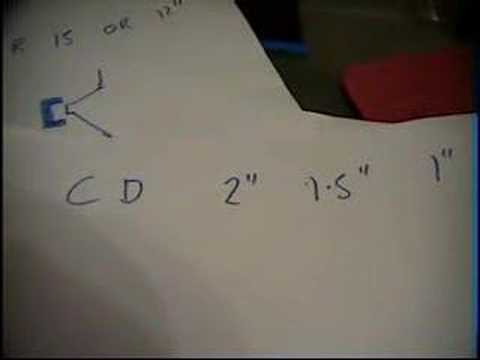
Also, while the coil is out of the magnet, it's actually getting superheated. And like I've said in previous lessons, that's when you can bugger up your speakers, OK? Mid-speakers normally get 10, 8, 6 and 4 inch drivers. Top end CD known as compression drivers. You get 2 inch, 1 inch, sorry, 1.5 and a 1 inch. Sometimes you can get 3 inch as well. When you see these huge massive PAs, they don't just chuck speakers in there and hope for the best. They're actually formatted for different frequencies. Like I've said, the bass will be safe from 20 hertz up to about 150. Those are those big huge subspeakers you see on the floor. Then the flown speakers... The mid and high, they will normally have 12 inch, 15 inch, maybe some 8 inch and some horns, some really high frequency sounds. Now then, let's go back.
To this, alright? Now then, if you imagine now, you've got everything full on and, you know, you've got your huge techno and it's going boom, boom, boom, and all of a sudden female vocal comes along, alright? Well, you will hear the female vocal, but if you've only got one speaker, the female vocal will almost slightly disappear. It won't be a good, true, honest sound because this speaker is doing too much, alright? The format of a two-way system is you have a big speaker and a little one. So the big speaker is doing the boom, boom, and the little speaker is doing the high end. The better type or the best type of speakers you can get by far are what's known as three-way. Bass, mid and treble, okay? Bass, mid and treble. The reason being is because the bass speaker will only do boom, boom.
4:38 Your mixer, you've got bass, mid
The mid speaker will do vocals. That will do all the mid sound, the vocal, the melody, some of the percussion. The treble speaker will do the hi-hat. That will do the clap. That will do the very extreme high end. So if you look at your mixer, you've got bass, mid and treble. Now inside these speakers there are what's known as crossovers. What they will do, they will actually separate those frequencies into the designated drivers. That's what you will have in the cheaper variety of speakers. In the professional PA systems, you will have what's known as an active crossover that is from... You go from the mixer, then you will go into an active crossover that will separate the sound into separate amplifiers. So for example, you will go from your mixer into the crossover, then out of the crossover you will go into a bass...
Amplifier, I beg your pardon, from the bass output of your crossover into a bass speaker. And then from that same crossover you will go out from the mid-output into a mid-speaker. One of these. And then from that same crossover, you will go from a high output into a high speaker. If you want to look at this sort of idea that I'm explaining to you, ideally go on the internet and just type in three-way PA systems, and I'm sure there is a format there whereby you can see. So basically, all I'm trying to say is that if you've only got a small setup in your bedroom and you want to turn it up as loud as you can, like I said, loud volume most of the time isn't a good idea if you've just got the one speaker or a small two-way system. It's always better to have the volume lower, therefore this is the most important thing.
You are hearing a better quality sound and let's be honest, if you're hearing a better quality sound, you will actually be able to mix better because you're hearing all of the relevant sounds from the records and you're not hearing a muffled horrible noise. Thank you for listening. Bye bye.
This transcript was produced automatically from the audio of the video and may contain mistakes.