 11:10
DJ Lesson Complete Break Down on Constructing a Mix BY DJ Tutor Aka Ellaskins Part 3
Contents of the video
0:01 Jonathan here, and we're going to do part three of Constructing a Mix
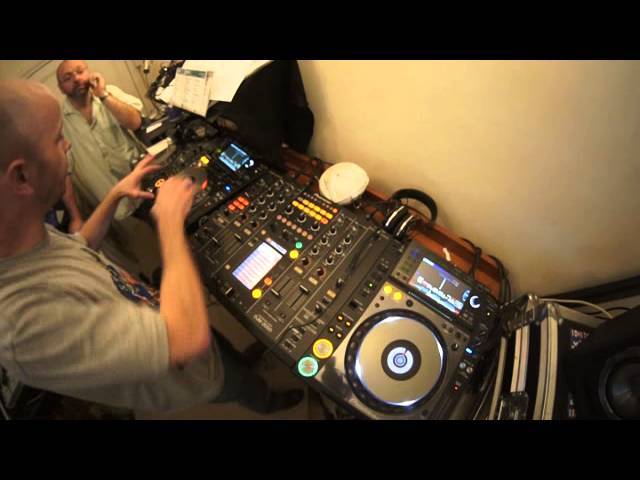
All right ladies and gentlemen, Jonathan here, and we're going to do part three of Constructing a Mix. I've got my mate with me, Rob. Say hello. Just very quickly, Rob, where do you work? What do you do? You work in, is it Harleys and Abba? Harleys and Abba, yeah. Yeah, what, Friday, Saturday night? Friday, Saturday night. I've done work in loads of places. What sort of tunes do you play there? Oh, I love House. Good. Sounds good to me. House all the way. All right, so if you're an Abba-ist, let's go and check out Rob in Harleys, because Abba is all right, isn't it? It's a bit of a laugh, isn't it? Yes. It's a bit of fun. You need to educate him a bit more. He does need educating, but then everywhere does.
All right, in video number three, again, what we're doing is we're looking at the dance releases from CDPool March 2014, and if you've watched video two, I will put a link in the description to the CDPool website, and I'll also put a link in the description to video two on Constructing this Mix. So we have a listen. This was the last track I played in video two, and what I'm going to do is I'm going to then bring in track number 11 from disc one, which is Armoured Van Helden at this point here and there.
Now, again, the idea of this video is to show you that you don't have to just continually mix the end of one track into the beginning of the other. So this point here is at 2 minutes and 27. It's only going to be six seconds into the track if you're counting down, not counting up. So if we have a listener to the Armoured Van Helden track, of course, Armoured Van Helden, if you want to pronounce it correctly, is here and again, counting down, it's at 3 minutes and 55 seconds.
If I just set a cue point, so that's the point I want to start mixing the track in. If we have a listen to the beginning of the track, that's all it is. So to me, I could mix it in there if I wanted to. So if we did something like this, I mean, that works. But I just want to add, do you see what I mean, Rob? I want to add some more depth to it. I want to make it like these sort of mixes that you get on Ministry of Sound style CDs where you've got a continual flow and one track doesn't finish and then you've got this sort of gap and then the other one starts. So the point where I'm going to mix it in is here. And all I'm going to do is, I'm going to use the low-pass filter to bring track 5 out. So if we have a listen to track 5 again, I'm going to let it play and also just so we know exactly where we are,
I'm going to count the bars for you as well so you can hear how many bars we're counting. I'll count the bars and I'll put my fingers up, not rudely like that because it's very rude to do that. Never do that and don't do that because that's even more ruder.
3:18 Just before that bass line comes in, I want this track to disappear
So here we go.
1, 2, 3, 4, 1, 2, 3, 4, 1, 2, 3, 4, 1, 2, 3, 4, 1, 2, 3, 4, 1, 2, 3, 4, 1, 2, 3, 4, 1, 2, 3, 4. Right, just before that bass line comes in, I want this track to disappear. So we've got 8 bars. Probably what I'm going to do is around about the 6th bar, I'm going to start to filter out. So 2 bars from there. Say 5th, 6th. It doesn't really matter that much but I definitely want to filter the track out completely before we get to the 9th bar and that small little bass line comes in. If we have a listen.
That sound I don't want in my mix.
So again, what I'll do, I will give you the demonstration now. We've got that set up there, C and C. So if I pause those, it'll sound a little bit like this.
There. So you see we've got that get into the music. So as one track disappears, the other one is taking over. Do you like that? Yeah, I do. So I'm keeping a natural flow. Now this is very easy. Well, it's not easy to do but how do we make sure that these two tracks are mixing in perfectly at that point? What we need to do, again, we need to count back on both of the tracks. We need to count back on track 5. We also need to count back on track 11. And we need to count back. Exactly the same amount of time, for example, it's up to you. It could be 4 bars, it could be 8 bars. We need to count back on both of them because the same time because we need to know exactly the point where we bring track 11 in to track number 5.
It's no point counting back say 4 bars, 8 bars on track 5 and just chucking track 11 in anywhere because the timing could be completely off. So if I look on track 5, I've got a couple of breaks. I'm just going to go to one of those breaks now. So if we press play at this point here, have a listen.
5:45 1-2-3-4, 1-2-3-4, 1-2-3-4, 1-2-3-4, 2-3-4, 1-2-3-4, 1-2-3-4, 1-2-3-4,
Right, 1-2-3-4, 1-2-3-4, 1-2-3-4, 1-2-3-4, 2-3-4, 1-2-3-4, 1-2-3-4, 1-2-3-4, 1-2-3-4. Now again, you know, professionalism here is taking over. You know where the fish are, you couldn't see that. We were pretty much half way through that gap so 8 bars, that pretty much tells me that should be 16 bars before we get to that break. So again it doesn't, this isn't rocket science. All I need to do now is from point C here, I need to count back 16 bars. Now I'm looking at the readout here, the waveform and I would say quite possibly from this point here it could be 16 bars. So let's start counting from here. 1-2-3-4, 1-2-3-4, 1-2-3-4, 1-2-3-4, 1-2-3-4, 1-2-3-4, 1-2-3-4, 1-2-3-4, 1-2-3-4, 1-2-3-4. Yep, it's 16 bars.
Two things we can do here, we can start from the 16th bar, work our way through, that gives me 16 bars to beat match the track that's coming in. And then I know after two lots of 16 bars from both tracks, the mix will start at exactly the point that I wanted it to start where I showed you earlier. If though, I don't want to spend 16 bars, I can just do it with 8 bars, so I'll do that for you now. So what we'll do, we'll go back to that point here on track 11. Are you following this by the way? If you're not, then I'm really stuffed aren't I? No, no stop. Right, what you've got to bear in mind, even if this track was playing, I could be doing this now on my headphones. So, cue point there, so 1-2-3-4, 1-2-3-4, 1-2-3-4, 1-2-3-4, 1-2-3-4, 1-2-3-4, 1-2-3-4, 1-2-3-4, and that is my cue point there.
So, I've counted 8 bars, I need to now make sure I've got 8 bars. Before, 8 bars ready before that part comes in where I want the mix to take place. So I need to go back to my break that I saw. Again, if you're not following me then please watch this video again. It's very self-explanatory, I hope. So from here, count 8 bars and 2-3-4, 1-2-3-4, 1-2-3-4, 1-2-3-4, 1-2-3-4. 1-2-3-4, 1-2-3-4, 1-2-3-4, 1-2-3-4, 1-2-3-4, 1-2-3-4. Okay, so what I've done now, I've actually got 2 cue points on both tracks. 2 cue points on the point at which the mix will start. The other two are the cue points where I will start to mix beatmatch this one in. So even though they're pretty much beatmatched anyway, what I'll show you now is what you would be doing, let's say if you were doing this live.
So instead of going straight to those cue points, I need to just perhaps with this one.
9:15 In fact, if I start from that break which is here
Just go slightly... In fact, if I start from that break which is here.
There. Then what I want you to do while you're watching this is I want you to watch my moves and count 8 bars. As soon as we get to the 9th bar, you'll see me starting B which is my 2nd cue point. I'll be mixing the track in on the headphones and then at exactly the right time, both tracks will come in which were the original cue points C. I'll have my mix and like I said at the beginning of the video probably about the 5th or 6th bar start to fade out the low frequency pass filter fade out that track. Bang! We're straight in with Van Halden. Let's hope we get this right. Here we go. Whoops. 1, 2, 3, 4. I can't hear anything. That's it. That's the mix. I thought about the timing, the key, the BPM, the construction and bars and phrases.
If you do it this way, you cannot go wrong. Also, you make your mix more interesting. Practice and enjoy. And that's called a talkover.
This transcript was produced automatically from the audio of the video and may contain mistakes.