 13:46
DJ Mashup advise, tutorial
Contents of the video
0:01 We've got that guy there, DJM700 and I've got a piece of vinyl ove
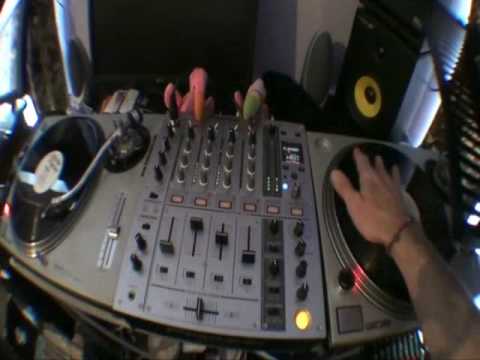
Alright guys, another demo, well more sort of a tutorial really, bit of a demonstration as well on a mashup. Now first of all I'm going to be hopefully in the next month liaising with quite a big company and I'm going to be bringing back the mashup competition. Of course the company are going to be involved and going to be chucking prizes your way but more importantly this is the brilliant part, the winners could possibly get their mashups On CD. Yes! Alright, so it's going to happen. What is a mashup? Right, let's have a look. We've got that guy there, DJM700 and I've got a piece of vinyl over there and a piece of vinyl there.
Now one of the first major points about a mashup is the two pieces of vinyl have to or pieces of music have to be able to work The two tracks are quite minimalistic, so with a bit of tweaking the old knobbly bits up here, they do work quite well together. This one here is a track, it's Johnny D and Nicky P. I will put the names in the description. And the all-star madness, it's entitled Magic, and it's the Armand Van Helden mix, and it's pretty awesome, have a listen. Nice hard edge to that. So if we haven't listened to this particular track, While bass, mid and treble are at 12 o'clock we get theoretically the full amount of frequencies that has been produced in the studio.
Now what you have to remember with your mixer is when the bass, mid and treble are at 12 o'clock and you have your gain control at 0 dB
4:48 There, some people say you have, I'll prove it
What you're getting is you're getting near enough the precise sound that was made in the studio. When you start doing this, you're just highlighting the sound. Alright, it may get louder, bass, mid and treble, but you're going to start maybe getting a little bit of distortion. You can see that getting into the amber quite a bit if I move that up into the red. Red is distortion. A way of remembering red is dead. It's better to keep it like that. And very quickly as well, if anything, maybe move your bass. One o'clock, half one. Same with your mid, half one, something like that, two o'clock. Treble up here, but you can always turn it down as much as you want. You can go anti-clockwise as much as you want. Just be very careful moving your bass, mid and treble the other direction because if your sound system is very loud and you do something like that, bass all the way up, you could hear nothing because you could blow your bass cabs. Right.
So logically, one of the first things you need to do is make sure they're in time. In other words, they work in conjunction with each other. If that one is at 120.03 BPM, excuse me, that one over there should be at 120.3 BPM. They've got to be precisely at the same point. Again, a lot of people say, well, you know, one's at 120, the other one's at 120, why won't they... Match. Why do they go off? Well, it could be because this one's at 120. This one is 120.05. So, slowly but surely, that one is going to go a little bit faster. It may take a bit of time, but it will go faster. When you're doing a mashup, I highly recommend you keep your headphones on and tweak the pitch control. There is no need to tweak both pitches. In other words, you can leave that one there
Right, no, I'll leave that there and I'll tweak this one so you can see this one. So in other words, leave one pitch control, don't touch it, and just mess around with one of them. There's no need to do two of them, alright? Because all you're doing, if you move them both, you're contradicting one against the other. And okay, there is a certain philosophy behind moving two pitch controls. But it's the next level of beatmatching. And when you get to that next level and you can start to control both pitches, you'll find you do not at all need to touch the platter. But I have done videos on that before and I'll try and do another one in the future. Right, so what I'm going to do is I'm going to start this one up. I haven't got headphones on by the way, so you have to bear with me. There, some people say you have, I'll prove it. Shut up. Right, so we'll put this one out over here. Right, that one's ready.
7:20 Very, very slight subtle change, but that was the beginning of another
Alright, so we've taken the first idea, the first major point about doing a mashup. The two tracks have to sound well together. Sound, that is the important issue. The next one for a good mashup, they've got to be in time. That is another very important issue. Third one, you have to get them in time with the bars, the phrases. There's no point just 2, 3, 4, 1, 2, 3, 4, 1. You've got to try and listen to the sounds, listen to the way the music is constructed and then work on that construction and on that basis you will find the appropriate time to bring your next track in. Now this is a very punk style of showing your mashup but theoretically if you take those principles, listen to the two tracks, you should be able to find the precise point where it's a good idea to bung the next track in.
9:01 Let's say that part there is where it's going to finish
So, I'm going to have a look at this guy here. Right, what I'm going to do, did you notice we had that sort of maraca sound? But it started to build. What I'm going to do, I'm going to try and find the beginning of that build and start counting from that point. There, it was just there, but I'm pretty sure that wasn't actually on time with bars, so I'm going to maybe find somewhere else. Again, this is random, this is how we're going to work it today. Well now, here it's building.
12:00 Drums drums
Very, very slight subtle change, but that was the beginning of another bar. Have a listen. There. It just lifted slightly. There. Now also what you can do quite often is, if I just put it like that, make a mental note of the area on the record itself. There. Okay, so bring that back and what I'm going to do, I'm going to bring this track in here. Now also, with reference to a mashup, there is a very big difference between a mashup and a mix. A mix is the mix of two tracks, so in other words, here's this track playing, and you bring this one in, and this plays here, this is the whole track, this is the whole track of the second one, and they mix here, like so, maybe 2 or 3 bars, 4, 8, doesn't really matter. A mashup can be one of two things. One is where the two tracks...
So, for the duration of most of the two tracks, both tunes are playing. Now, if you're going to be doing a mashup in the mix, one important factor is to make sure you've got the third track ready. Because of course, logically, if you're having a mashup and you want both tracks to play for a long period of time, then when this one here finishes, if you look, there may not be much time. Let's say that part there is where it's going to finish. There may not be much time for you to get the next track ready. So you've got to be damn quick. Right, so let's get this one. That point there. Right, here we go. Hold on. Take the bass away from this one. From here.
The DJ Tutor offers a wide range of sound effects, including bass, drums, drums, drums, drums, drums, drums, drums.
This transcript was produced automatically from the audio of the video and may contain mistakes.