 6:12
DJ Mixing Lesson on Getting the bass Line to Flow
Contents of the video
0:00 This video is all about keeping the bass line flowing
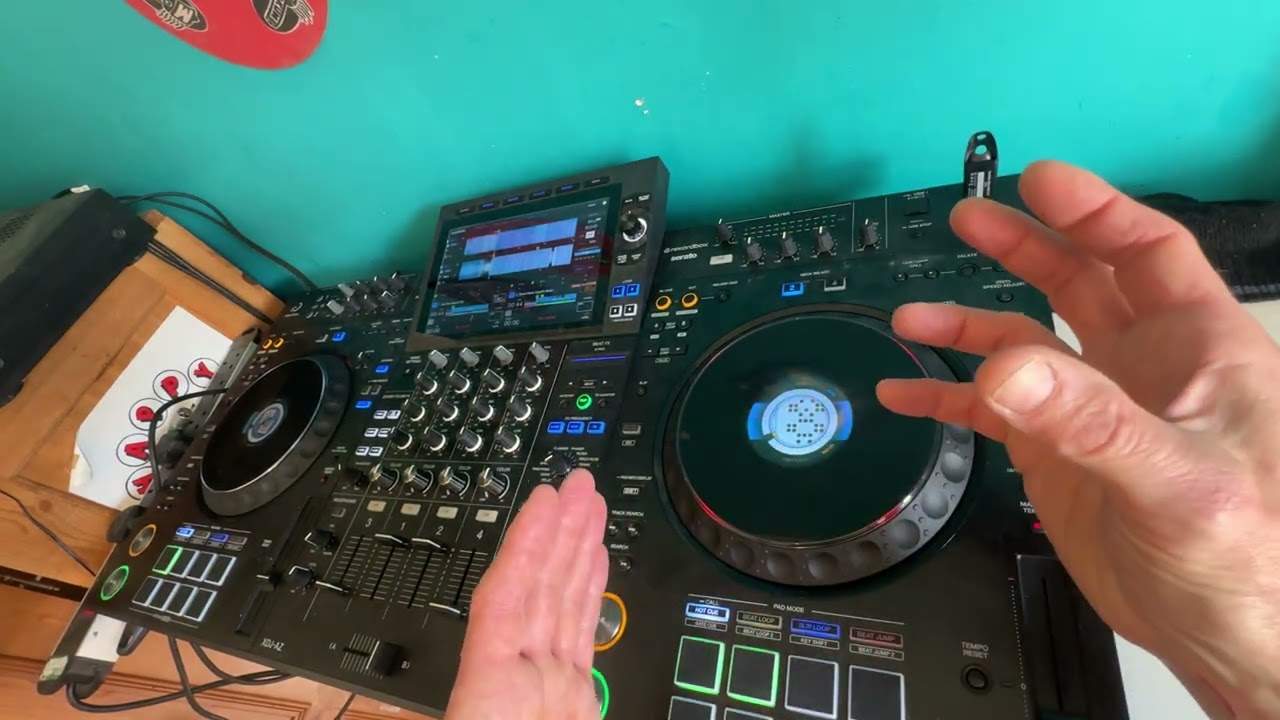
All right, ladies and gentlemen, this video is all about keeping the bass line flowing. We're going to do a transition from one track to the other. We're going to bring in the track on the left into the track on the right. The track on the left, this side here, is by the Groove Shifters. It's a track entitled Louise. It's the Dirty Harry re-edit. And on the right-hand side, we're using the Mihalis Safaris, spelt M-I-H-A-L-I-S, and then Safaris S-A-F-R-A-S, Papaya, which is P-A-P-A. It's the original mix. That's on Skint Records, and they're both from CD Paul. So what we want to try and do here is keep the vibe going by keeping the bass line continual. But we don't want to have bass lines over bass lines, or we don't want to in this transition. I don't want to have a bass line overlapping. So in other words, imagine my hands are the two bass lines. I don't want it like that. I want it like that.
And so, bass line finishes, bass line begins. Or for this particular lesson, the bass line will finish on this one and the bass line will start here. So first of all, let's have a listen to the end of Papa. It's Papa, beg your pardon. Yeah, sorry.
1:24 Coming up to the last 30 seconds
So. If you're wondering what the bass line is, it's that sort of sound in the back going, woo, woo, woo, woo, woo. That's our bass line.
Okay, coming up to the last 30 seconds. And again, when you're into the last 30 seconds, you've roughly got around about 16 bars left. So I'd say pretty much 16 bars from that, have a listen. As soon as you get that, bass line stops.
There. It doesn't really matter about how much we've got left. What we want to do. We want to try and make sure that the bass line starts in this track when the bass line finishes in this one. So what we need to do, we need to count from the beginning of this track how many bars we've got to the bass line starts. And then when the bass line finishes here, we just need to work our way back. So, for example, 16 bars, bass line. From that point, I just showed you, we need to work back 16 bars, start that one at that point. Believe it or not, bass line finishes, bass line starts. So, let's have a listen to the groove shifters. As soon as we get that first kick, I'm going to start to count bars. One, two, three, four.
One, two, three, four. One, two, three, four. One, two, three, four. One, two, three, six. There's our bass line. So we have 16 bars before the bass line comes in quite sure we've got 16 bars after that point where the bass line stops. But we want to now go back. We want to find out. We want to work back 16 bars from the point where the bass line finishes. So let's have a listen again from there, there. Now I'm going to give a rough guesstimate. If we go to that break, just going to form a hot cue there and use that as a reference point, there. Three, four, one, two, three, four. One, two, three, four. One, two, three, four. One, two, three, four. One, two, three, four. One, two, three, four. One, two, three, four.
4:32 A certain part of this mix you probably wouldn't hear straight away
One, two, three, four. One, two, three, four. One, two, three, four. One, two, three, four. Sausage, beans, chips and mash, eggs, potatoes, fried onion, peas, chips, bananas, apples, sausages, apples, bananas, chips and peas. There you go. Right. So we've got 16 bars. So of course from this point here that's where we start to bring our other track in. Now I'm not going to be using headphones here. What I'm going to do now is I'm going to go back a little bit before that cue point and I'll just bring it straight in. So I am using the BPM readouts there, so go to A. OK. Now a certain part of this mix you probably wouldn't hear straight away. You know, the DJ would be starting to bring the track in. So what you're about to hear now is let's say for example the DJ may be just doing the first part of the mix on the headphones.
Now maybe the DJ's got it mixed in. So now start to bring the volume up. I'm taking the bass away on this track, but of course I want to make sure that I've definitely got the bass up on the track coming in because if I didn't have the bass up I wouldn't be hearing the bass line. There you go. It's a perfectly beat match. That's not the point of this video. This video was showing you how simple, I mean how simple it is to form transitions perfectly. By just counting your bars and phrases. Hope that's been a help. Go check out CD Paul's practice and enjoy. Thank you.
This transcript was produced automatically from the audio of the video and may contain mistakes.