 4:32
Mixing rock
On YouTube this video is called DJ Tutorial, How to mix Rock
What this lesson teaches
A frequently requested subject and he does not pretend it is easy.
The first problem: real people
Rock is made by bands. Ask a drummer to play at 120 for an hour and they will finish at roughly 120, having fluctuated the whole way.
So everything from the funk and soul lessons applies: no correct pitch setting, continuous correction, short overlaps or none.
The second problem, which is worse
This is the one specific to the genre and he is right to raise it.
There is often nowhere to mix.
A house record gives you a long drum intro and a long outro. A rock record frequently has neither - it starts with the whole band and ends with the whole band, and the middle is a guitar solo with everything playing underneath. There are not many instrumental breaks and not many passages of drums alone.
So even if the tempo held perfectly, there is no window. You cannot bring a record in under a full arrangement without it sounding like two records playing at once, because that is what it is.
What you do instead
The mobile DJ answer, which is the right one:
Cut. On the one, at the end of a phrase, with the next record arriving at full volume.
Fade out and bring in. Let one finish, start the next. Entirely respectable and frequently the best option.
Use the intro and the outro you do have. Some rock records start with a drum fill, a riff alone, or a count-in, and those few bars are your window. Know which of your records have one.
Stop dead and talk. If there is a microphone, a clean stop on the final chord is better than fading awkwardly out of something that was not built to fade.
The honest summary
Beatmatching two rock tracks is not impossible and it is rarely the right goal. The skill with this material is selection and timing - which record follows which, and landing the change where the music says it should go.
Contents of the video
0:00 Very briefly, a drum machine will be able to keep exactly the right BP
Right folks, had a whole bunch of emails from people asking me how to mix rock music. Now I have delved on this subject in the past but rock music is made most of the time by a real band so how to mix it? Well it's rather difficult. If you mean mixing as in mixing one track beatmatching it into the other one then I'm not saying it's impossible but it's very difficult because we're dealing with real people not a drum machine. Very briefly, a drum machine will be able to keep exactly the right BPM. In other words, if a drum machine starts here at 120 BPM, an hour later it will still be at 120 BPM. If you ask a real person to play, to start at 120 BPM and play for an hour, in other words, a person, you ask them to play the drums, start at 120, after an hour finish at 120, they may be able to finish at 120.
1:27 Any of the mobile DJs out there hopefully will know where I'm coming f
But I bet you they'll fluctuate very slightly. So of course it's quite difficult to mix one rock track into another rock track, or maybe one old school disco track into another old school disco track. Also, quite often in rock music there aren't that many places where you can mix the tracks together, there aren't many instrumental breaks, there aren't many areas where you've just got the drummer so you can bung one track out and another track in. So how do you do it? Well, any of the mobile DJs out there hopefully will know where I'm coming from. What you generally do in a mobile environment is not mix. You listen to the track, you listen to the key, the tone, the sound of the track and at one point where you've got a certain tone, you'll bung the next track in. Now, a lot of turntablists will do something called chopping. They'll have one track here...
And they'll play that and then they'll use the crossfade, bang, straight over and they'll bring the next one in. So, they'll be in time, they'll be in beat, but instead of having a mix, they'll go one track, bang, to the other. So, instead of having one track, two tracks as in the mix. And when I say two tracks, if you think about it, the one track that's playing is number one. When you're doing the mix, it's almost like the second track because you've got track one and track two. So this is the second track. And then the third track in a sense is the second track coming in. That's the difference. Or should I say this is the difference with chopping because you've just got the one track and then you go bosh straight into the next track.
2:47 In this demonstration, hopefully I'll show you what to do
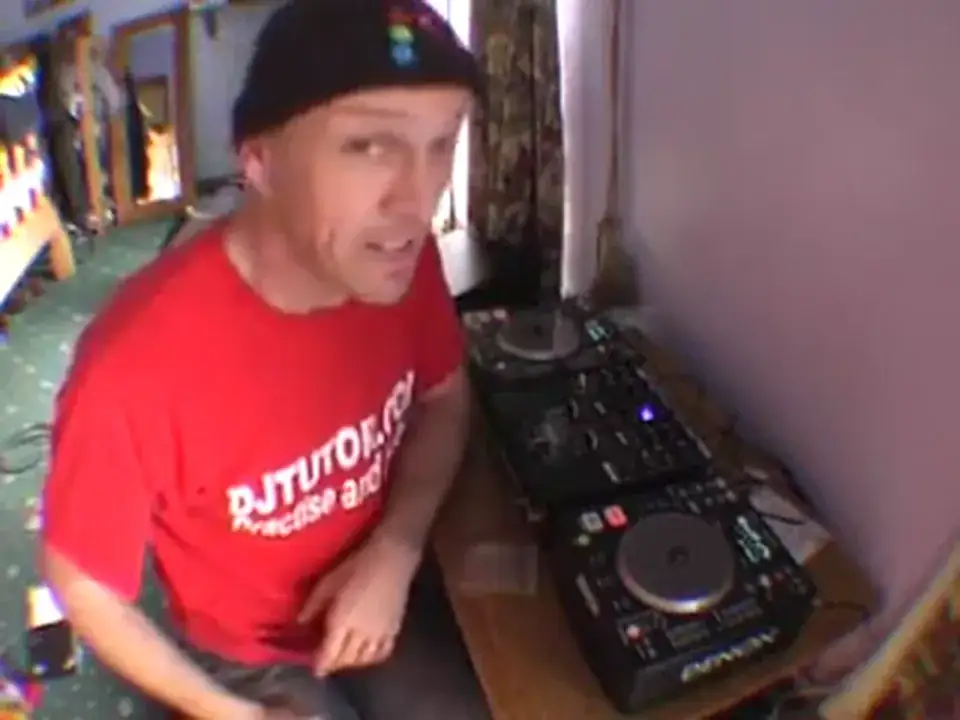
If you think about it, the likes of the old school music, 60s, 70s, 80s, because the beats fluctuated quite a lot, it's very difficult to beatmatch them. So instead of trying to beatmatch them... And having them going all over the bloody place, you might as well go bang straight over. So in this demonstration, hopefully I'll show you what to do. The two tracks we're going to be using are the Animals and then there's this one here, Bad Company Can't Get Enough. The Animals is Gotta Get Out of This Place, so have a listen. And this is the next one. So, right. Now if you imagine we're playing this one. And you're there and you're twiddling your thumbs and you're holding your microphone wondering what to say and whatever. Right, what we'll do is we'll wang this one forward a bit. It's all finding the right place and bringing the next one in. You don't have to beatmatch it. Just think on these lines and you can't go wrong. Right, just enjoy. Thank you.
This transcript was produced automatically from the audio of the video and may contain mistakes.