 8:56
Cutting breaks and breakbeat
On YouTube this video is called DJ Tutorial on cutting music known as Breaks, Breakbeat
What this lesson teaches
Breaks is drum-led music, and cutting it is a different discipline from blending house.
What breaks are
His placement is useful. Hip-hop is slow. Drum and bass is roughly double-time hip-hop. Breaks sit somewhere in between.
What they have in common is that the drums are the content. Not many vocals, not much melody - a lot of drumming, and the lineage runs straight back to James Brown's Funky Drummer, reconstructed with a drum machine and layered with everything since.
The reassurance
If you cannot find the one in this music yet, he says what needs saying: it is there. Anybody who can count bars can hear it, and if you cannot yet, you will.
That is the same point as the drum and bass lessons. Unfamiliar rhythm reads as absent rhythm, and the fix is exposure rather than cleverness.
The setup, which is the technique
Three things, and together they are what separates cutting from fumbling:
Both channel faders fully up. You are not using them. They are set once and left.
Everything on the crossfader. One control, moving side to side, doing all the work. Your hand never has to decide which fader to reach for.
The crossfader curve set sharp. This is the important one. With a sharp curve, a tiny movement of the fader brings the other track in at full volume immediately - which is what cutting requires. With a gentle curve, the same movement produces a fade, and a fade is not a cut.
Why that arrangement matters
Because cutting is about when, not how much.
Every decision is a moment: now, or an eighth of a beat later. Any control that introduces a gradient between the two states is working against you, and any arrangement that requires choosing between controls costs time you do not have.
Set the faders, set the curve, and then the only variable left is timing - which is the thing you are actually performing.
Contents of the video
0:00 This video is all about mixing, or really I should say cutting
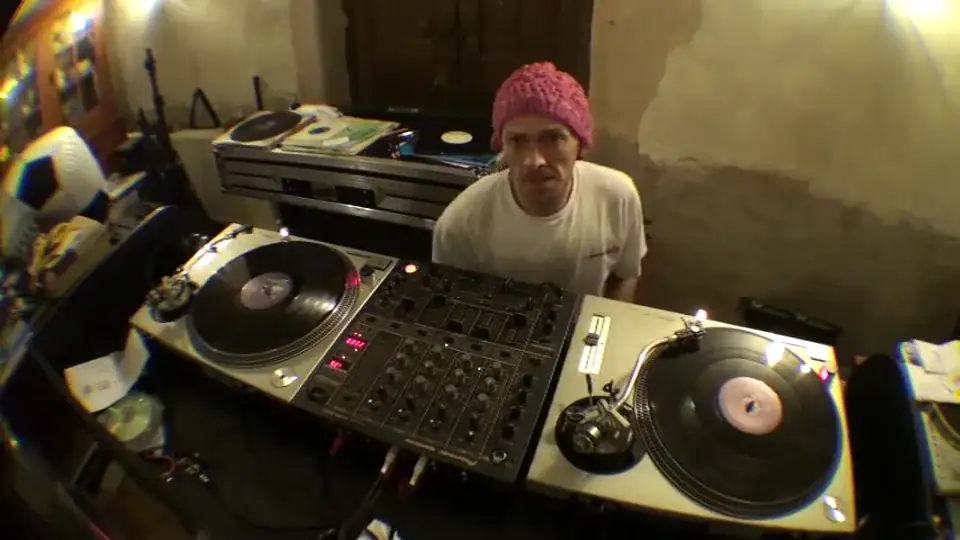
Alright folks, this video is all about mixing, or really I should say cutting. Cutting what are known as breaks. Now for a lot of people out there, you know what breaks are. Quite a few you don't. Well breaks is not dissimilar let's say to the likes of hip hop or drum and bass. Hip hop, very slow, slow BPM. Drum and bass is almost the equivalent of double time hip hop. Somewhere in between really. What we're dealing with here is not necessarily loads of vocals, loads of melody, but we're dealing with a lot of drumming. Now if you imagine, let's say we have the godfather of soul James Brown and he had the funky drummer play that fantastic beat. If you can imagine a modern day version of the funky drummer beat but done with a drum machine and then adding loads more influences
1:59 Mainly this particular tutorial is about something called chopping
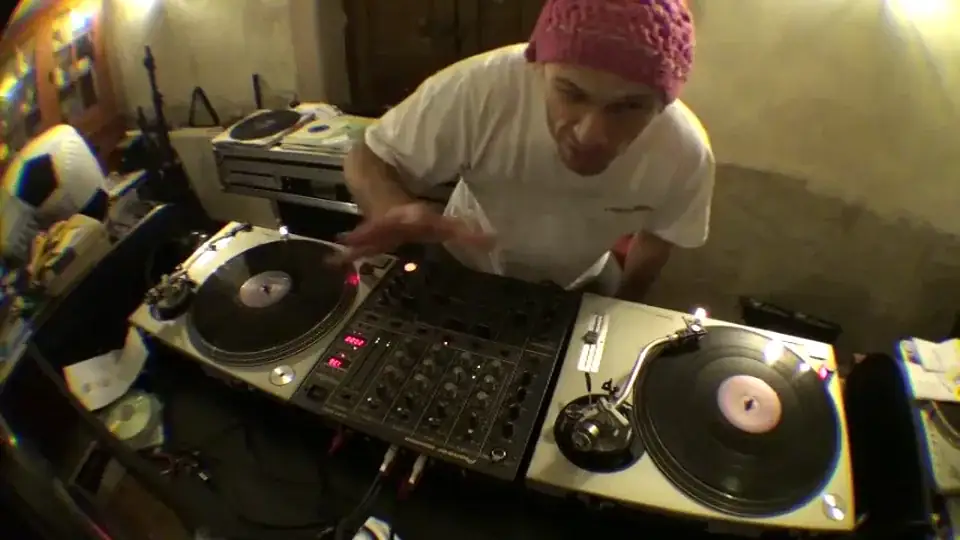
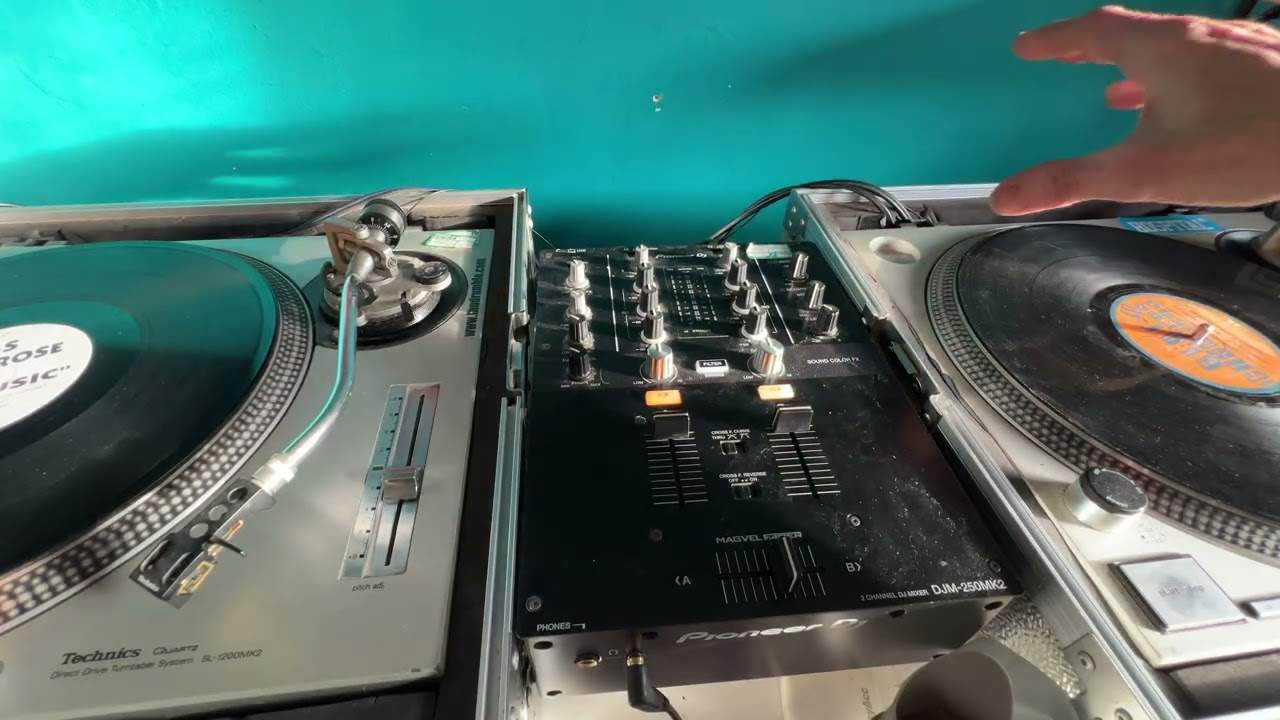
Thanks for watching, and I'll see you next time. Electro Tech Superfly. Now first of all, I'm going to play you a little bit of the hybrid track. Let's have a listen. This one is entirely burning. Now to the discerning ear, you're probably thinking, how do you count bars? Where is the timing? Where is the 1, 2, 3, 4? Well it's there. It's there. For anyone out there who, you know how to count bars, you can hear it. For the people out there who can't count bars, you'll get it eventually, don't panic. Let's put the track on a little bit. Right, mainly this particular tutorial is about something called chopping. Now what we've got here, we've got two sliders, I've got them both up. Two turntables are Technics SL-1200 and the mixer SL-1200 Mark II. The mixer in the middle is the Pioneer DJM-600.
Two faders all the way up to the top. What I'm going to be doing is using crossfade, going from one side to the other. Now where's my piece of paper? I've got the crossfader curve set to that. There's a good reason. I want to be able to go from that track and as soon as I move the crossfade over, a tiny amount, I want this track, bang! Now normally when people cut, they get in a rut. That rhymes. Because what they tend to do is they count 1, 2, 3, 4 and they'll do this, 1, 2, 3, 4, 1, 2, 3, 4, 1, 2, 3, 4, like so. Alright you can do that but with breaks, like I said if we go back to the funky drummer there's a lot more into it. House beats you've just got boom, boom, boom, boom. With breaks... There's more going on. You've got loads of hi-hat, loads of bass drums. It's a whole mishmash of music, mainly a mishmash of the beats. So what you can do, you don't just have to do 1, 2, 3, 4, 1, 2, 3, 4. You can do 1, 2, 3, 4, 1, 2, 3, 4, 1, 2, 3, 4, 1, 2, 3, 4, like so.
4:28 We'll listen to this guy now, which is Electro Tech,
You're almost getting to the stage whereby you're being a bit of a turntablist, but only on the crossfade and you're going from one to the other. Now of course you've got to get them in time, the tracks have got to sound relatively well together. When I say in time, counts are beat bars, 1, 2, 3, 4, 1, 2, 3, 4. So what I'll do now is play you a little bit of this and we'll have a listen to this, listen to that. There's no mixing involved here, it's what's known as chopping from one side to the other. Also sometimes it's known as cutting. So we'll listen to this guy now, which is Electro Tech, a track entitled Superfly. Here we go. What I'm going to do is get this one ready at a beat where I know it's suitable to bring it in. Now that is the count of one. Let's have a listen.
7:26 This one's playing, we're bringing this one in
Okay, we'll go back over to this guy here. And I'll start it just after this small break here. Here we go. Here we go. I'm going to start this one here. One, two, three, four. One, two, three, four. So, into the test. There's one way we can actually mix a track whilst we cut or chop. What I want you to imagine is let's say for example... This one's playing, we're bringing this one in. Well, when you're cutting you could make sure you've got this one playing most of the time and slowly start to cut this one in a little bit. Imagine a scale from 1 to 10. Well all of a sudden we're starting at number 1 and we're bringing this one in. 1, 1, 1. Eventually we're going to start to bring this at 2 or we're going to start to bring this one in more, more. But this one will be slightly less.
And then we're going to start to bring this one in even more, which means this one would be slightly less. And then in the middle, we're half and half, so we're actually going from this one to this one just the same amount. And then what we do, we start to bring this one in more and we use this one less. We start to bring this one even more and we use this one less. And then eventually at the last part of the mix, stroke, cut, whatever you want to call it, We're only bringing this one in a tiny amount. So in other words, we are using the crossfade, we are chopping, we are cutting, but we're actually doing a chop-cut mix. Now there's the difference. So you don't have to just go from here slowly over to that side. Right, what we'll do, we'll bung this one on... No, actually I won't play the third one. So I hope that's been a general sort of idea for you. And don't forget, if you've got any videos exactly like this, tutorials, stick them underneath.
Practice and enjoy. Thank you very much.
This transcript was produced automatically from the audio of the video and may contain mistakes.