 17:40
DJ WHY You Should Use Vinyl and Basic Scratching Lesson BY Ellaskins the DJ Tutor
Contents of the video
0:00 You want to become a vinyl DJ
Alright guys, so you want to invest in vinyl. You want to become a vinyl DJ. You've watched lots of DJs out there on controllers, CD players, iPads, Spotify and you just want to do it the real way. Well, is vinyl the real way of DJing now? It used to be of course because that's all there was unless of course you were... Very, very poor and I had to use cassettes like I did many years ago in a ghetto blaster. I won't go there in this video. But a lot of people are saying now that vinyl is coming back in. A few people are saying that it never died. Some people are saying that vinyl is a waste of time. Other people are saying that you're a muppet if you start using vinyl because you're going to have to carry around loads and loads of boxes of records.
Other people like to use vinyl. There are some DJs out there, possibly you, who have got what's known as DVS, which is virtual vinyl, and you've never touched a real piece of vinyl in your life because all you're using is virtual vinyl. There are some people who will still only use vinyl. A piece of vinyl in their lives. And if you showed it to them, they'd wonder what it was. And in fact, I can relate to that going back many years to a car boot sale when I was selling a few of my picture discs that I didn't want anymore. I remember two young ladies walking past me going, what are those? It was scary! But vinyl still has a warm feel. It still has a natural sound. And there are nightclubs out there that will pay...
2:49 It's a work of art
A DJ more if that DJ uses vinyl. So, let's have a look. Here we have a Technics SL-1200 Mark II which is pretty much or was and still is pretty much the industry standard for vinyl users. It is robust, it is solid, it is a chunky piece of metal and hardened plastic and rubber underneath. It's very, very heavy. Yet, believe it or not, mobile DJs, if you earned a bit of money and you were a professional mobile DJ, if you were a posh mobile DJ, you didn't go around with a console all in one with belt-driven turntables, you had Technics. Oh yes, come on! I mean, look at it. Look at it. It's a work of art. And no, that light does not work. In fact, after a few months, the little cue light there stopped working. And you know what? If you had to fix that, which I did many times, it was an absolute bloody nightmare. You have a small bulb inside there and you'd think, oh, just take that out. Nope.
You had to turn it upside down, take everything off here, undo all the screws, find it, pull all the little cables out and put a light bulb back in. It took about five years. It was a nightmare. And then of course the pitch. If the pitch wore away you had to replace that. And again you had to take everything off here, turn it upside down, take the feet off, unscrew all of the bits. Unsolder the thing and dip the back in and oh dear, the worst thing I ever did though was I had to rewire the little wires. In fact it was the earth wire going through the arm and it was a nightmare but a tip for you if ever you have to rewire the little cables in the arm just remember this what you do is prior to pulling all of them out
Okay, because you have to unscrew the housing and whatnot and unsolder underneath here. You'll know what I'm on about if you've done this or you know what I'm on about. Forget that. But what you do is prior to pulling the cables out... You get a small piece of twine and you somehow, I used to use, I used to tie it and then a bit of sellotape but a tiny amount so piece of twine to all the cables and then as you pull the cables out guess what that piece of twine then follows the root of the cables and you leave it there You attach the new cables, pull it back through and there you go. Your new cables are in exactly the same position as the old ones were. So, vinyl. This turns at two different speeds. 33.3 and 45. 33.3 revolutions per minute.
5:11 .3, sorry, RPM or 45 RPM, 45 revolutions per minute
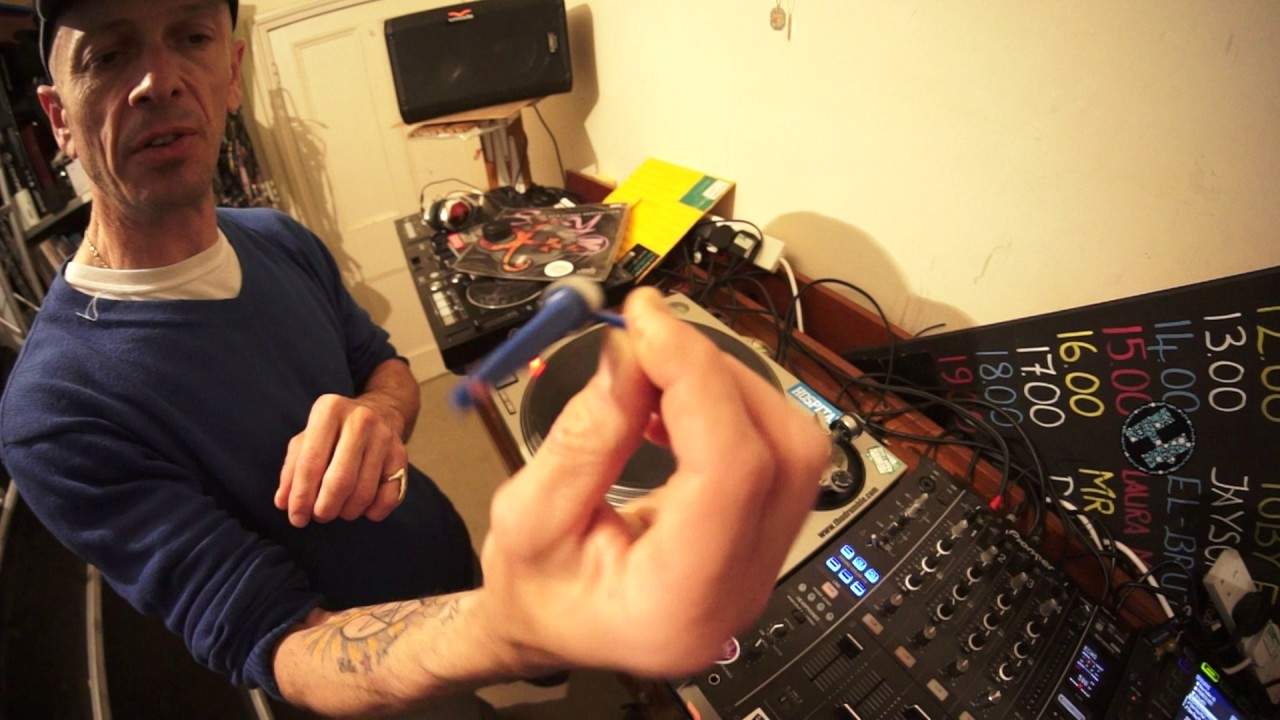
.3, sorry, RPM or 45 RPM, 45 revolutions per minute. Now the sound of vinyl is more warm, it's definitely sort of, it's got a warmth to it, it's got a grime, it's got a bit of a grumble to it, a rumbly grumbly kind of sound. A lot of that is down to how you set your needle. Also known as the Styli, I'm going to take that off and give you a closer look because it's the camera's actually a bit far away from there isn't it. Let's have a look at this masterpiece and there it is. This is an Autofon Concorde Styli cartridge and what I like about these is there's no need to set the level, the height or add weights onto it. That is perfectly balanced and set. Put that in there. If ever you had any problems with loose connections, what I generally did or still do now is blow and you have four pins on the back of the cartridge. Rub them on your jeans, push it back in and that should form quite a good connection again. So I'm just going to get to the scratch sound which should be here.
6:37 Correctly, scratch sound, small wobble
There, scratch sound. Now also there used to be a problem which there still is, of course if you use vinyl, of the record wobbling quite a bit in the middle. Now this is down to the holy bit in the centre either being too big or too small. If it was too small it didn't wobble, it just wouldn't spin properly so when you held your piece of vinyl... Everything could slow down including the turntable as well and then when you started, when you wanted to push the piece of vinyl off it would go which you don't want. So one way to compensate for that if the hole in the centre was too small what I would do is I would get a pencil and I would not ram it in, I would gently just press it in. What you're doing is you're just easing the plastic away
To give it a little bit more room. Now we are talking about fractions of a millimetre, not one or two millimetres because you don't want that at all. Now I don't know if you can hear this, have a listen. Now that is, the hole is too big there, OK? So a way to compensate for that was a piece of paper and I put the piece of paper in the centre of the hole and of course you've got to, it's trial and error really to get the right size. Too big, too much tension and it won't move so much. Too small and it's still going to wobble. So that's pretty good now, so I'm happy with that. But the needle on the record, the drum beat goes like this. OK, and we have a scratch sound. This scratch sound is one of probably the most well-known samples of all time. Ah, this stuff is really fresh, have a listen. Brilliant. And apparently...
The original sample of that was from an old school French record in the 70s or early 80s, I think. Don't quote me there. OK, so we've talked a little bit about vinyl and there is a lot more to it. I mean, I could go on and on and on. In fact, there could be millions of videos out there which I'm sure there are on vinyl. But to make sure that the needle doesn't jump, you have to make sure you set the arm correctly. The height, the weight at the back. Now I don't know if you can see, I'm going to go a little bit closer again. I do apologise I've got a wide angle lens on here. But can you see at the back of the tone arm there is the weight? Now some DJs would tend to turn that around and push it in so there's more weight at the front. Well there's actually no need. Other DJs would sometimes put a tiny coin on the...
10:04 Three four, extra weight, adding extra
If you set all of the arm correctly to begin with, then there would be no need to put jack SHIT on the styli because everything's set correctly. So think about it, no wobble, set correctly, everything's level, then there should be no need to put any other weight on the top of the... Also by adding extra weight to the styli, you are then in turn adding extra weight to that tiny pinprick of a point on the end of the needle. That is of course a diamond and diamonds are very very strong and they tend to scratch things so of course the more weight you've got on the diamond tip the more Chants you will have of wearing out your piece of vinyl in not so short a time, so always be careful. Right, I'm going to put a loop on here. The loop I'm going to be using by the way, hold on, hold on, I did say I was going to put a loop on. There we go, I think this is okay. Yeah, this one's okay. Alright, the tune by the way is Don Ray Mag.
Last in Love from Karmic Power Records. So, what we're going to do now is a very basic kind of scratch. This one's pretty much known as the baby scratch. So what I'm going to do is forward and back. Have a listen. That's it. One, two, three, four. One, two, three, four. I'm going to turn the low down on my mixer to around about the seven o'clock position. What that will do, that will help to eliminate the rumble sound because we don't need that anyway. When you're scratching, there's no need for a lot of bass at all. In fact, if anything, to compensate I'm going to increase the mid. Now can you hear? That is so... The sound is so much better now, more clearer. Let me turn the bass up, listen. Okay, so I'm moving it forward, forward, back, forward, back.
12:08 Forward, forward, back, back, forward, forward, back, back
Forward, forward, back, back, forward, forward, back, back. Something like this. You see, even that move can be done in many, many different ways. For example, the first time I did it, I had my hand on the vinyl all the time. Hand on my vinyl forward, hand on my vinyl back. When I moved forward twice and back twice, hand was on the vinyl. Then, I let the piece of vinyl move forward by itself and brought it back. And I was able to do that By of course having the platter move underneath the piece of vinyl. So the platter itself is making the vinyl go forward by itself, naturally, depending of course on the original speed of the turntable itself. And then I'm bringing it back to the original position. Here we go. So, alright, let's just do all of those moves randomly. Here we go. Slight different kind of move there as well. That may sound and look sort of difficult.
But in a way it isn't. I want you to now imagine yourself going... That's all I'm doing. Scratching, what tends to happen eventually is you're not thinking about the moves you're doing because over time your moves get faster and faster and if you think about this, if you actually thought about every move that you were doing You wouldn't be able to do it because your thought process would not be as fast as the moves that you're doing. That does make sense, okay? Jump slightly. And again. And also, a lot of professional turntablists who can do this a lot better than I can, their touch is very light. You have to have a light touch. You can't start banging the vinyl. As soon as you do, of course, the needle has more chance to jump.
15:31 Half time and double time
So again, if you want to start to learn how to maybe do a bit of scratching, start off with something simple, which is called the baby scratch. By the way, also I will put a link in the description to a very good friend of mine, Mr DJ Angelo, who is not only a very good DJ, very good at turntablism and scratching, but he is exceptionally good at teaching you how to scratch and a bit of turntablism. So go and check. His videos out, also his channel. Information will be down there. Right, here we go. So, Baby Scratch. Double it. You see, you can try this. Half time and double time. Like I said, check out Mr DJ Angelo. And just to finish off with this video, he's never died. Practice and enjoy. Thank you for watching. Don't forget to like and subscribe. Thank you.
This transcript was produced automatically from the audio of the video and may contain mistakes.