 23:52
The drum and bass double drop
On YouTube this video is called Drum N Bass Double Drop Tutorial
What this lesson teaches
A long session covering several things, with the double drop as its centrepiece.
What a double drop is
Two records running together, phrase-aligned, so that both of their drops arrive at the same moment.
The effect is not two tracks playing at once. It is one event twice as large as either record could produce alone - and because the drop is the structural centre of a drum and bass track, doubling it is doubling the thing the whole genre is built around.
It is one of the signature moves of the style, and it exists in drum and bass more than anywhere else precisely because drum and bass is organised around drops in a way that house is not.
What it requires
More than it looks, and all of it is preparation rather than hand skill.
Both tracks beatmatched properly, and holding, for however long the run-up takes.
Both aligned to the phrase, not just the beat. Bar one of each has to be in the same place, or the two drops will land a bar apart - and a bar apart at 174 BPM is still obviously wrong.
Both drops known in advance. You have to have counted each record and know how many bars from where you are to where it detonates. There is no finding this in the moment.
So it is a planned move. The spontaneity is in deciding to do it; everything else was worked out at home.
When it fails
Two ways, and they are worth knowing before you try it in public.
The drops are a bar apart, which sounds like a mistake because it is one.
The two drops do not suit each other. Even perfectly aligned, two enormous basslines in unrelated keys arriving together is noise. The pairs that work are ones somebody tried at home and remembered.
And the counting, for newcomers
He spends part of the video on the basics again for anyone who has never heard drum and bass - where the beat is, how to count it, and the reassurance that it is there even when it does not sound like it.
That combination is characteristic of the series: an advanced technique and a beginner's explanation in the same video, on the grounds that somebody watching will need each.
Contents of the video
0:06 We're going to do loads of stuff, whi
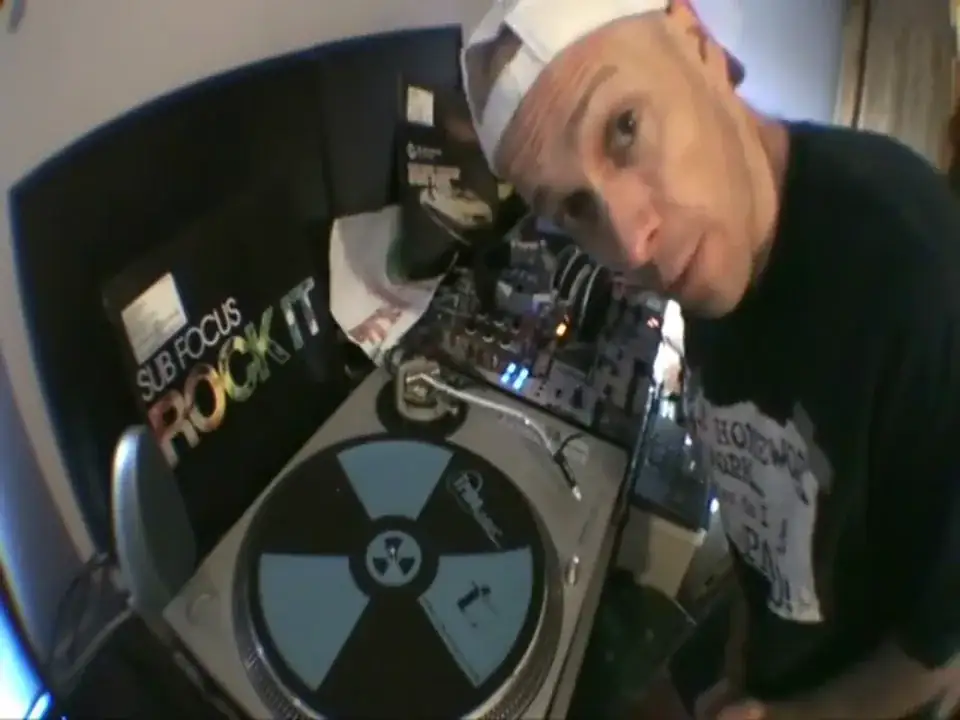
Alright guys, now loads of people have been asking for more tutorials on mixing drum and bass. So what I'm going to try and do is incorporate loads of stuff into one video. So this particular video could go on for like a long time or it could go on for a short time. It might even go on for a middle bit of time which in other words is not long or short. That there is Subfocus Track Entitled Rocket and it's like mmm. That one there is Turkish Delight Speed Freak and that's even mmm as well. And that one over there... It's the other one we're going to mix in. We're going to do loads of stuff, which is great because it's not... I mean, stuff. Yes, right. Okay, so, first of all, let's give this little spinny sucker a turn or turny sucker a spin. Stuff. Right, here we go. Check it out. Now, a lot of people have been asking about double drops as well, so we're going to do that as well. Also, I'm going to try and incorporate, make this video for someone who is like really new
And it's never really even heard a drum and bass. Now, for the discerning ear, you're listening to this and you're thinking, where's the beat? Well, it's there. Two, three, four. One, two, three, four. One, two, three, four. Now that's all well and good, but where is the beat when it's like over here stuff? It's lots of stuff. It's like stuff and stuff. A lot of people are asking me, how on earth do you count the beat in drum and bass? We don't count the one, we count the two, no sorry, the one, two, yeah, and the four, beg your pardon. So you're like, one, two, three, four, two, three, four. Now if you imagine a set of drums, you've got the hi-hat, bass drum, and you've got the snare. You're actually going to count the snare. One, two, three, four. One, two, three, four. Let's have a listen.
2, 4, 2, 4, 2, 4, 2, 4, 2, hold on, just talk amongst yourself for a second. I need a pen, a red pen, look. See that's not going to come off for ages now. Okay, we've got that one sorted. Right, what I'm going to do is I'm going to get this one here and I'm going to put that over there into building and let's have a listen. Same thing. Right, there's a lot going on.
2:54 They're either doing the curly wavy sort of
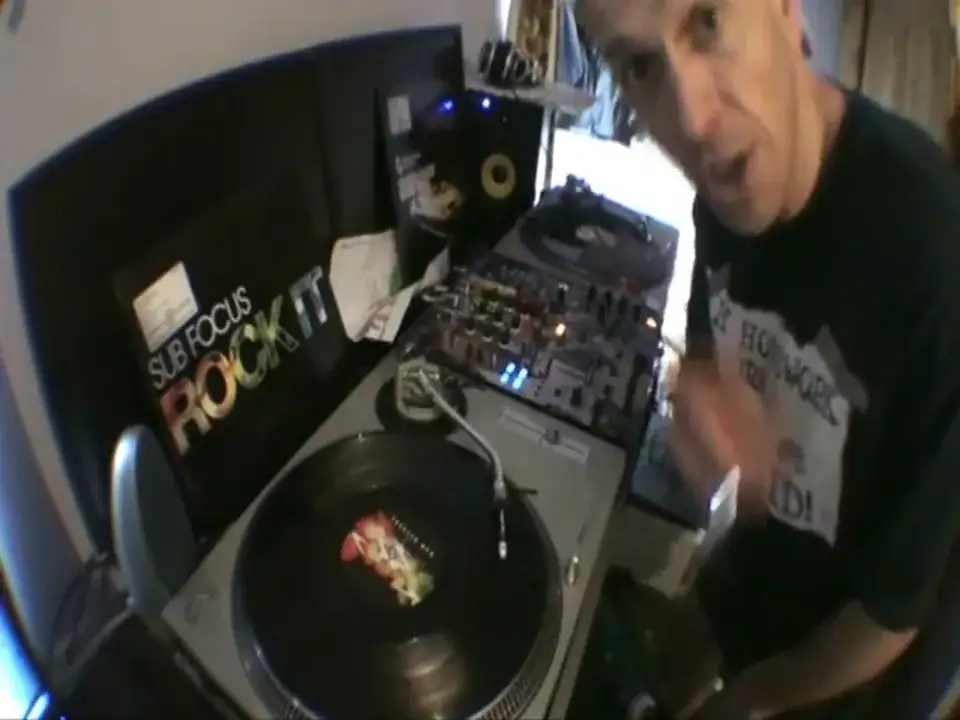
Now, notice there I was counting exceedingly fast but also very slow because in a sense I could have counted at double time or half time. Have a listen again. Now, when you see people dancing to drum and bass, they're not muppets. They're doing one of two things. They're either doing the curly wavy sort of... which is they're actually dancing to the one. Two, three, four. They're the more sexy people who just want to go, yeah, bump and grind. Whereas the ones who are on A, B, C, D and N probably lots of tablets and stuff. One, two, three, four. They're the mental ones. So, oh dear, calm down. Right, okay, so same with this one. Here we go. One, two, three, four. One, two, three, four. One, two, three, four. One, two, three, four. One, two, three, four. One, two, three, four. One, two, three, four. One, two, three, four. Oh! One, two, three, four. One, two, three, four. Now again, drum and bass. Yes, hip-hop. Think about it. Listen. Wicky, wicky, wicky.
4:38 Let's mix these two in together for a start
That's a scratch. Or the likes of Dubstep, you know? That's a really bad track. Right, so let's mix these two in together for a start. So even there. We've got a beat, so if we start... I'm just going to start counting at this point anyway. 2, 3, 4. 1, 2, 3, 4. 1, 2, 3, 4. 1, 2, 3, 4. 1, 2, 3. Now sometimes with drum and bass, just because you hear that first beat doesn't necessarily mean that's the count of one. You need quite often sometimes to find the count of one, work your way back. And it could start on the count of two. Sometimes they can be really awkward sometimes. One, two, three, four. One, two. Right, we'll get this one in. It's a basic mix, but what we're going to do now is something called a double drop. Now, first of all, if you imagine I have... Hold on, I'll explain a double drop. It's quite simple, alright? That's one of my inhaler things and that's a pen. Watch!
7:09 One is that you let them drop at the same time
That's a double drop because guess what? I let them go at exactly the same time and they sort of theoretically fell at the same time. Now that's all well and good, but you do sort of have like two or three different kinds of double drops. There's one when you start them both together and let's say they hit the floor at the same time. That's the best one because theoretically the time in between them leaving and hitting is exactly the same. But of course that's based on two things. One is that you let them drop at the same time. And the other one is that they hit the floor at the same time. There's no steppy bits. Now, I want to show you this. Let's imagine this printer here is a step. So there's a printer, a step. Now, I'm going to drop these at the same time. Now, guess what happened? I just broke my printer. No, what actually happened was the pen hit the printer first and then the boxy thing hit the floor second. So in other words, that was sort of a double drop.
Start, but not a double drop finish. Alternatively, we could do it this way. I could start off like that, that there, and that there. So, based on the distance between here and the floor, the topper here and the floor, if I have the distance the same here, like so, they should hit the floor and the... I've broken it twice now... at exactly the same time. So, right, I'm just going to put that back over there. Just like that. Right, so I need to get a longer standy a bit because this isn't really long enough, said the bishop to the actress. So, right, oh dear, it's funnier. Right, so at this point here is the point precisely here in this building where I'm going to do the double drop which is there. But of course we need to count. So, where's my county piece of paper? There it is.
Cantey piece of paper, pen, that's what I wanted. Right, so what I'll do now is I will put that there, that on there, and you can come over here a second. Right, just stand there. Don't move, or you'll be pissed. Sorry, it's this stand actually, because one of the legs broke and I had to sellotape it so it's slightly longer than the other one. Right, what I'm going to do is where we have that break, I'm going to start to count.
9:46 One, two, three, four
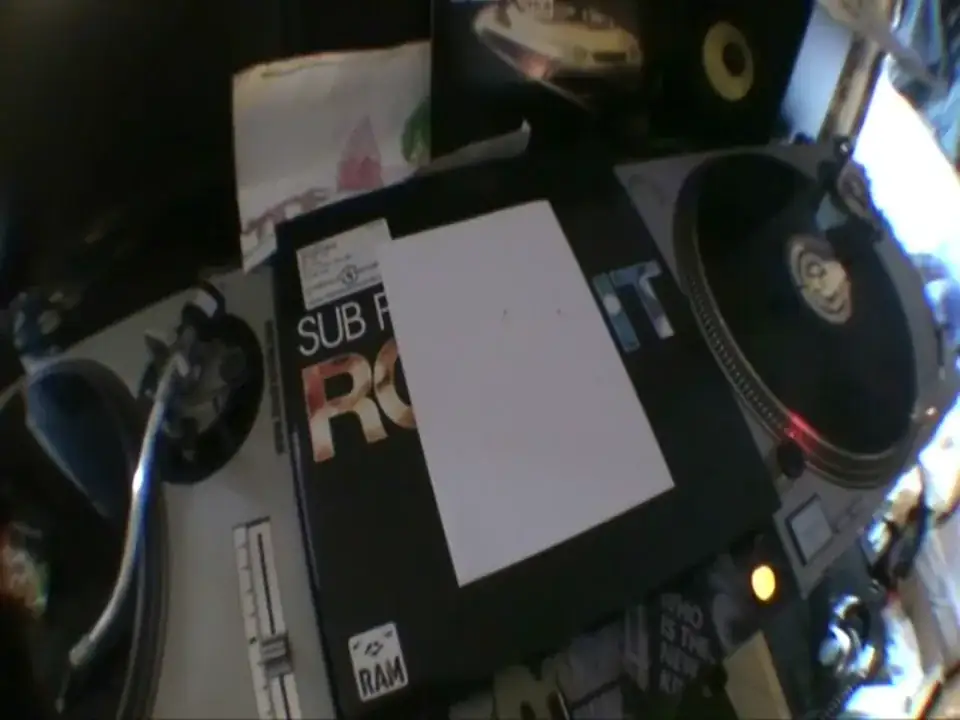
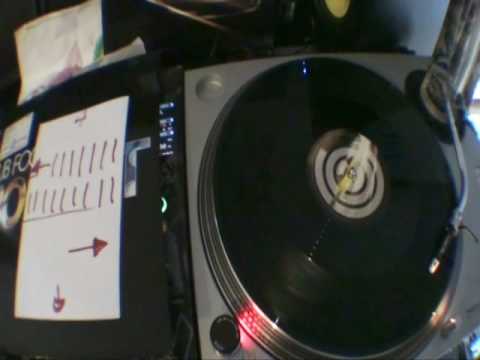
Precise point, I'm going to start to count one and then I'm going to start putting liney bits along here for bars. So if I just do an arrow that side, no it's not really an arrow is it? It's more like an arrow, an arrow that side so you will be able to associate that there and that there. I won't put one up there and I won't put, I've just done it haven't I? Right.
11:50 Your piece of vinyl, the shinier
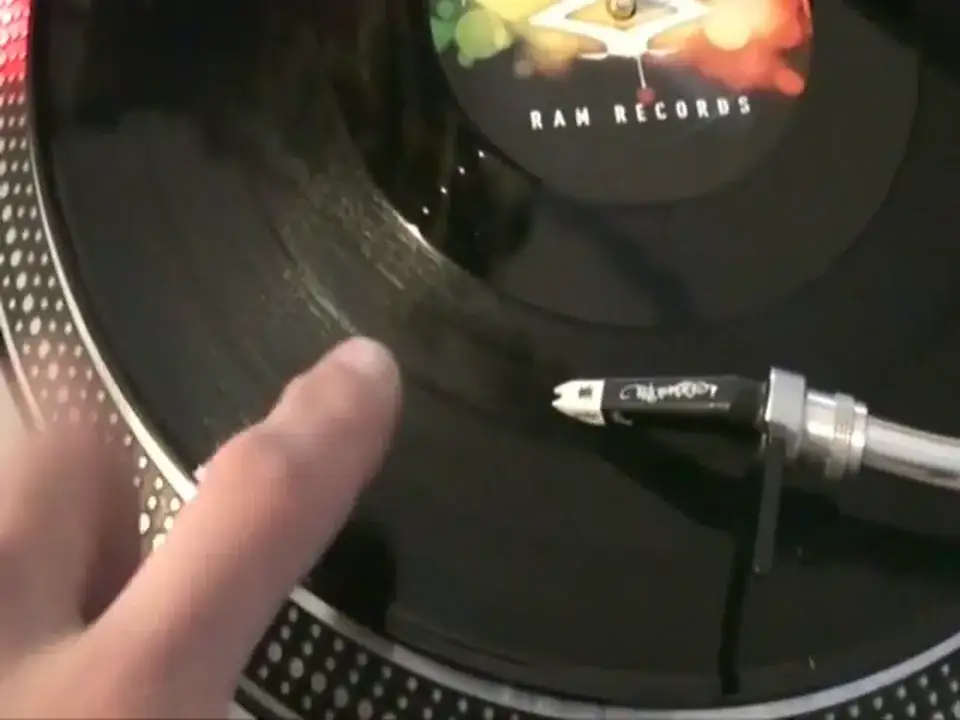
One, two, three, four. Now, we've got quite a few, but what you do find in the likes of 99.999% recurring dance music You get your bars into like sets, into phrases of maybe 4, 8, 16, 32. Occasionally you get a 2, very occasionally you get a 1, but to get a good rubble drop, rubble dibble, to get one of those things you need to sort of count stuff. Right, now very quickly as well, what I'm going to do, I'm going to make the camera go blurred because I'm going to try and do as much as I can in this tutorial so you can see exactly what's going on. On blue please. Right. Then if you can see that shiny area about there, now that is the area where we do have the drop. How do you know that's a drop? Well basically, if you look at your piece of vinyl, the shinier it is, the less information there will be on that piece of vinyl. In other words, what's happening is all of a sudden a lot of the music, a lot of the instruments and all the sort of knobbly bits going on in there will disappear. So in other words, if I put...
Oh, sorry, scratchy record. If I put that there... And also around here somewhere. See? Go blurred again, sorry. Oh no, it hasn't. Marvellous, brilliant. OK, let's put that over there like that. Right, we'll do the same thing to this one. Now as well, very quickly, sometimes it is sort of difficult to count. The actual break, because you haven't got many beats going on, so sometimes your timing may go slightly off in counting, but it doesn't matter, because what you will have is certain points in the music where you'll think, you know, you'll be counting 1, 2, 3, 4, 1, 2, 3, and something will come in just before you've counted 4. So in a sense, you need to use that as a metronome because your counting could be slightly off when you just have those whirly-curly bits as opposed to a beat. And what I mean by a whirly-curly bit is something like this. I'll put it up a little bit. See, no beats. Right, so... Start counting. Swing it back. Ten ready. One, two, three, four. One, two, three, four.
4. 1, 2, 3, 4. All right, I did go slightly wrong there with me putting me lines in and I put a line in sort of on not on the four do beg your pardon but Sorry, I'm just going to put this on anyway. Right, now I think I made a mistake there. Let's count. 1, 2, 3, 4, 5, 6, 7, 8, 9, 10, 11, 12, 13, 14, 15. Yeah, there is an extra one there, but believe me, it is 16. So, there you go. Right, that's life. You all make mistakes. Right, I'm going to put that there. Right, where are we? Nope, I don't want to do that. That's better. Pull that out. Nope, wrong way. There. Right, now basically what I need to do... is logic tells me, logic that if I've got the likes of 16 bars there and 16 bars there in the break, if I start them off right at the same time, then theoretically they should, guess what, finish at the same time. But you can't exactly, well when I say you can't, but of course what you have to do, you have to try and mix them together. You've got to try and get them beatmatched before you do that. Now of course it would be very difficult to get this one on the break and bump like that.
16:39 What I'm going to do now is find the break
And it would also be virtually impossible to do this, well it wouldn't be impossible but it'd be difficult to do the thing on the other one as well. What you need to do is you need to play them back so they're working together so the drop comes in at the same time. So of course to do that you have to find the drop and you have to work back a certain amount of beats as well. Now on that basis let's say this one here is playing and you want to mix this one in. There's no point trying to bring this one in at two bars before the break because you've only got two bars to match the tempo, the beats. And on that basis there's possibility of it going slightly off beat and that drop going... Not so much in, but out to be slightly off. So what I'm going to do now is find the break. Now I'm pretty sure I did 16 bars there and I'm going to do exactly the same over here. So let's find the big thing. Now this is going to be a rather nice experiment here because I just sort of like... Like that in my head. So theoretically what you need to do, if it does go slightly off, alright?
18:47 That point there, you'll notice I
If this does go wrong, then I'm just going to let it go wrong anyway because it means that everyone makes mistakes which is part of living really, isn't it? And then what I'm going to do is just imagine that I've counted back correctly. I will explain that again and then we're just going to let it ride. So what I need to do is start these two off exactly the same time. I'm going to keep that volume down on that one and then play that one so you'll only hear that one. I will hear this one through the headphones. As soon as I've got it beatmatched, I'll wang it straight up crossfingers. Here we go. All right. No, I need to put my headphones on there, don't I? Okay, so we sort of got it. I mean at the end of the day you are going to construct it slightly better than this because this is like a demonstration. So now at this point here if I take that off there and we have a look at that point there, you'll notice I haven't got much time left really at all.
21:22 We'll try something like that
So, I need to make sure I've got another record ready. I mean, if I'm going to have that one over there playing with this one together for a certain amount of time and I haven't got much time left there, I need to do a couple of things. One is I could possibly bring this one back in at the beginning and play the beginning of that and then as soon as I've started this one in with the one over there, bring the third track in. Alternatively, I've got to be blinking fast to bring the next one in. So, we'll try something like that. So, again, let's imagine, right, they're both playing together. In other words, what I did there is I made sure I had the third track ready because I only had a certain amount of time to bung that one in. Alternatively, like I said, if we imagine we have that track playing, we have this one playing, double drop kind of thingy, whatever. I mean, I could have done a couple of things. I could have, like, which I did, left that one on, brought that one in. Alternatively, I could have left that one on, taken this one out and put another track in on this side.
It doesn't really matter. Use your imagination. In other words, get outside the box. Don't copy lots of other people. Do your own stuff. Marvellous. Right. So what I could have done was double drop, play them both together. Oh, dear me. Oh my God, they're finishing. Right. Take that one off. No, sorry. Start again. Play them both together. Oh, they're finishing. Right. Get this one. Put this one right back at the beginning. Play the beginning of this one. Take that one off, and then while this one is still at the beginning, because everyone's heard it, they want to hear it again, then bring this one in. Use your imagination, and as ever, practice and enjoy. Thank you. I do.
This transcript was produced automatically from the audio of the video and may contain mistakes.