 7:39
Mixing dubstep
On YouTube this video is called DUBSTEP DJ Tutorial 1, Break it down.
What this lesson teaches
He is honest about why this video took so long to make: he owns almost no dubstep, and could only do it once somebody sent him some. The characterisation he arrives at is the sharpest in the course.
Built by subtraction
Start with a drum kit. Bass drum, snare, hi-hat - and in drum and bass all three are busy, layered and fast.
Dubstep takes that and removes the hi-hat almost completely. The snare is reduced to a trace. What is left is bass, and an enormous amount of it.
That is the genre in one sentence, and it is accurate.
What it means for mixing
This is where the characterisation earns its place, because it changes the EQ problem completely.
In house, the bands divide the work: bass holds the bottom, mids carry the tune, tops give it air. Pulling one band out of one record still leaves two carrying content.
In dubstep the content is almost all in the low end. Two tracks overlapping is two basslines against each other with very little else in the picture - and there is no equivalent of handing the melody over, because the bassline is the melody as well as the rhythm.
So the bass swap is not a refinement here, it is the whole transition. One record's low end has to leave as the other arrives, decisively, because there is nothing else to carry the overlap.
And there is no hiding place up top: you cannot bring a dubstep track in on its hats and mids while holding the bass back, because it does not have enough of either to be audible.
The rest of it
Broken beat, related to breakbeat and drum and bass, with real timing and a real format inside it - the work is finding that format and listening for it, exactly as with drum and bass.
If you can count one, you can count the other.
Contents of the video
0:00 It's on the lines of breakbeat and drum and bass
This is video number one in a selection I'm doing on mixing a type of music known as dubstep. Okay, people have been hassling me for ages about the likes of dubstep, how to mix it, what is it about etc. The only reason I haven't done any videos on it yet is because at the end of the day, I've got virtually none of it. And the only reason I can start doing something is because I've got this guy here. OK, I could buy some, but then again, you know, I can't buy every single genre. Right, dubstep. Now, it's on the lines of breakbeat and drum and bass. It does have timing, it can be mixed, and there is... There's a good format inside it, but it's all about finding that format and listening to it. Now in a sense the likes of dubstep is not dissimilar to the likes of drum and bass. If we listen to drum and bass you've got loads of... It's almost if you imagine the snare and the hi-hat in a set of drums. So you've got the bass drum... And then you've got the snare... And then you've got the hi-hat... Put them all together...
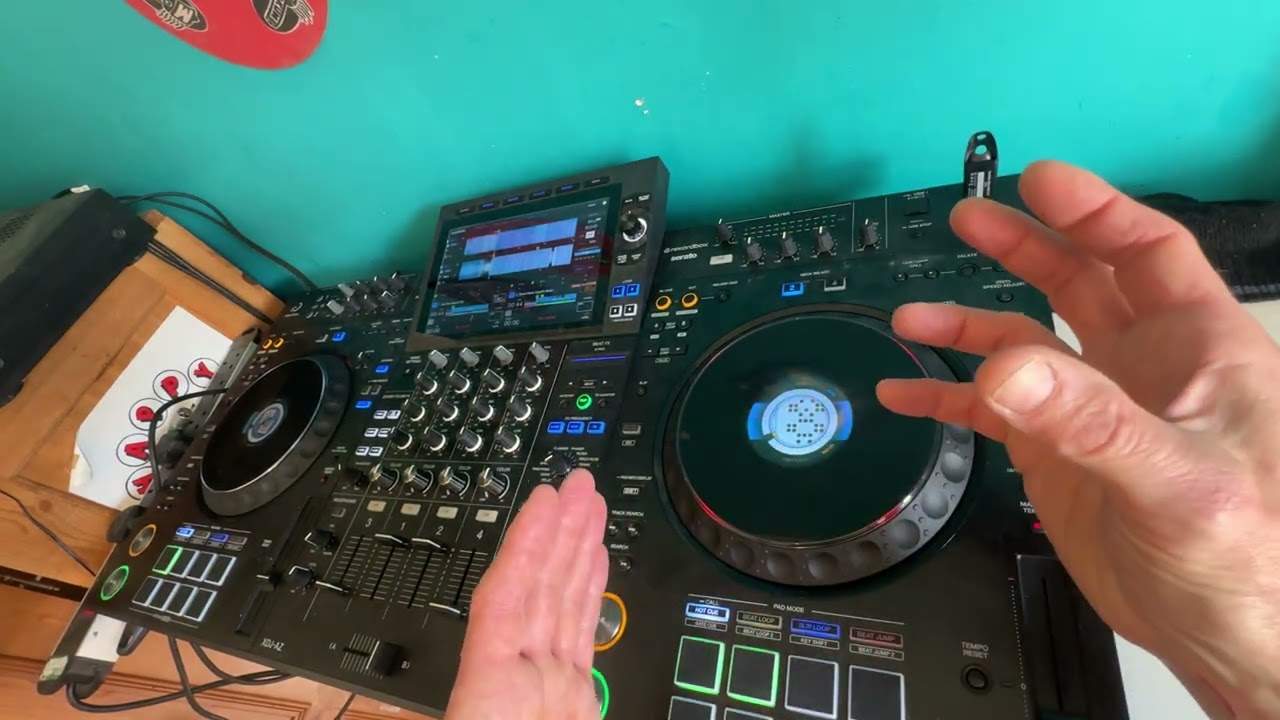
2:27 There's a link in the description, I'm using this guy here
Alright, okay. But the likes of dubstep, what we're doing is all of a sudden we're getting rid of the hi-hat. New enough completely gone. We've got a tiny element of the snare but more importantly we've got loads and loads of bass. That's where the emphasis is. Now I'm going to pause the camera and have a listen to a couple more tunes and then I'm going to rip them apart. There's a link in the description, I'm using this guy here. The first track you heard was track number one and now we've got track number five. This is Chase and Stata's Eastern Jam. What I'm gonna do is I'm going to count for you. One, two, three, two, four. One, two, three, one. Okay, here we go. In this part of the video, we're going to have mainly a look at
Timing. Now, let's imagine this dubstep track playing here and I'm counting the bars as follows. One, two, three, four. One, two, three, four. Come over here to a house track. One, two, three, four. One, two, three, four. One, two, three, four. One, two, three, four. Two bars here, four bars on the house track, two bars here on the dub step track. But if we counted, if we had a stopwatch and we watched how many seconds went past while I was counting four here and two here, we would have exactly the same amount of time. The only difference is we've squashed four bars into the same time as two bars. So, I'm going to give you a bit of a demonstration here. Now, bearing in mind as well, this is the first video. As time moves on, we're going to maybe look slightly more in-depth at dubstep. So, let's play the dubstep track first. Here we go. Again. Pause that. The house track.
If you haven't got any headphones, give it a go and hopefully you'll see exactly, and hear more importantly, exactly what's going on. Okay, video number one for you. More to come. Practice and enjoy.
This transcript was produced automatically from the audio of the video and may contain mistakes.