 6:11
Help with your light show Mr Mrs DJ( Get your kit out comp)
Contents of the video
0:02 This video, two reasons for this particular video
Alright folks, this video, two reasons for this particular video. One is helping people, giving them advice on how to set up their light show. The other one is to give you a bit of advice on get your kit out. It's the new competition I've just started targeting DJs with a light show. Basically all we want to do is we want to see your light show. What you need to do is watch the actual competition video. And also the video underneath that one, just giving you a basic idea of what we're looking for. So, the reason for this particular video, two reasons. One, two reasons yeah, one reason is to help you design your light show, say when you go into a function. The other one is to show you that you don't need many lights because there's a few comments from people going, Oh bloody hell, I've only got a couple of lights and it's not fair! Well...
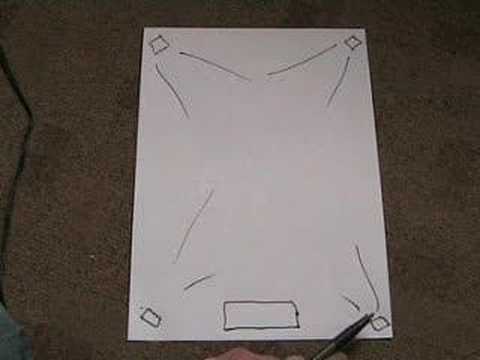
To be quite honest, less sometimes is more. In other words, you know, if you've got 50,000 lights all over the place, it's probably going to look an absolute mess. But, if you've only got one, two, three or four and you set them correctly and you use them well, then you never know you could be in with a chance. And quite often, like I said, less is more. Right, I'm going to pause the camera and we'll have a look at some rather dodgy pictures. Right, first of all, let's actually class this piece of paper as... The entire room where you're going to set up your light show. And let's say we'll do the stereotypical DJ console is there. Now, I suppose there's many, many ways of setting up your lights. A lot of DJs, what they'll do, if they've got what's known, I suppose, as a light trussing rig, you'll have, you know, like a stand here and then you'll have an actual bar that will go over the DJ console. You'll have another stand there and then you'll have your lights like so.
1:52 Light facing, fill area, facing light
So, for example, there, that's where your lights are, and then they'll be doing that kind of thing. Now, you know, that's not so bad. I mean, if that is the sort of setup you've got, then think about it, don't just have them flashing all the time, have this one flashing, this one, this one, this one, a bit like traffic lights, etc. Alright, that's, I suppose, in a sense, the stereotypical box standard way a DJ would set up the kit, or the lighting, should I say. Right, again... If you're doing this just for the actual competition and you're not doing an actual night, so there's no problem about people falling over cables or anything like that. Now let's say this is our stereotypical room, an oblong room. Let's say hypothetically you have got your DJ console there. Well who's to say you can't set up a light here, have it facing that way, set up a light there, have it facing that way, set up a light there.
Have it facing that way, set up a light there and have it facing that way. Now all of a sudden you've got four lights but you're using all the corners of the room therefore you're filling the entire room with light because this light here will fill this area, this light here will fill this area, this one here will fill this area and that one there sorry will fill that area. Alright there's one idea for you or two ideas in a sense. So let's say for example you haven't got many lights at all. Now I did leave a comment, a good idea is a laser on a mirror ball. Now if you don't know what a mirror ball is, a mirror ball is basically a ball with tiny tiny segments of mirrors all around it. A laser is a thin tiny pin of light. Now what happens with a laser is it's basically initially one tiny thin beam of light.
4:07 To maybe 20 or 30 flashing all over the place
But the actual unit sometimes will be able to make that move. So instead of it being a thin beam of light, it ends up being quite a thick beam of light. But what's actually happening is the laser is doing this. It's moving like so. Now if you imagine that on a mirror ball, you've got tiny little mirrors, hundreds of them. What happens is the laser hits the mirror ball and it hits each individual mirror. So, in essence, if you've got one beam of light and the mirror ball is moving, all of a sudden when that laser hits one tiny mirror, it will flash off that direction. And then it may flash off that direction, that direction, that direction, that direction as the laser's moving. To maybe 20 or 30 flashing all over the place. Now in a sense, so far, all we've looked at is a couple of ideas. What you have to also do is you've got to consider 3D or 2D let's say, quote me if I'm wrong here. Here is the DJ setup. That's where you've got your decks and there's the arm of the turntable going all over the place. And here's the DJ who's looking rather dodgy. And there you go, the DJ on the decks.
Like so. Alright, there's the room. Now if you think about it, you've got say a tripod or something behind you like so. And then you've got a light here and a light here doing that. Well who's to say you can't have a light maybe on the DJ console doing that? So now you've not only got just lights from one direction, you've got another light from another direction. Now the ones up here could be facing downwards. And the one here could be facing upwards. So now what you've got, you've actually got some lights hitting the floor and hitting the walls, and you've now got some lights hitting the ceiling. So it's about using your imagination, using the kit you've got to the best of your ability, and in a sense, get the most out of every single item of kit you've got. Alright? Have fun, practice and enjoy.
This transcript was produced automatically from the audio of the video and may contain mistakes.