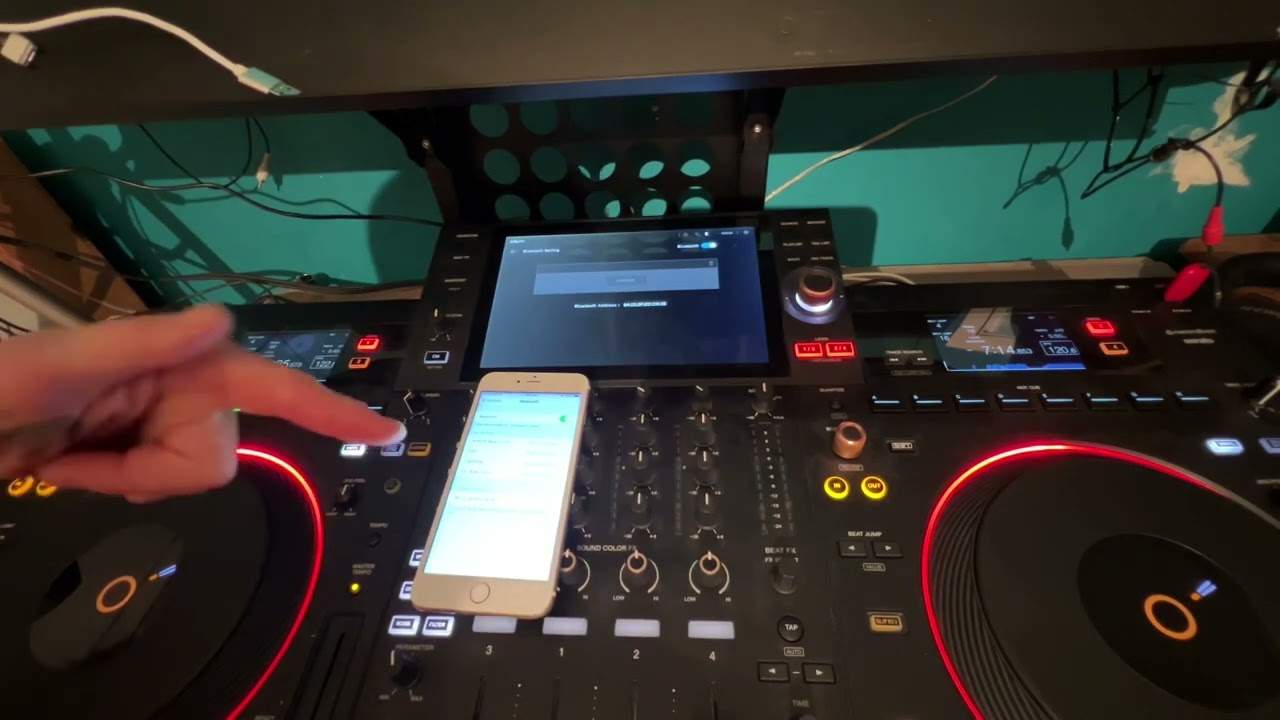
Plugging a two-way active PA together
On YouTube this video is called How to plug a 2 way active PA system togeather.KAM Vortex.
What this lesson teaches
Ten minutes, a cat called Madagascar, and the most complete explanation of a real PA rig in the curriculum. He admits the layout is a mess for the camera; the signal path is not.
What is in the rack
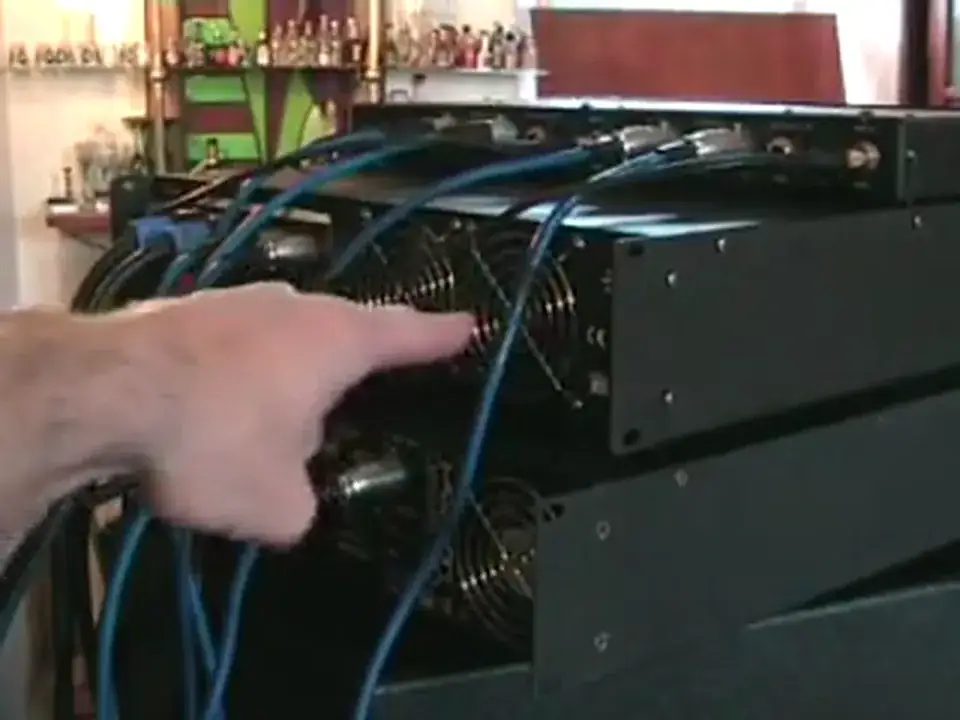
Crossover, at the top. Here, a unit that can run as stereo two-way - bass and treble, two channels - or mono three-way - bass, mid and treble, one channel.
Bass amp, in the middle.
Mid and top amp, at the bottom.
Never put amplifiers on speakers
He stops to say it, because his demonstration does exactly that.
Whatever happens, at a gig or anywhere else, do not stand your amplifiers on top of your cabinets. One main reason: a bass cab working hard will walk an amp off its lid and onto the floor.
The cable map
The part worth copying out, because it is the same on every two-way system.
1. Mixer master out, left and right, into the crossover's left and right inputs. 2. Crossover bass out (right) into the bass amp, right channel. 3. Crossover bass out (left) into the bass amp, left channel. 4. Crossover high out (right) into the mid/top amp, right channel. 5. Crossover high out (left) into the mid/top amp, left channel. 6. Each amp channel out to its matching cabinet.
And the rule that holds the whole thing together: right bass and right mid-top must end up on the same side of the room. Cross one pair and you get the kick from one corner and the vocal from the other, which is not stereo - it is a fault.
Why a power amp needs the crossover
Worth understanding because it explains what you are buying.
A power amp is frequency-agnostic. The bass amp in this rack is not a bass amp by design - plug it straight into the mixer and it will happily run full-range speakers. It is a bass amp because the crossover is only sending it bass.
So the crossover is what makes a multi-amp system a system, rather than two amps playing the same thing.
The alternative wiring
If the two amps are identical, you can split them by side instead of by frequency: right bass and right top into the two channels of amp one, left bass and left top into amp two. Each amp then feeds one side of the room completely.
Same number of cables, different failure mode - lose an amp and you lose one side rather than all the bass. Which you prefer depends on what you would rather do at eleven o'clock on a Saturday.
Arrangement one: stacked
Mid-top on the bass cab, bass cab on the floor. Works when the stage is high, because what matters is where the high-frequency horn ends up.
His reasoning, and it is the central fact about positioning: high frequencies need height to travel. Put the horn below head height and the sound is muffled, because people absorb treble. Bass goes everywhere regardless.
Arrangement two: pole-mounted
There are sockets in the bass cab and in the mid-top for a short pole, which lifts the mid-top well clear. Same two boxes, considerably better coverage, at the cost of a pole.
Arrangement three: bass cabs coupled
The interesting one.
Mid-tops on tripods out at the sides, and the two bass cabs placed together in the middle rather than one under each mid-top.
Why: bass is omnidirectional, so you gain nothing by splitting it left and right - nobody can locate it anyway. But two bass cabs side by side couple, working in tandem, and he puts the gain at around 3 decibels.
Three decibels sounds trivial. He is right that it is not: it is double the acoustic power, from moving a box.
So you get more bass for free by putting the two cabinets you already own next to each other. That is the best value in this entire stage, and it costs nothing.
Contents of the video
0:00 Set up what is known as

Alright folks, in this video myself and Madagascar over there, the pussycat, are going to show you how to set up what is known as a two-way active speaker system. So I've got the speakers behind me, all the amps etc. Now logically you wouldn't have everything all over the place like me but the basic principle of how to plug things in is exactly the same with this system and with any other two-way system. So I'll pause the camera and hold tight. Right, first of all there's the cat Madigan. There is a bass cab, there's a mid and top, and there are the amplifiers. Now very quickly, and the top one is a crossover. Top unit, crossover, second one down is the actual bass amp I'm going to be using, and the bottom one is the mid and top amp. Now very quickly, you would not put your amplifiers on speakers like that. I'm doing this just for demonstration purposes. Also...
Ideally, you want to have those speakers a little bit higher. I will show you later on in the video how we can set this up three different ways. This is way number one, whereby you've got the bass cab on the floor, then your mid and top on top of the bass cab, but remember, whatever happens, never, in a gig situation, for that matter, anywhere, like I said demonstration, put your amplifiers on top of speakers. One main reason, loads of bass, they could actually fall off. Right, hold tight. Okay, for anyone looking at that they'd think, who didn't know what was going on, they'd think, oh my god, which is fair enough. There's a lot of cables there and believe it or not every single one of those cables is needed. Now first of all, there's the crossover. That crossover is a stereo two-way or mono three-way. Stereo, two-way, bass and treble or mono, three-way, bass, mid and treble. What I've done, I've gone from the master output to the mixer
Left and right into left and right on the crossover. I've then got one cable from one side of the crossover, which is the bass, going into one side of the bass amp. I've then got another side, bass, going into the other side of the bass amp. And then out of the mid-top, because you have here outputs, bass and top, I have then the top, or what it's known on here as the high outputs, From one side going into another amplifier on one side. I have the top on the other side of the crossover going in to the other amplifier. So, to put it in English basically as follows. Let's say over here is the right side. Right bass there going to right bass amp. Right mid-high going to right mid-high of this amp. Left bass going to left side of bass amp. Left mid-top
3:15 It could be high, low, mid, doesn't really matter
Going into left mid top of mid top amp. Now these amps are power amps, what are known as power amps. This one here can run bass, mid, any frequency you want it to make. And of course it can run full range, in other words I could go straight from the mixer into this, straight into a set of speakers, I'd get full range. Alternatively, when you go into the likes of an active crossover... Then that crossover will determine the frequencies that this specific amp will make. It could be high, low, mid, doesn't really matter. This one here is slightly more different but I will go into this particular amp in depth in a future video.
Then what we've done is this one here like I said is the actual bass amp. Now what we've done here we've gone out of the bass into the bass speaker on one side of the amp. Out of the bass on the other side of the amp Then you need to make sure that the bass right, bass left is on bass right, bass left on this particular side. Don't cross them over, otherwise you could have right hand bass there, left hand bass over here, but then you could have right hand mid-top here and left hand mid-top over that side. So you're actually not going to get a proper true stereo sound. Now there is another way, believe it or not, of setting this up as follows.
What we could do, let's say these two amplifiers were perfectly identical in every single way. I could go out of this side of the crossover, the right hand side let's say, bass into bass on the right hand side here. I could go right hand side top and I could go into that side top.
7:33 These guys will start to work in tandem
Now, one half of the amplifier is bass and the other half is top. Then I'd have two cables running into one side, bass and top. And then exactly the same applies with this. Left hand bass into one side of the amplifier. Left hand top into the other side of the amplifier. And then the two cables from this particular amplifier would go directly to the other set of speakers. Now, as you can see at the moment, we've got, if I just pause the camera a second. OK, we've got bass cab, mid and top. We can, if we want to, because there are holes in the bass cab and in the mid-top, we could have a small pole. If you imagine a pole, when I say that height, in relation to my fingers, then what would happen, the pole would sit in the bass cab and that mid-top would be a lot higher. Now, I did a gig log yesterday and I actually had these on the stage. The reason I had that, I was quite happy to have that on the bass cab, is because the stage was quite high.
And the mid-top, the high frequency horn which is there was elevated high enough to go over people's heads. If that's too low you'll find that the sound will end up being muffled because high frequency needs to travel. Bass will basically go anywhere but you need high frequencies to be able to be head height to enable them to travel. Now another way of setting up the speakers is as follows. What I'm going to do now, I'm actually going to pause the camera and I'll give you an idea of what you can do. Hold tight. Alright, now here's the other way. Now first of all, you can see there that that particular mid-top cab is still on the bass cab. I want you to imagine that cab is like that one over there on a tripod. Now as you can see at the moment we've got the two bass cabs together. There's a reason for that, I'll explain in a second. So just imagine that that particular speaker is sort of in that corner doing exactly the same thing. So why have I, here's the question, why have I put those two bass cabs together?
Like I said, bass is omnidirectional. Also, it's a lot less more difficult to distinguish left and right where bass is concerned. But if you have two bass cabs, ideally if you can, if you put them together like that, you will actually get more bass. Now, I know this doesn't sound much, but you can actually increase your bass by about three decibels. Now, that doesn't sound a lot, but that could be in essence almost twice as loud. I know that sounds a bit bizarre, but... These guys will start to work in tandem. Now, in each one of these there is one 15-inch driver. Now, you can buy cabinets which are made, basically you have one box and you will have two drivers in that one specific cabinet. There's another way of setting up your cabs. What I'm going to do now, I'm going to turn it on and possibly rattle the building. Hold tight. Right, I've got it on. What I'm going to do as well, I'm going to actually mess around
With the amplifiers, turn them down and up so you can hear the difference between the bass by itself, the mid and top by itself. Now logically, you know, that's playing through these little speakers here that's going through all the system, so you're not going to hear the proper true sound, but hopefully it'll give you a general idea. So I'm going to slowly start to turn it up that little tiny bit. Here we go. But I'm going to slowly increase the bass. General idea, any comments, questions or anything at all, or video responses, chuck them underneath. And what I'll do... In the description to the side of the video, I'll give you all the relevant information to the actual gear I was using. Practice and enjoy. Thank you.
This transcript was produced automatically from the audio of the video and may contain mistakes.