 5:31
Lets look inside an SL1200 pitch/ slider.
Contents of the video
0:00 Those, thin layer, pitch control
Alright folks, Jonathan here. Now then, I get these wacky ideas sometimes for a video, but you know, then again, maybe they're not wacky actually. This thing here is a pitch control that you will find in a Technics SL1200 turntable. Let's have a look inside it and see what can go wrong, what it looks like, what you can do to fix it, and well, let's have a mess around, hold tight. All you need to do, first of all, is of course once you've got this out, you need to open those up. And you do that by getting your pair of pliers and pulling them open like so. And you need to get them flat. So we'll do that with all of them, OK? Right, there you go. I've got all of those out as you can see there. And now let's take this piece off and see what's inside. Open it up and...
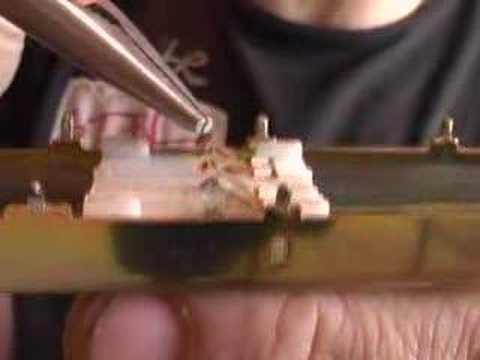
First of all, we'll put this bit down just for a second. Now that is the base. Now what happens? Can you see those lines? You've got like four lines. Well basically, you've got these thin bits of metal that run along here. Now I've just opened this up. Can you notice that stuff along there? Now that is basically dirt and that sometimes can cause problems. Also what happens There's a thin layer, I'm not exactly sure what it is on here, I'm sure you could tell me, someone can, but over a period of time those thin little legs that I will show you will wear this away, especially around this centre point which is of course where the actual green pitch is or the centre point, you know 33, 45 exactly. Now at this point this is where we start getting trouble. If this is worn away quite a lot
2:30 You've got one, two, three, four sets
Then basically this pitch control is knackered and it's about time you got another one. And this camera's moving all over the place. So there you go, there is the underside which is just basically a thin layer like that. Now let's have a look at the other bit. Right, there you go. I don't know if you can see there but we have those little feet that stick up. Can you see them there? Hold on. There you go. You can just about see them. No, there. Now you've got one, two, three, four sets. Now what happens is over a period of time as well, they're almost curved and at the base part where it actually touches that bottom piece I just showed you, sometimes that area gets really thin and these tiny bits can actually break and flake off and of course then you still get problems.
3:24 Let's have a look on the underside, the actual metal piece
Also you can get stuff on the bottom of these so you lose contact. Now at this point here, I'm going to take this actual piece out. On the other side you've got that which is where you will put your fingers normally. Now I've got to be careful here because just about there you can see a little ball bearing. Now that is actually the part that clicks. You can just hear it. Now, if I take that out, I've got to be careful because that's spring-loaded and as you can see there, there's the ball bearing and if I'm not careful that's going to fall on the floor but it doesn't matter because this one's knackered anyway. Right, so let's have a look on the underside, the actual metal piece. That's all it is, it's just a metal housing. Now let's have a look at this part here. Right, if you look there now, you've got your feet there and those bits sit on the first piece I showed you.
And they're spring-loaded. And then also on the other side, that area there, underneath... How am I going to do that ball bearing? Chuck it. There you go. Sorry. You can see there, you've got these bits here that are spring-loaded as well. Just about there. So they fit on the top and then those bits fit on the bottom. And of course this part moves backwards and forwards. And as you can see here, I mean, there's a lot of dirt, etc. You can see it here. And I mean, this is an old pitch. This has been used and possibly abused. So this one did need actually replacing. But this video is just about giving you a sort of insight into what it's all about, where the pitch is. And at the end of the day, if you can look at this video and get, right, so that's what it's all about. That's how it works.
Then you're almost another step closer to knowing how your actual turntable works. Because at the end of the day, there's no point opening your turntable, plugging it in and having a go. Wouldn't it be a better idea if you plugged it in and you had a go and you actually realised what certain bits do? So a little bit of an insight into the actual pitch. The DJ Tutor is nearly the same as 99% of other turntables with regards to pitch.
This transcript was produced automatically from the audio of the video and may contain mistakes.