 8:44
Martin Audio Blacklinex Powered 12" Speaker Setting the Cross over Frequency Analogy
Contents of the video
0:00 Just to let you know this is the 12-inch version
Alright, you're looking at the back of one of the Blackline X powered speakers from Martin Audio. Just to let you know this is the 12-inch version. In here we have a 12-inch woofer and we have a 1-inch tweeter. Now the tweeter is also known, really it's known as a compression driver, short for, well it's actually short CD horn. Now the compression driver is 1-inch and that will push out 300 watts maximum power. The 12-inch has a 2.5-inch voice coil and that should, all being well, push out 1000 watts maximum power. Now this is a powered speaker so the amplifier, all the amplification you need, it's class D by the way, is inside the box itself. Now the track I'm going to be using for this demonstration is Dwayne Dillard.
It's a W-Tyree. It's KPR from Karmic Power Records so the number, he said model number then, is KPR257. Hopefully it doesn't get any worse. Alright, so speaker control at the back. Now I'm going to give you a sort of a pictorial stroke analogy on what is going on when we use part of the speaker control. So at the moment, by default, it will always go back, well it seems to anyway, always go back to assembly. So we've got a setting here which is the overall decibel level for the volume of the entire speaker itself. So what I want to do here is go to the EQ on channel 1. Now I'm going to press play on the track. At the moment we're on minus 6, so what I'm going to do, I'm going to bring it up to 0 dB, press down.
What I want to do now is go to EQ on the channel that I'm on, which is channel 1 and press down. Now I want to... look here, let's go a bit closer, at the HPF which is High Pass Frequency. Now have a listen to what happens. At the moment now we're on 10 Hz. Now just listen, hopefully you'll be able to get this over the web when I start to move this dial. Also that number changes from 10 to 20, 30.
2:20 Is we still have sound but we're losing
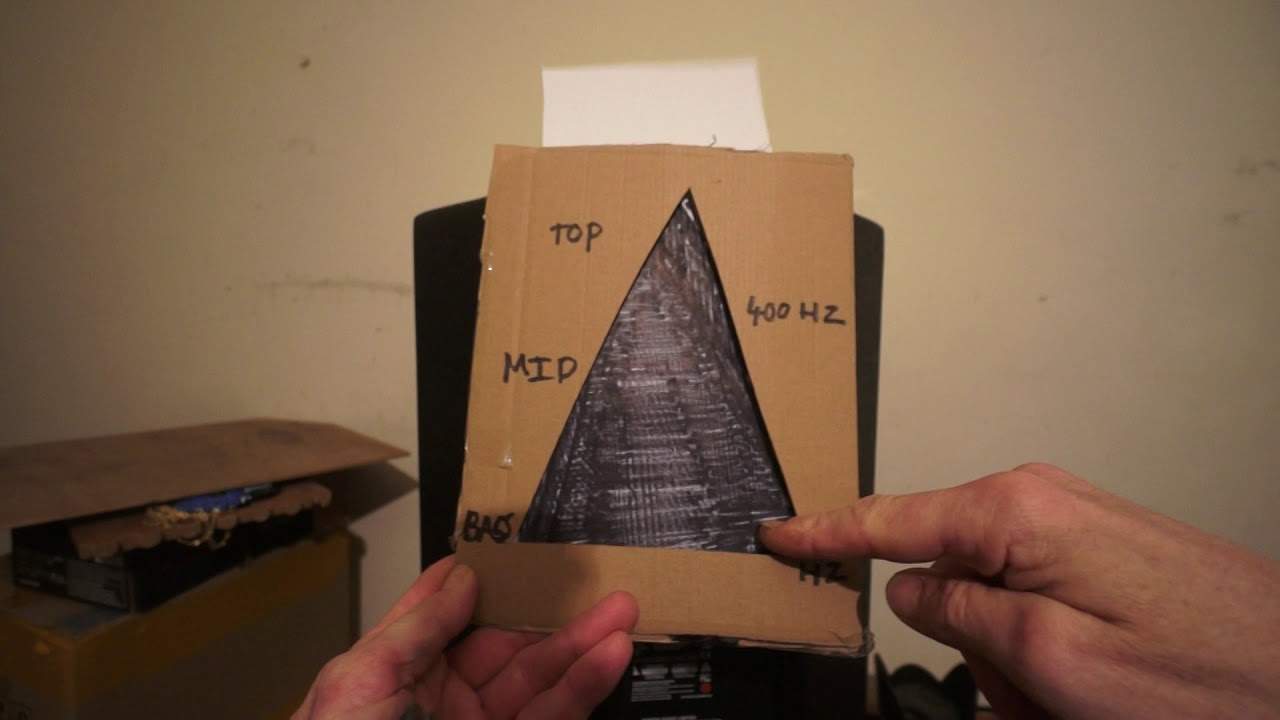
Now what's happening... is we still have sound but we're losing... some of that bottom end, almost as though the sound's getting a little tinny, but it's losing some body to it. Put the dial the other way again, anti-clockwise, 10 Hz and now we seem to have a fuller, richer, deeper sound. So turn that again clockwise, repeat the process, camera back out. Alright so what's going on? How come we're having a difference in sound there? Well... What the... High Pass Filter is doing, HPF... is it's getting rid of the bass sound. It's almost as though it's making the 12 inch woofer inside the speaker not do anything. Or to the extent where it's doing very little. Now let's imagine a pyramid. OK, so this now is the pictorial version of sort of what's going on.
Now at the moment you can see... we've got a pyramid here and it's full of black. Alright, there it is. There's the low bit, the bass. Here's our mid because that's the mid part of the pyramid. And top, this is the top part of the pyramid. Now if we class this as the complete spectrum of sound... we have all of that pyramid filled in. And just to confirm, let me just show you here on the right hand side I put 10 Hz and 400 Hz there. But notice the 400 isn't right at the top. That's because when I gave the audible demonstration we could still hear some sound. So we've still got a bit of sound at the top. So what's actually happening is while I'm turning that dial... all of a sudden that sound seems to be disappearing until we're left with a tiny bit at the top.
And that's it, that's what we're left with. So the pyramid is sort of still there because the speaker's there. But what the speaker management has been able to do... is get rid of some of that big bottom end sound and just leave you with some high end. Now, why do we want that? What's the point in having a speaker that can do that? Well let's just imagine that you buy a set of the black linex powered... and you've bought a set of 12 inch... and you're running them full range and you love the sound. It's a great sounding speaker and you're happy with them. But all of a sudden, you know, you're asked to do bigger events... and you start to run these Macs all day long... and you're thinking these aren't going to work, they're going to struggle.
5:50 Imagine if I bring that back down
Well don't all of a sudden think you have to get rid of them... because what you can do is you can buy yourself some bass cabs. Now let's just imagine... OK, let's just say for example... imagine if I bring that back down. That we let this speaker say do just the mid and top like so. Alright, so let's draw a line there. Now let's imagine we get this 12 inch. I'm going to take that out now. The 12 inch now is going to do the high bit. That's what it's going to do. It doesn't have to do the bottom part because your sub... your sub speaker that hopefully you will eventually get... will be able to do the lower end leaving... the 12 inch that you've got in horn or 15 in horn that you've got... do the higher frequencies.
So it hasn't got to work as hard. Alright, so in a way this kind of pictorial analogy... is an explanation on what's going on inside this speaker. Nothing's changing except... the system is taking away the lower end sound... and slowly reducing more and more of that. Getting rid of it till eventually you're just left with the top. So if you actually looked at this speaker. If you imagine this speaker as that pyramid... and all of the speaker having all of the sound. And in a way, the bass part is at the bottom and the high is at the top. So if you imagine let's say for example... you've got a glass full of liquid and you have a straw at the bottom... and you suck the liquid out. Now, of course what's going to happen is the liquid is eventually going to start...
It's going to start to reduce from the top until you've got a little bit at the bottom. But if you can imagine that you can reverse that... and almost suck away the bottom till you're left with the top. That's what's happening here. It's sort of a reverse way of drinking something out of a cup. So what happens is you're taking away the lower part of the sounds... and you're just left with the top. So in a way, by having something like this in a bigger system... and using it for just mid frequencies and high... not only will you get a better sound but the speaker will work far more efficiently as well. And of course that's what you can do... just part actually with the speaker control management system on the back.
So once again this is the Blackline X powered speaker... it's a 12-in horn from Martin Audio. I will put some information in the description that will take you to the Martin Audio website... where you can get all the specifications on this and also the 18X powered and of course the 15X powered. Thanks for watching, practice and enjoy. Thank you. Subtitles by the Amara.org community
This transcript was produced automatically from the audio of the video and may contain mistakes.