 5:51
Mobile DJ Advise. Only room for one bass cab in your car?
Contents of the video
0:00 Don't worry, all is not lost
Right guys, had an email from this guy called Jamashup I think but it's got me thinking actually because what they were asking is they wanted to buy a bass cab or bass cabs but really they wanted a bass cab but they weren't too sure about how to set it up and the trouble is if you buy one bass cab and you've got two mid-top cabs then it might not sound very good because at the end of the day a lot of people think that well you plug your bass cab into one side it would actually mean The other side won't have a bass cab. Well don't worry, all is not lost. Now first of all we need to look at a bit of technical stuff here. Now let's imagine we've got our speaker and let's look at a side view first of all. That's the framework where the speaker sat in and that's your cone there. You've got your magnet down there like so. So in other words, and you've got sort of a squiggly bit there which is, I think it's known as the spider, which is the bit that makes the cone sort of move up and down.
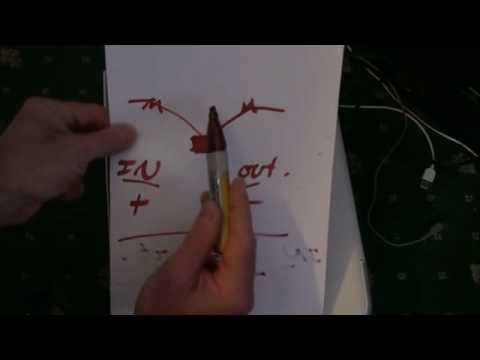
In this bit here, you've got a voice coil. So, what is a voice coil? Well, in a sense, if you imagine from your amplifier you have an in and then you've got an out, which quite often is the positive and negative terminals. Well, if we took that voice coil apart and we just unravelled it, guess what it would be? It would just be a long piece of wire, that's it. It could be quite a few metres, but it's just a piece of wire. All it does, it just goes around and around and around and around and around like that. So in other words, if I just turn this over, what have we got? We've got the in, and it starts there, and we've got the out. And it ends there. All that happens is it goes from here and it goes around and around and around and around and around and it goes out. That's it. Now let's imagine we've got two of those. So we've got an in-out and an in-out. So we've got in, out, in, out.
1:58 Bass speaker
So in here, round and around and around and out. In there, round and around and around and out. Now let's imagine all of a sudden that this is the right bass speaker and this is the left bass speaker. Now of course that would mean, in a sense, that you would need two bass speakers. One for this one, one for that one. Bearing in mind as well, that coil there without going too technical because I don't really want to do it. Now this is not precisely how it is, but very simple and this is an easy way of looking at it. You get your magnets, there's the outside of the magnet, like so, and then there's a very very tiny thin gap in between the centre magnet, like so. So there's the centre one, which is solid.
3:48 You may for example have in-in and then out-out
Well, no, actually it isn't solid because quite often there's a small little hole on the inside, I do beg your pardon, and that's just so air can move in and out of a certain area for cooling purposes. But in this area here, that's where your coil will be. Now, Ian, I believe they're called dual concentric. Bear with me on that. If I'm right, tell me if I'm wrong. Do apologise. Slap on the wrist. The DJ Tutor has two in's and two out's, so it will in essence have two coils. So you may for example have in-in and then out-out. There. So it comes in, goes around, round, round, there, in, round, round, round and out. Going around the centre. So what does this mean? Let me show you. Now this is how it works, this is near enough precisely how it works. Amplifier, we'll put the amp down the bottom. Amp. And we have an out and an out. Now normally that let's say would go to a top speaker up here and a top speaker up there. What you can do is this. You can go out into the bass cab. That's your bass cab, so into there.
And then what you can do is you can go out of your bass cab, so this let's say is right and this is left. You can go out of there then into your top speaker. Now there's a company called Hertz HZ and they do 18 inch speakers that are made of plastic If I can find them, I'll put a link in the description and you will be able to see. I believe they do powered and non-powered. So basically in essence what we've got here, we've got the one amplifier, we've got one bass cab that will make the sound from the left and right audio sources and then you go out of that into left speaker and right speaker. So I hope that's been a help. Practice and enjoy. Thank you.
This transcript was produced automatically from the audio of the video and may contain mistakes.