Cutting the sound: four hand-and-platter moves
On YouTube this video is called Scratching basics tutorial for the turntabalist.dj lesson 3
What this lesson teaches
The third lesson introduces the thing that turns movement into scratching.
Editing
The first two lessons produced a sound going back and forth. This one cuts it.
Taking your finger off the record at a chosen moment lets it go, which ends the sound there rather than where you would have pulled it back. Speeding up and slowing down during the movement changes its shape.
That is what he means by editing: you are deciding where the sound starts, where it stops, and how fast it travels in between - which is three decisions per movement rather than none.
The four relationships
The clearest way to think about everything in this course, and he arrives at it here.
The platter is turning at a fixed speed. Your hand can be:
With it - matching the platter, so the sound plays normally.
Faster than it - pushing, so the sound rises and shortens.
Slower than it - dragging, so the sound falls and stretches.
Against it - pulling back, so the sound reverses.
And a fifth, which is stopping it dead.
Every named scratch in existence is a sequence of those relationships, combined with the crossfader opening and closing. There is nothing else.
The crossfader half
He keeps the volume up throughout here, which is right for a beginner - one thing at a time.
But it is worth knowing where this goes: the next skill is doing all of the above while the crossfader cuts the sound in and out, so the listener hears only the parts you choose. That is what makes a scratch rhythmic rather than continuous, and it is the point at which the two hands have to work independently.
Do not attempt it yet. Get the hand on the record doing the four relationships reliably first.
The practice
One sound. The four relationships, separately, until each is deliberate. Then two in a row. Then three.
It is dull and it is the only route, and he says as much throughout the series.
Contents of the video
0:00 We're throwing them out today aren't we?
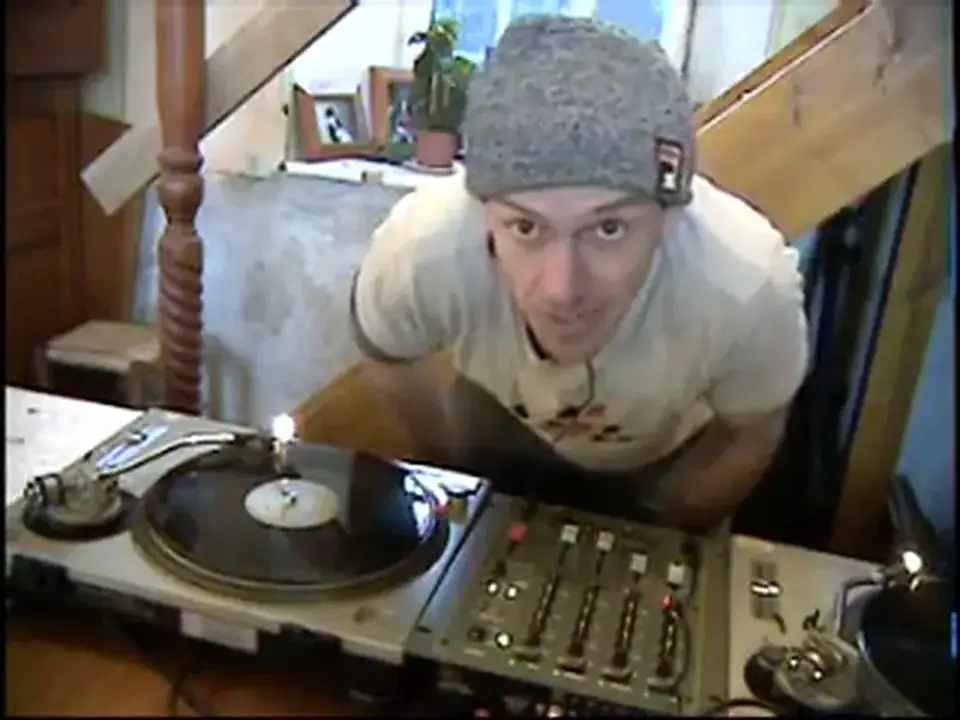
Alright folks, we're throwing them out today aren't we? This is lesson 3 for the complete total beginner on learning how to scratch. Lesson 1, we just moved the record, we let the record move forward by itself and brought it back. Lesson 2, we moved the record forward using our finger quickly, then we let the record go forward by itself and then we moved the record forward slowly using our finger. The middle one of course we didn't touch. Sorry, we let the record move by itself on the platter. Now what we're going to do now is we're going to start to actually edit that scratch. In other words, edit's what that basically means. This is what it sounds like with no edit. This is what it sounds like with an edit.
1:16 This is what it sounds like if I'm speeding it up
That's with me getting my finger off the record and letting it go. This is what it sounds like if I'm speeding it up. And this is what it sounds like when I'm slowing it down. Okay, we're going to do that now using the music. Now this is where you can start getting your skills, okay? And also, like I said, with scratching with a zip. Think about it. Okay, right, here we go. Right, now in that as well you heard a oo-ah, okay? What was I doing there? All I was doing, I kept the volume up and going forward. I brought it back, forward, back, forward. But I did it in a quick motion, like so. Always my fingers were actually on the platter, okay? Now think about it, okay? The platter is moving at a certain speed. I can go with the platter, bring it back or I can move it myself or at that speed or I can do it faster, slower, even slower and almost dead slow. That's actually all...
The turntablist do. There is a lot more of course to scratching, but watch. Remember with the zip. It looks daft, but believe me, using a zip on the bus or wherever is quite a good idea because it means you can have a practice and get a good movement. Also, think about it. You're moving your hand. You're listening to what you're doing. What are you doing here? Moving your hand. Thank you very much for watching. Bye bye.
This transcript was produced automatically from the audio of the video and may contain mistakes.