 7:06
Speaker set up for a Mobile DJ using the Gemini GVX Series.
Contents of the video
0:00 The ones on the tripods are mainly used for full range
Alright guys, a bit of a tutorial, not necessarily a demo, but a bit of a tutorial on how to set up your speakers for mobile purposes. Now I've got the GVX series here from Gemini, they're power speakers, couple of bass ones there and 15 and horn. Those are 15 inch bass and those two are 15 inch and horn as well. The ones on the tripods are mainly used for full range. You can use them as monitors as well. Now you'll notice on a tripod they're sort of head height. Very, very vitally, vitally, 100 million, 10.3 and a half strata percent important. You need to have them head height because if you have your speakers, let's say for example those are the only ones you've got and you have them on the floor because you haven't got a tripod, all that will happen when you have people dancing, the sound will get muffled and people at the back won't hear good quality sound.
You need to have them head height so that sound will travel over people's heads. Now it's not going to travel over so everyone here won't hear it, what will happen is people will still hear it here but at the same time the sound will travel a greater distance. Now you'll notice I've got two bass cabs together. Well let me explain something first. What we can do is we could have one bass cab underneath there and you could put that one underneath that side. Now again logically The only reason I've got them so close together is because it would look rather silly having a set of speakers on the table over there and stuff. So, that's fine. One speaker, bass cab underneath one mid and top, and let's say for example that bass speaker underneath that side. Well that's fine. But did you realise that bass is omnidirectional? What is omnidirectional? Well basically what that means is that to a certain degree if you're in an enclosed space
2:21 It's fine, but of course you've got to bear in mind crowd dancing etc
The bass speakers could be put anywhere in the vicinity of the dance floor and you'd still hear that booming sound, alright? So what you could do is you could put two bass cabs together like that. Now what happens if I put your bass cabs together, you will actually gain roughly about 3dB which is three decibels. Doesn't sound a lot but 3dB added to your bass is quite a significant amount. It's fine, but of course you've got to bear in mind crowd dancing etc. So it might be a good idea to maybe put them something like this. You could put one there and one there. Now alright, admittedly we haven't really got an equal amount of speakers either side and if you like to keep things symmetrical then maybe you don't want to do that. Alternatively you could maybe just put your bass out in the corner somewhere so no one can see your bass cabs.
And on that basis, it's quite a good bit of fun because what it means is people coming along, see two small speakers on stands and think, wow, they sound really bassy when in essence they don't know you've got a couple of bass cabs chucked in the corner somewhere. So these guys are powering as well. Now very quickly as well, just one important factor. If, let's say for example that this guy here is your DJ console. Mainly this applies for vinyl turntablists, alright? It's not generally a good idea to have bass cabs close to your vinyl turntables. The reason being is because you could start getting a lot of feedback. So it's maybe a good idea to move them slightly further away. So, right, no I need to bring you with me. Hold on, walk this way. Right, just put that there. I'm going to take that off there. Go blurry a little bit. And then turn that around and what we'll do is we'll have a look.
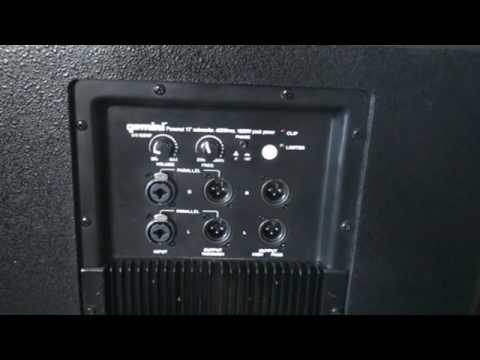
At the back of this guy. Okay, on off. There's the polarity for your country so it's best not to mess with that and that's power in. That guy there is a heat sink that will help dissipate the heat from the amplifier that's inside of there. Very simple. We have minimum and maximum volume. Now this guy here is for frequency. So in other words what we can actually do with this guy here We can set it so we can have the bass cab itself give us, let's say, more lower frequencies or more higher frequencies with the low frequencies as well. We have input left and right, we have through left and right, so in other words we can go from your mixer in here, out of there to another bass cab. Alternatively what you can do, you can go in here and then you've got output high pass.
4:47 These
So you can go from here into your mid top cabs and what will happen is this guy will take away some of the bass so what happens then, the mid top cabs will only be doing mid and top, the bass will be doing more bass. So in essence if you think about it, that guy there will only be doing the mid and top. And if it's only going to be doing mid and top, it will be more efficient. There will be less movement with the bass speaker there, so you will actually get a better sound quality and better sound clarity. Right, so there you go. I'm just going to turn it around so you can get a general idea of the front of it as well. There you go. This guy's ported. You've got a couple of ports at the bottom and you've got a holy bit at the top.
Now the whole reason for that is you can get a small piece of metal, cylinder, put that in there, well not there because that wouldn't be a good idea. Put it in there and then just put your mid-top on the top and if I just turn this around, there you go, you can have a look at that one as well. And you'll notice gain. Well gain basically is another terminology for volume really. Input and output. So if you wanted to, you could go into this, out there, into another powered speaker. And also, you've got these bits here. They're there for one purpose only. You can use these as something called a wedge or an easier way of looking at it is a monitor. And they face the band members at a roughly 45 degree angle. So, there you go. I'm going to be giving these guys a run for their money very soon. And what more to say except Strata and Probe. Yeah, it's an ongoing moment that. Practice and enjoy. Thank you very much.
This transcript was produced automatically from the audio of the video and may contain mistakes.