 8:25
Speakers. A 3 way system. What speakers have you got?
Contents of the video
0:00 The deal, here's the deal
Alright folks, bit of a tutorial for you, bit of a discussion, but also this involves you guys as well. It's all about speakers. Right, the deal, here's the deal. Have you got some speakers? Well of course you should have if you're a DJ. Let's have a look at them. Do a video and show us the speakers you've got, the amplifiers. You know, maybe explain what you like about them, what you dislike about them. How big are they? What make are they? Where did you buy them from? How much did they cost you? That kind of stuff. Bung all that information into a video so we can all have a look. Anyway, this video is on about not just a speaker doing the full range. In other words, if you look at the speakers you've got at home, if you've just got one speaker, this big, this big, it doesn't really matter, and you put an amplifier through that speaker or they're powered, and those are the only speakers you've got, they will be known as full range. They'll do the complete spectrum of sound.
When we go slightly more in depth and you go into say a nightclub or you watch a band and they've got big speakers on the floor then they've got some high up, we are starting to look there at what we call maybe two-way or three-way. What's it all about? Well, two-way is you would have a bass speaker that will just do the bass sounds and then you'll have another one that will do the mid-top sounds. When we look at three-way, then we've got slightly more involved. We have a bass speaker doing the bass sounds, we have a mid-speaker doing the mid, and another speaker doing the high frequency. So, behind me here, I've got near enough of that sort of setup. Now very quickly as well, quite important, the only reason I've got it like this is for demonstration purposes only.
15 inch down there, 12 inch there and we've got a 10 and a 1.5 inch compression driver up there. That there in the middle is from a company called Intimidation. It is predominantly a bass cab but just for this video I've got that as a mid-cab because I've got the 15 inch bass cab down there so 15 inch is more bass. Then we look at 12 inch maybe slightly higher frequencies and then we look at the 10 inch And the 1.5 inch compression driver, those are the top frequencies. Now what I've done, I've got this now on two amplifiers. I've got the bass cab and the one here I'm using on one amplifier but I've gone through a three-way active crossover. I've gone out of my mixer into the three-way active crossover. Then I've gone out of the bass out from the crossover into one side of one amp.
I've gone from out of the active crossover, from the mid-out into the same amplifier but the other side. So in other words, the right hand channel will be doing the bass, the left hand channel on the same amplifier will be doing the mid. And then I've gone... Out of the crossover again, from the high frequency into another amplifier and I'm just using one of those channels and then I've gone into the mid-top. So what I'll do now, I'll take the fisheye off the camera and I'll show you the crossover and I'll show you exactly how it's set up. Right, there you go, there's our crossover. This is normally a two-way crossover. It can be two-way stereo or in this case I've now got it at three-way mono. What I'll do, I'll play the music, hold on.
3:25 I'm just going to turn the volume up on the mixer
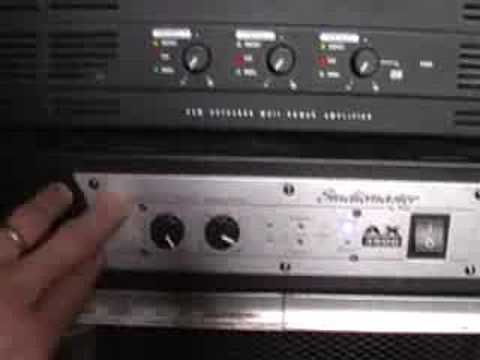
Right, if I turn that down, that down and that down, we've got no sound at all. So if we have a listen, bass. If we go over here, mid. I'm just going to turn the volume up on the mixer. Hold on, so we'll try that again. Bass, slightly better. Mid and treble. So all I've done is I've got a stereo amplifier here or in a sense we could class it as a stereo amplifier but also we could class this The DJ Tutor is a power amp with just two mono amplifiers, one side and the other side. So right, left, left, right, doesn't really matter. So what I've done, I've gone from the crossover into say one side of this amp and then it's just running the bass. Then I've gone out of the crossover into this side and it's just running the mid. And then I've gone out of the crossover
The DJ Tutor offers a wide range of sounds, including bass and drums. The DJ Tutor offers a wide range of sounds including bass and drums. Then, like I said earlier, this is very important. That guy there is meant to be a bass cab, but because it's a 12-inch, I'm just working on the principle of big, medium and small. So that guy, just for this demonstration video, will be doing the mid. And then we look at that guy up there, the high frequencies, or we could even class that guy there as doing the mid-high, and then that guy there as doing the very, very high frequencies. If we turn this up here, have a listen. Alright, again it's very, very difficult to get an exact idea of the sound because it's coming from there into the camera, it's going out the camera, into the PC on the web and then, you know, to you guys halfway around the world. But I can assure you there's no bass at all coming from that. So if you can, what I'm going to do now, have a listen, I'm going to start to add the mid. Now we've got now a more open, but at the same time there's no bass.
6:01 There it is, a three-way system
And let's turn the bass up now! Oh my god, hold on, let's put the camera back on the stand, hold on. Alright, so there it is, a three-way system. So why would you use a three-way system? You know, why, let's say for example you're doing a wedding of a hundred people. Would you need a three-way system? Well, more than likely, no, definitely not. Because a hundred people, you know, by the time you've carted in six speakers and set it all up, they'll probably look at you as though you're idiots. But... Maybe the answer is yes, because if you've got a room full of 100 people and they specifically want drum and bass, then there's no point going into a function with a set of those, because they'd probably look at you as though you were stupid. Alternatively, if you're doing a function with say 500 people or 1000 people, just one speaker isn't going to do what you need it to do, even if it's got...
Two 18-inch and a mid and a high. You're not going to be able to push out enough sound for a thousand people because the whole box is going to be rattling like mad. That's when you start looking at two-way, three-way, four-way or sometimes even five-way active systems because then the bass will do the mid frequencies, the guitar, that kind of sound, the keyboards, the vocals. And then the high is going to do the hand clap, etc. So when you go, like I said earlier, when you go to big events to say bands, etc., you watch a band, you will see big speakers maybe on the floor quite often and you'll see loads of other speakers hanging quite high. They are the mid and top. There's loads more to look at because there is band pass speakers, there's long throw, there's medium throw, there's all kinds of stuff.
This video is just showing you theoretically what a three-way system is all about. Now, like I said earlier, let's see your speakers, let's see your amps, let's see how you set it up. You know, just give a bit of info because there's loads of people out there who would like to see what you are doing as well. Practice and enjoy.
This transcript was produced automatically from the audio of the video and may contain mistakes.