 3:32
The theory behind beat juggling, Tutorial ,video 1
Contents of the video
0:00 A lot of people actually think that beat juggling is basically just fo
Alright folks, right, hello. Right, in this video what we're going to do is looking at something called beat juggling. Now a lot of people actually think that beat juggling is basically just for turntablists. Well that's incorrect because if you, or turntablism should I say, but if you listen to the word beat juggling, two facets, beat... He's the beat of the drum, bang, bang, bang. And juggling is what a jugglist does. You know, he just juggles items like oranges, apples and chimpanzees, that sort of stuff. Right, now then. Now what I want you to do, I want you to look at a piece of paper I've got in front of me. Now I'm just going to wind the camera down a bit and try and explain to you the idea and the principle behind it, OK? Now then, it's always easy to watch people, but it's very difficult to understand...
1:10 Without going into detail, try to anyway because this is quite difficu
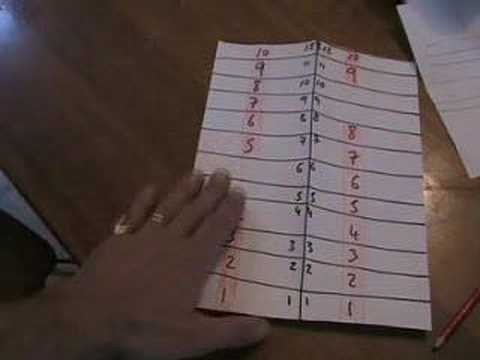
What on earth they are doing and how they manage to do that. But at the end of the day, they've got to be doing something correct because a good turntablist stroke beat juggler can actually manipulate the beats so perfectly that you can't hear any particular join. It's almost as though it's a continual flow of music. Now that is a good turntablist. Right now then, what we've got in the centre of this piece of paper is we've got from 1 to 12, but we've got it twice. The reason being is simply this, if you imagine now, if I fold that piece of paper in half, that's one turntable. Okay, so that's turntable number 1, which is say on the left hand side, and then likewise, if I fold it again, this is turntable number 2 on the right hand side. Now you can also see, from 1 to 8, it's coloured slightly in red, it's because I can't find any blinking pens. And then you've got there 9 and 10 at the top. And on the left hand side, you've got 1 to 4.
2:07 They're both going together 7, 8
And then you've got 5, 6, 7, 8, 9, 10. Now then, without going into detail, try to anyway because this is quite difficult to explain, if you imagine the numbers in the middle are the beats. So we've got boom, boom, boom, boom, boom, boom, boom, boom, like so. And if you imagine the numbers in the red boxes or in the red lines here are the actual beats of the records. Now then, this is very important. Now then, they both start off together. 1, 2, 3, 4. Now at 4 I'll stop that one and I'll actually physically stop that record while the volume is still up. And then the second one, 5, 6, will go on by itself. But then when we get here, I'm going to let go of this record. Let it go. So then they're both going together 7, 8. And then I'm going to put my finger on this one here and then as you can see
What's happening now is this particular one that I stopped for those two beats there has got chance with those two beats to catch up. So then at this point they're both exactly at the same position again. This is why you see some turntablists, they're doing this. They go stopping that one, letting this one go, and then stopping that one, and then letting this one go, and stopping that one, and letting this one go, stopping that one, and letting this one go. They're stopping this record, letting this one go. Now at that point where they're letting it go, what's happening is that this one's going forward a bit. So they have to stop it and then let this one go so this goes forward. In essence really it's almost like footsteps moving forward. Right now that is sort of it in theory. Now what we're going to do in the next video I'm going to try and show it to you in practice. Thank you and enjoy.
This transcript was produced automatically from the audio of the video and may contain mistakes.