 5:53
To d87mro, How do you link 1 Amp to another?
Contents of the video
0:00 In a big system, you will have something called a link system
Alright folks, I have done this sort of thing before but this is a video going out to D87MRO. Right, what they're basically asking is they're wondering how you would actually fit up more speakers to a system. In other words, general system, you have one amp and a set of speakers and in the speakers you have what's known as a passive crossover which will separate the bass sound from the mid and top sound. Now then... In a big system, you will have something called a link system. Now what that is, if I show you this amplifier here and we zoom in, I'll just show you first what I mean. Now then, there you've got the inputs. Okay? Now then, these are known, I've got a pointy thing here, these are known as Canon inputs. Okay? Now then, three pin Canon inputs so they're earthed as well which
This is a good idea if you're going to link systems up, link amplifiers up. I will explain what linking means in a minute. But there you have a jack input, which is the round circle, and then you have a male and a female cannon input there as well. So these things are quite good because they're user friendly. You can either have a cannon or a jack in there. So what you would do if you were just running one amplifier, you'd just basically go into this one here and that would be it. So this amplifier then would run a complete full range system. But let's say now you wanted to use this amplifier just for bass and you had five of these amplifiers and five sets of speakers. What you would do is you would come in to this side here and then you would go out from this side, the link into the next amplifier. So if you imagine from this side, from your mixer
2:20 I'll give you a general idea
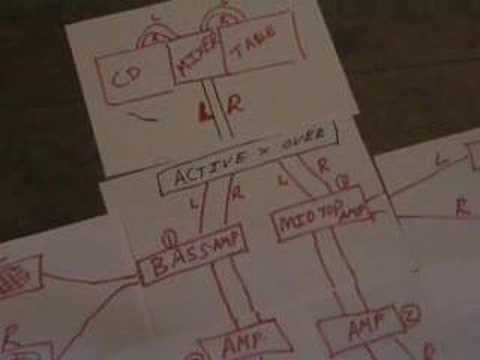
The DJ Tutor. Zoom out. I'll give you a general idea. Right, there's your typical setup. It doesn't really matter what it is, CD, mixer, turntable, etc. But what you'll find, always you'll have a left and right output. Now then, what you'll need is something called an active crossover. Now that is actually a powered system. What the active crossover does, it takes all the bass frequencies, the boom, you know, the sub from the mid and top frequencies and vice versa. It takes all the mid and top frequencies from the bass, and then it separates them. So a two-way active crossover will do this. What you'll have is you'll have at this point here, you'll have left and right coming into your active crossover, then left and right you'll have four outputs on this, and then you'll be able to go into the amplifier. Now this amplifier, even though it's a full range amp and it'll do all kinds of sound...
Because now the active crossover has taken away the mid and top, the bass amp now or known as a bass amp now is only utilising, only amplifying bass. So what happens then is you will then plug your speakers in and you can have bass cabs left and right because you've got left and right there and that will just run bass. Now the opposite applies with mid and top. You go from your active crossover left and right into your mid and top amp and then out of there ...into your left and right mid and top speakers. But, let's say you want to add another amplifier to mid and top and another amplifier to bass. Now this is what they do in big situations outside events, but they won't just have one or two amps, they'll probably have 20 or 30 just on bass alone, just for one side. Okay, so bearing in mind that's 20 or 30 bass amps for the left side and 20 or 30 bass amps for the right side.
4:12 Remember what I said and I showed you with my amplifier the link syste
Quite often as well they'll have a 3, 4 or 5 way system so just work that out how many amps they've got. Right now remember what I said and I showed you with my amplifier the link system. So what you're basically doing is you're going into this bass amp so the actual signal, the bass signal's coming into this one and then it's going across to these speakers here. But then at the same time you've got a link system that will go to the next amplifier Which is a bass amp, exactly the same. And then you can go to more speakers. And if need be, you could have another link going to another amplifier down here and more speakers. Likewise, it applies with the mid and top. You'll go from the crossover into the mid and top, into the speakers left and right, the mid and top speakers with no bass going into there, and then a link system which is basically exactly the same signal along those cables
As the signal that's coming along these cables, there's no difference. The signal there is exactly the same there. It will go to another amplifier which will be doing exactly the same as this mid and top amp because the active crossover has taken away the bass. So then you'll go in exactly the same to the mid and top speakers and then exactly the same principle applies with the mid and top. You can have half a dozen all the way along. It's what's known as daisy chaining them. And then you can get to a nice... Thanks for watching, practice and enjoy.
This transcript was produced automatically from the audio of the video and may contain mistakes.