 5:58
What bridging an amplifier means
On YouTube this video is called What does bridge on an amplifier mean
What this lesson teaches
He opens by inviting any sound engineer watching to make a better, more technical version and post it as a response - which tells you the level this is pitched at, and it is the right level for a DJ.
What a stereo amp is
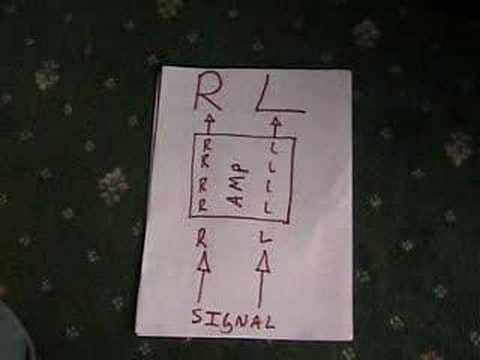
Two separate amplifiers in one box. Right in, right out. Left in, left out. They share a case, a mains lead and usually a power supply, and otherwise they do not interact.
What bridging does
In bridge mode the amp stops being two amplifiers and becomes one.
The signal goes into one channel, and instead of coming straight out of that channel it is routed through the other half as well, with the output taken across both. One mono channel, considerably more power than either side could produce alone.
Which means: a bridged stereo amp is a mono amp. To get stereo you need two of them, one bridged for the left and one for the right.
His analogy
An amplifier as a bridge you walk over. Normally it is anchored at both ends - signal in on one side, out on the other, and the structure carries what crosses it comfortably.
Bridged, the load is no longer distributed the way the designer planned. The same traffic is being carried by a structure working in a different configuration, and whether it copes depends entirely on how well it was built.
The warning, which is the point of the lesson
His own position, stated as opinion: do not bridge an amplifier unless it is a genuinely solid professional amp.
The examples he gives are from the top of the market - Macro-Tech VZ series, four of which he ran at 1565 watts a side into 4 ohms, and Lab.gruppen. Those got hot when bridged and handled it, because they were designed to.
A thousand-watt-a-side amplifier that cost two or three hundred pounds new will have a bridge switch on the back, and you can use it. What he is saying is that you should expect it to run hot, and to have a shorter life than the same amp used in stereo.
The practical reading
Bridging is a way of getting more power out of an amplifier you already own, and it is paid for in heat and headroom.
If you need more power, the better answer is usually another amplifier - which is cheaper than it was, and which the link sockets in the first lesson of this course make easy to add.
If you bridge anyway: check the minimum load the manual allows in bridge mode, because it is higher than in stereo, and a bridged amp into too low an impedance is the fastest way to find out what the protection circuit does.
Contents of the video
0:00 Bridging amplifiers

Alright folks, it's Jonathan here aka The DJ Tutor and I'm going to be talking about bridging amplifiers. I'm going to give sort of my interpretation. Now very quickly if you are an engineer, a sound engineer, I would like you please to make a video and give a bit more of an in-depth discussion on bridging amplifiers, maybe more technical and if you do so please post it as a video response to this one. So people say I'm like stage 1 Then maybe people then can look at your video and get more of an in-depth idea into what it's all about. Okay, now then. Right, bridging amplifiers, okay? Now what I'm going to try and do, I'm going to try and actually explain it on the lines of a bridge that you'd walk over. Now very quickly, right, bridging an amplifier, what we're mainly on about are the big professional pro amplifiers. Now before I go any further...
1:53 They have amplifiers called the VZ series
There's one thing I will say and that is, this is my own personal opinion, I don't recommend you bridge an amplifier or you bridge your amplifier unless it is a good rock solid pro amplifier. Now what I mean by that, if you've got a 1000 watts aside amplifier and it's brand new and it's cost you 200 pounds or 300 pounds or 400 US dollars etc. Thank you for watching. They have amplifiers called the VZ series. I used to have four Makrotech VZ3600s, which were 1565 watts a side at 4 ohms. They could be bridged. Even though they'd get hot, they were able to handle it because they were proper pro audio amplifiers. And also the likes of Lab Groupon. Just a couple of makes. So again, very quickly, if you have got a cheap amplifier and it says bridge on the back, all I'm saying,
You still can bridge it, but just be wary, OK? Because there's a possibility your amplifier could overheat and it won't last as long as if you just used it normally in stereo mode. Right, now then, if we go on to the first sort of picture. Generally an amplifier... A stereo amplifier is two separate entities inside. You have an in and an out. The in is your input from your mixer, the out is going straight to your speakers. Now then, if we look at it from this point of view here, there's your amplifier. Stereo in, right left, stereo out. The signal going in is small, it's amplified inside here and it comes out a lot powerfuller, louder through your speakers. Now, what I want you to do, I want you to imagine that each amplifier is like a bridge. There's a plateau here where it's fitted and secure on the inside, coming in, the power coming in, and then as it goes out, it's secure and the power goes out. Now these people here, let's say that's the signal, that's the actual music running over the amplifier, and because the amp is secured either side, it's able to handle what's going over it.
3:40 What's actually moving through that amplifier

What's actually moving through that amplifier. Now what happens is when you bridge an amplifier, it doesn't go in one side and out of that same side. It actually goes in the one side but then let's say it goes in through the right side. What happens then? The power is then taken from the right side and passed through the left side and then it goes out. Now this is where we start to get problems because The DJ Tutor offers a wide range of features and features to choose from. The DJ Tutor offers a wide range of features and And you have a right channel and a left channel. Now, normally what would happen if we go back to this picture here, you'd see the amplifier would run right side in, right side out, left side in, left side out. When you bridge an amplifier, what's happening is you're going right side in or left side in, dependent on your amplifier. The sound will then travel through the one part of the amplifier, the right side.
But then instead of coming out, it will be redirected through the left side and then come out. So the stereo amplifier is no longer a stereo amp, it's a mono amplifier. Likewise then you'd need another one to get stereo. So you'd have the left side from your sound going into the amplifier, into one side, being redirected through to the other side of the amplifier and out left. Now, this is basically a brief description. Like I've said, it would be a nice idea if there's anyone else out there who can go a little bit more technical where this is concerned in relation to Ohm's Law and what exactly happens inside the amplifier. Thank you for watching, practice and enjoy.
This transcript was produced automatically from the audio of the video and may contain mistakes.