 9:13
What is your home pa,active x over,2 and 3 way pa???
Contents of the video
0:00 Crossovers, speakers, passive
G'day folks. Right, it's a bit of a video here now on PA systems. One-way PA systems, two-way and three-way, crossovers, active crossovers, passive crossovers, all that boring sort of stuff, but then again it is quite interesting because when you're in your bedroom and you're looking at your speakers and you think they're the whopping big fantastic marvellous things that annoy the neighbours, spot on, that's what we like to do. As you know, if you go to a nightclub or you watch a band or you watch a DJ at an outside event, they won't just have one speaker throwing out all the sound, they'll have half a dozen of them. So this is a brief description, brief mind you, and please don't look at the pictures and think that's what the speakers look like because if they did, they'd sound shit. Crap. Right, okay, so I'll pause it here and I'll show you some of my very, very dodgy diagrams. So, excuse me.
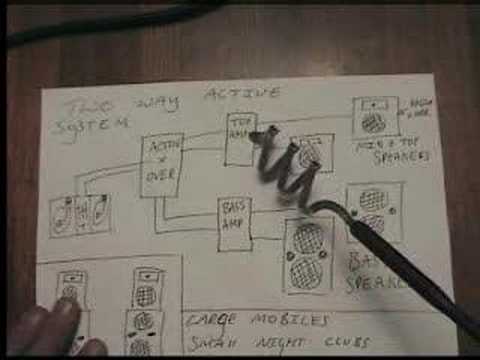
Folks, here we have a very simple setup. And by the way, this is a pasta twirler for the pointer today. It's not my son's sword, but who gives a monkey's, right? Basically what you've got here is your normal average setup. Two turntables and that's a mixer. So that's what that little diagram there is. So those could be CD players, PCs, DAT machine, MP3, even your PC. Then what will happen, you've got two lines here, that's left and right. They'll go into an amplifier, stereo amp, they'll go out of your stereo amp so you've got one lead going into one speaker, the other lead going to the other one. Now in these speakers here, if you've got two speakers, a big one and a little one, the big one will throw out the bass and the mid, that kind of sound. The top one, the small one, will throw out the high frequency.
2:20 What do we use these for?
In that speaker you will have what's known as a passive crossover. Now what that does, when you have the output, the signal from the amplifier, that very loud signal, it will go into here and it will go into a little passive crossover. What that will do, the passive crossover will do two things. It will cut the bass frequencies, the bass sounds, and it will only allow high clapping frequencies into this top speaker. And it will do the opposite to this one. It will take away all the high-pitched sounds, the hi-hat, the clap, the really high pitched screaming horrible vocal females that we sometimes hear and it'll take them out and then only have bass sounds going into here. So what do we use these for? Small PA, home use, small mobile discos and dodgy things like that. And generally what you'll find as well in band PA and discos, you'll always have them on stands because if you have them on the ground
And then you get, if you imagine, there's the crowd of people there and they're on the ground down here. Of course, as soon as you've got people in front of them, you won't hear them. So always have them on stand. Right, now that's the simplest. Oh, no, it's over here. Right, the next one is something where we go a bit more technical. This is called, my God everyone say, this is called a two-way PA system. Just the same, exactly the same as the last one. There is your source of sound. Your mixer. Turn tables, CD, DAT player, MP3, dishwasher, washing machine, tumble dryer, whatever you want to do. Now here this is where we go quite different. We go into, left and right, into what's known as an active crossover. Now this is actually powered so you've got to go from the mains. Now what the crossover does, this active crossover, this here will separate bass and mid and top. The bass will go then
Left and right into one amplifier. Now, you don't buy bass amplifiers. This could be any box standard amplifier. The reason this will only produce bass sound is because the crossover here has taken away all of the mid and all of the top. So you only have bass going into this amplifier, then left into a bass speaker which could be two 15s, two 18s, two 21s, two 24s, one 18. The top amplifier, out of the active crossover, again into the top amp or a normal amplifier and what the active crossover will do, for this one here it will take all the bass so you will only have mid and top. And then the same applies here. It will go into some other speakers with say, I don't know, maybe a 15, a 12 inch and a horn.
4:44 Large mobile discos, small nightclubs, band PA
Quite often though you will still have your passive crossover because even though you've admitted, admitted, duh, you've taken away the bass, you've still got a lot of mid and if you put any mid into this high frequency compression driver it will blow it straight away. So you've still got to have a passive crossover to separate the mid sound from the high frequency sound. Now these guys... Large mobile discos, small nightclubs, band PA. And then that's what they'll look like. Generally you'll always have the bass speakers on the floor, the mid and top on those, and you're sort of looking about head height here so there's no real need for any other way of putting them on top of each other. But occasionally what you'll have is you'll have, if you imagine there's the bass speaker and you'll have this guy up here and people will pole mount them, they'll have a pole.
So the mid and top cab will say be above head height because the high frequencies need to be thrown a great distance. If you have anything in front of a high frequency, it will actually stop the sound. Bass frequency is what's actually known, the terminology is omnidirectional. In other words, if you have a bass cab facing away from you, you'll still hear that bass very clearly. A treble unit facing away from you, you will still hear it, but if you slowly turn that speaker towards you, the sound will become more prominent. So that is the basis of a two-way system. Now what we've got here now is what's known as a three-way system. You can also have four-way and a five-way system. Here you've got the basis of your...
6:31 Your audio input, you've got mixer, turntables, CD player
Your audio input, you've got mixer, turntables, CD player. You can even have a band mixer here which of course then you'll have microphones and all that kind of stuff in so the drums are mic'd in, the guitar would have his guitar mic'd into this, the vocals etc. Again you would go into what's known as an active crossover but again it's a three-way stereo crossover and instead of being top and mid and bass, in other words top and mid for one channel, This is a three-way, so on this one you will only have top, high frequencies, the hi-hat, the clap, the clashing really high sounds. The mid will be your vocals, it will be the melody and bass, basically the bass line. So out of your top you will go into one separate amplifier left and right. Out of that amplifier you'll go into a high frequency box which is known as a horn.
Compression driver. And then also the same there, so that could be left, that could be right. Then the mid, you would go into another separate amplifier, into mid boxes. These guys here could be say 8 inch, 10 inch, 12 inch cabs. Again here now, because you're separating the sound completely, there would be no need for a passive crossover, because the active crossover will be doing its job. So treble, Mid, and then these guys here, which is what we like, it's the good old bass. You've got to have a bit of bass. Low bass, mid and high. Now think about it, what have you got on your mixer? Quite often you've got three knobs, high, mid and low. Guys, this is exactly what these speakers are for. High, mid and low. So when you cut out the mid on your mixer, you will eliminate quite often the sound from here.
Likewise, you will eliminate the high frequencies. Likewise, you will eliminate the bass frequencies when you cut out the little knob and you turn it all the way off. Right, what do we need these guys for? Large PA, outside band, clubs, raves, and please, this is not for home. Home. My God, I can't even spell to save my life. Hom. Right, I'm going to do that right now. Hom. Bloody hell. Right, OK. Hold on, let's get a pen. Home. Not for home use. I can't spell to save my lift. Have I done anything on there? Yeah, there you go. So that's the sort of thing you'd have. You'd have the bass speaker there, you'd have the mid and top, and you'd have the high frequency there. Now if you've ever...
This transcript was produced automatically from the audio of the video and may contain mistakes.