 6:59
Mixing an acapella into a beat
On YouTube this video is called DJ Tutorial How to mix An Acapella into a beat.
What this lesson teaches
The foundation lesson for the course, and it rests on one piece of information most people never think about.
What an acapella is
His definition, for anyone who has not met the word: a version of the song with the beat, the melody and the bassline taken away. Just the vocal. That is all.
They turn up as the last track on a twelve-inch, as an extra on a CD single, and as a separate file on digital releases.
An acapella has a BPM
The sentence to take away, because it is not obvious: the acapella has beats per minute.
It sounds like it should not. There are no drums in it - nothing to count. But the singer was recorded over the backing track, so the vocal is in that tempo, and it stays in that tempo when the backing is stripped out.
Which means an acapella can be pitched, beatmatched and dropped onto another record exactly like any other track. It is not a free-floating thing you lay over the top and hope; it is a record with a tempo that happens to have no drums.
And it came from somewhere
The second half of the insight. If the acapella was released alongside the original mix, then - as he puts it, 99.999 per cent of the time - it is in time with the original. It was cut from it.
So you have a reference. Play the full version, hear where the vocal sits against the beat, and you know where it sits on anything else at that tempo.
Finding the one
The practical work, and it takes a minute per acapella.
He plays the vocal and finds the first syllable - the point where the words land. Then he counts: one, two, three, four. The vocal begins on the one, because that is how records are made.
Mark that with a cue point. From then on, starting the acapella is the same job as starting any other record: drop it on the downbeat of a bar.
That is the whole technique. Everything else in this course is a variation on it.
The loop record
A good aside. The vinyl he has to hand has loops pressed into it - five or six of them, each a bar or two of a beat, cut as a continuous groove so the needle circles in place indefinitely.
That is how DJs had loops before mixers had loop buttons: somebody cut them onto a record. Put the needle down and you have a beat running for as long as you want, with no loop function anywhere in the signal path.
Worth knowing because it explains where the technique came from, and because records like that still work perfectly.
And his invitation
Worth noting for what it says about how the channel worked. He admits he rarely gets round to video two, and offers it out: if you know more about this, make the follow-up yourself and post it.
A fair offer, and this course exists partly because he kept making them.
Contents of the video
0:00 I do quite often, but I'm really busy
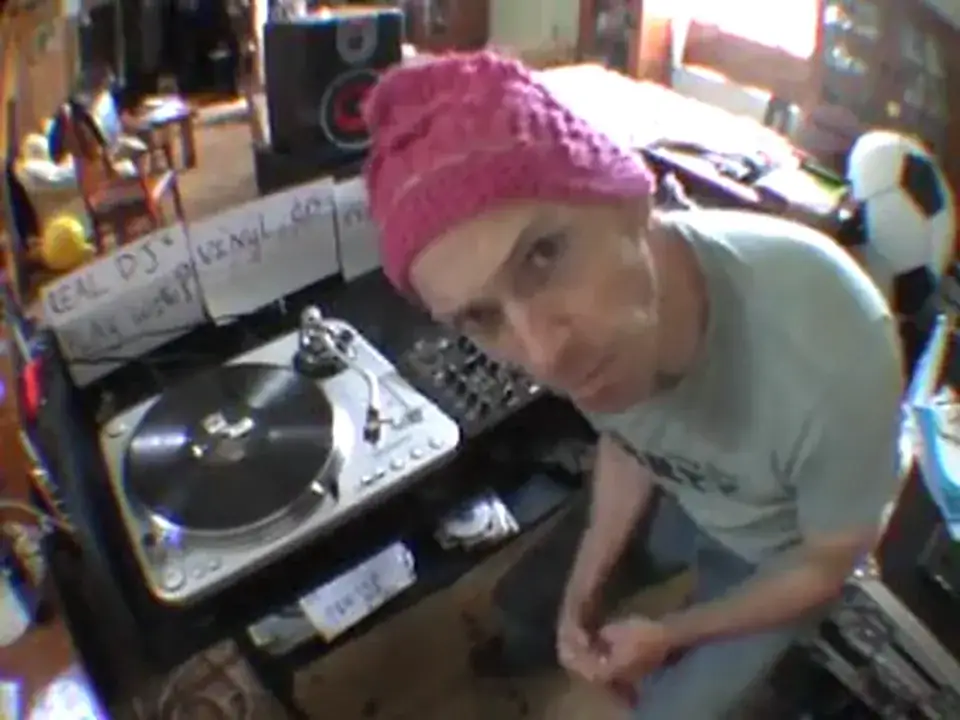
Alright folks, loads of pausing and probably not much editing on this video, but this is video number one. By the way, very quickly, a lot of people out there say, well you never really do video two, three or four on anything you do. I do quite often, but I'm really busy. So here's the deal, if you can do a video number two, then do it. Chuck it underneath here. If you've got a bit more knowledge on what I'm about to discuss and show you what to do, then you do your bit and post it as a video response underneath here. Anyway, video number one for me on mixing... Acapellas. I might have done one in the past. I've done so many damn videos, I can't remember. Right, first of all, I'll show you the tracks I'm going to be using. Hold on. Alright, that there is a track by Eddie Amador entitled Rise. OK, what I'm going to be doing, I'm going to be mixing it in with that one over there. Now, that is the acapella. Now, I just want to show you this track here because this may interest a lot of people.
Okay, you may have or you may find that your mixer possibly has not got loop on it. Well guess what? There are some vinyls out there that have got loop on the vinyl itself. Basically what you've got is you've got a loop like so in beat, in time and you can use that. What you do is basically put the needle on the record and it'll just carry on going around and around in that loop and there's about five or six on here. This is on subliminal records. And it's Harry Choo Choo Romero Beats Volume 2. Now what I'll do, I'll put this on and have a listen. Bearing in mind there's different ones. This is the one I'm going to be using to basic loop. By the way, also in this video, the acapella I'm going to be using has got a bit of swearing in it, so I do apologise.
2:28 We'll find the beginning
For people out there who don't know what an acapella is, basically it's part of the song whereby someone has taken all the beat, the melody, the bass line away and you're just left with the vocals. That's it. Let's have a listen to the acapella. Here we go. Right, I'm going to put the fisheye back on the camera and we'll run you through what you need to do in a sense. Okay, right, I'm all set up. What I'm going to do now is go to the beginning of this acapella. And first of all, we're just going to have a listen to it, nothing else. So, we'll find the beginning. What I'm going to do is I'm going to turn the record over and have a listen. Here we go. Now this will be the same with 99.9% of acapellas you have. In other words, if you have a 12-inch single, CD, it doesn't matter, and you've got an acapella along with the original mix, then the acapella, 99.999% of the time, should be in time...
With the music whereby you've got the acapella in with the original track, so therefore we're getting now somewhere whereby in a sense I suppose you should be able to understand how you can mix acapellas with beats because theoretically they should be in time with the original music. Now let's have a listen to the track where we've got that acapella in it. Alright, hopefully that'll give you a general idea. What I'm going to do now is go back to the acapella. Now what I'm going to do is tap with my foot.
3:55 It's the way my mind works sometimes
Actually also, before we do that, let's get the I, the first... Do this first. It's quite important. It's the way my mind works sometimes. Bang! It went on the one. I just can't believe all the things... Now if I was to count this in bars, I guarantee you it would be at the count of 1. 1, 2, 3, 4. 1, 2, 3, 4. Like so. Now straight away, hopefully, you may be starting to get the picture here. What we'll do now is we'll go back to the acapella. It jumped, sorry, I made it jump. OK, so what I'm going to do now... I'm going to mix that in with this track here. So, we'll start this off. This is Eddie Amador, track entitled Rise. I'm going to count the bars. One, two, three, four. One, two, three, four. One, two, three, four. One, two, three, four. Real DJs do not play with bananas, they don't play with vinyl, they don't play with CDs, they don't play with themselves. Maybe if they wanted, they'd play with music. Right. OK. Find the beginning.
So basically what we're dealing with is the acapella has a BPM as well. The acapella has beats per minute. This is video number one, in video number two I'm going to get a classic track by Tony Lee entitled Reach Up and I'm going to be using the acapella I'll find out and you will as well. Practice and enjoy. Thank you.
This transcript was produced automatically from the audio of the video and may contain mistakes.