 6:22
Mixing trip hop
On YouTube this video is called HOW TO MIX TRIP HOP, This style is similar to hip hop
What this lesson teaches
A requested lesson, and he defines the genre by triangulating from two you already know.
The comparison
House: steady four to the floor. One, two, three, four, every beat marked.
Hip hop: broken - dum, cha, da-dum - no four-to-the-floor kick, but still in time. A track that starts at 98 or 100 BPM finishes there.
Both have melody, both have a bassline, both have a beat, and both hold their tempo.
What makes trip hop different
The operative word, as he says, is trip.
It is a trippy kind of music: samples thrown in, an eerie quality, odd effects scattered across the arrangement. Where hip hop usually has a rapper or MC running all the way through, trip hop very rarely does.
Why that matters for mixing
Because the vocal is the hardest thing to mix around, and this genre mostly does not have one.
The no-vocals-over-vocals rule is the binding constraint in hip hop and in pop - it dictates where the overlap can be and how long it can last. Remove it and your options open up considerably: you can hold two trip hop records together for a long stretch because nothing is demanding to be understood.
What you have to watch instead is texture. The samples and effects that give the genre its character are the things that will clash - two eerie atmospheres at once is muddy in a way two basslines are not, and it is harder to EQ out, because the material is spread across the whole frequency range rather than sitting in one band.
In practice
Longer overlaps than hip hop allows. Attention to the top end, where the atmospheres live, rather than only the bass. And the usual broken-beat counting: find the snare, count in half time if the tempo makes full time awkward.
Contents of the video
0:00 Hip hop, you've got dum, cha, da-dum, dum, cha, da-dum, dum
Alright folks, Jonathan here. Someone's asked me to do a bit of a tutorial on the likes of Trip Hop. Now first of all, house music, steady 4-4 time, bam, bam, bam, bam, 1, 2, 3, 4, etc. Hip hop, you've got dum, cha, da-dum, dum, cha, da-dum, dum. So you haven't got that bam, bam, bam, steady 4-4 or that bass beat, but they're both in time. Theoretically, if one starts at 120 BPM, it should finish at 120 BPM. With hip-hop, maybe it starts at 98, 100 BPM, it will finish at 98 or 100 BPM. Now the reason I'm talking about house, talking about hip-hop, trying to get a similarity here, is house music, there are lots of different genres. You've got techno, trance, electro house, etc.
They're all relatively the same with regards to the actual beat, a steady 4-4 beat. Tiny little subtle differences. The likes of hip-hop, quite often you'll have a rapper or an MC go all the way through. Yes, you'll have melody in both of them, trip-hop and hip-hop. Yes, you'll have a bassline in both of them. Yes, you'll have the beat. But what you find with trip-hop, the operative word here is trip. It's a very trippy sort of music. There are different samples thrown in and it's quite eerie and sort of weird, funny, googly effects all over the place. That's a nice word, isn't it? And very rarely do you have a continual rapper going all the way through.
4:21 We'll start leaner off, here we go
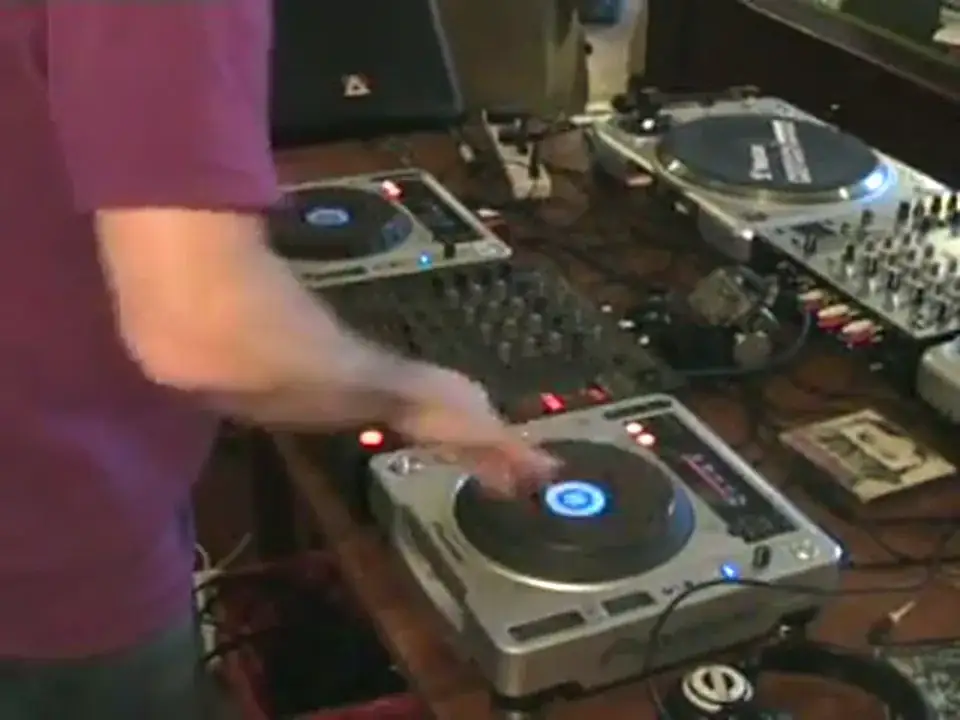
Now there's, probably people are going to say now, oh I've got loads of trip-hop with rappers all the way through. Oogies and monkeys! Right, this is the album, I'm going to play a cut from this, it's called Dope on Plastic, and the track I'm going to be playing is Primal Scream, Jailbird, and I'm going to be mixing it into Lena Conquest, a track entitled Boundaries. Now again...
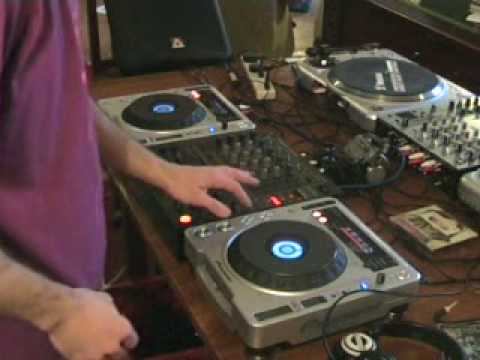
Very quickly as well, with regards mixing trip-hop. Exactly the same with any other sort of modern day dance music. You've got to be in beat. The timing's got to be right. Ideally get it in bars and phrases. And also just as important, the key has got to be right. It's got to sound nice. Sometimes, I mean I do it occasionally, we all do it, you know, you play a track and you think that doesn't sound right, it's in beat, it doesn't sound right. It's possibly because maybe slightly out of key or maybe you're hearing ga-dunk, ga-dunk, ga-dunk. Again, if it starts going off, don't try and get it in beat and think, oh my goodness, and it's going ga-dung, ga-dung, ga-dung. Bit of a train crash. It's better to whop it straight out and start again. Right, here we go. So I'll put the camera down there and the kids are coming home soon, so we'll give it a go. On this side we've got the actual trip-hop track and this side we've got Lena Conquest. So what I'm going to do, I'll play the beginning of this one first. Have a listen.
This is funky, this is seriously soulful. Wicked track. That is bad. And this is the trip-hop one. Not all trip-hops like this, alright? We'll have a listen to another couple of cuts. Let's go to, say, track five. I'm just going to chuck this one out, hold on. It's a nice, relaxing sort of music. The face. Wrong one, we'll go back to number two. And... What I need to do is get it right at that beat, the first beat. So about there. So we'll start leaner off, here we go. What I'll do, I'll go forward a little bit. Enjoy myself actually, because it's wonderful, because I'm sat here now, what not, I'm standing up too big, pardon. Right, I'm standing here now in this place and there's, hold on, shh. It's just me and it's great, it's good fun. So I'm enjoying myself, I'm having the time of my life because I'm sharing a lot of information out there.
And I'm getting other people motivated as well. It's what it's all about, there's a tiny little lens there and I'm hopefully facing the world. So there you go, it's a little bit of an insight into mixing trip hop. At the end of the day, it's no different really to the likes of hip hop. Practice and enjoy.
This transcript was produced automatically from the audio of the video and may contain mistakes.