 6:52
A beginner's vinyl mixing lesson
On YouTube this video is called Beginner Vinyl DJ Mixing Lesson
What this lesson teaches
Demonstrations first, then the explanation - and the method he explains is the one to use any time you have no numbers to read.
Finding the direction by testing
He starts the record on the one, and hears it drifting off beat. Which way should the pitch go?
Rather than guess, he tests:
1. Move the pitch to minus. Start again. It goes off beat faster - so that was the wrong direction. 2. Move it the other way. Start again. It still goes off, but more slowly - so this is right. 3. Keep going in that direction, in smaller steps, until the drift becomes negligible.
The insight is that the rate of drift is the measurement. You do not need to know either tempo. You only need to know whether your last change made the separation faster or slower, and that is something anyone can hear.
It is a search by feedback rather than by calculation, and it works with no display, no BPM, no waveform - which is exactly the situation on a pair of turntables.
The paper trick
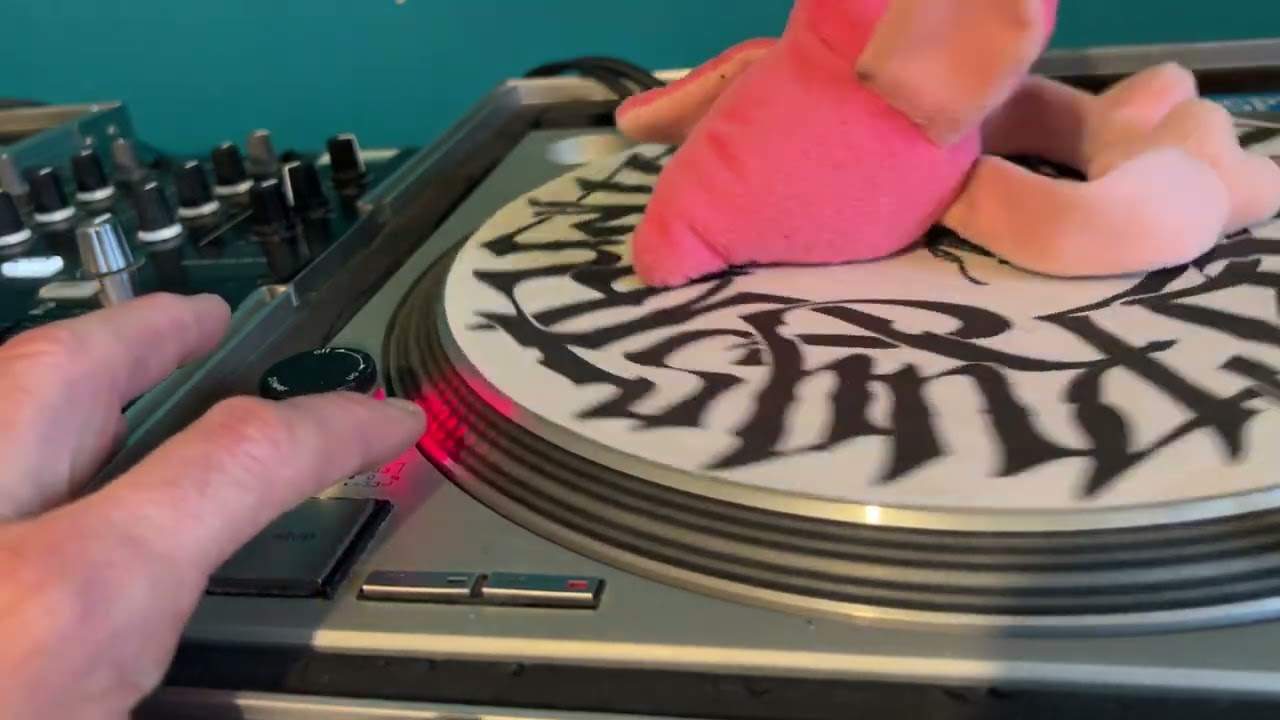
He lays a small piece of paper on the record while it plays.
It is a visual indicator: if the paper is travelling, the vinyl is travelling. When you have a hand on the record and are not sure whether you are actually holding it or merely touching it, the paper tells you at a glance.
A small thing, and useful when you are learning what your own hand pressure does.
Two pieces of practical advice
Stick to similar genres. He is firm about this and it is right for a beginner on vinyl: do not try to mix hip-hop with house. Records within one style sit within a few BPM of each other, which keeps the pitch adjustment inside the range the fader can comfortably reach.
Find the BPM with a stopwatch if you want a starting point. Some records have it written on the label and some do not, and the thirty-second count from the counting stage works on anything.
Why this lesson matters beyond vinyl
Because the test-and-observe method is the fallback for every situation where the machine cannot help: a track the software analysed wrongly, a live recording that drifts, somebody else's equipment with the display broken.
Move it, listen to whether the drift got better or worse, and act on the answer. It is slower than reading a number and it never fails.
Contents of the video
0:00 Some rather large tips on learning how to mix using vinyl
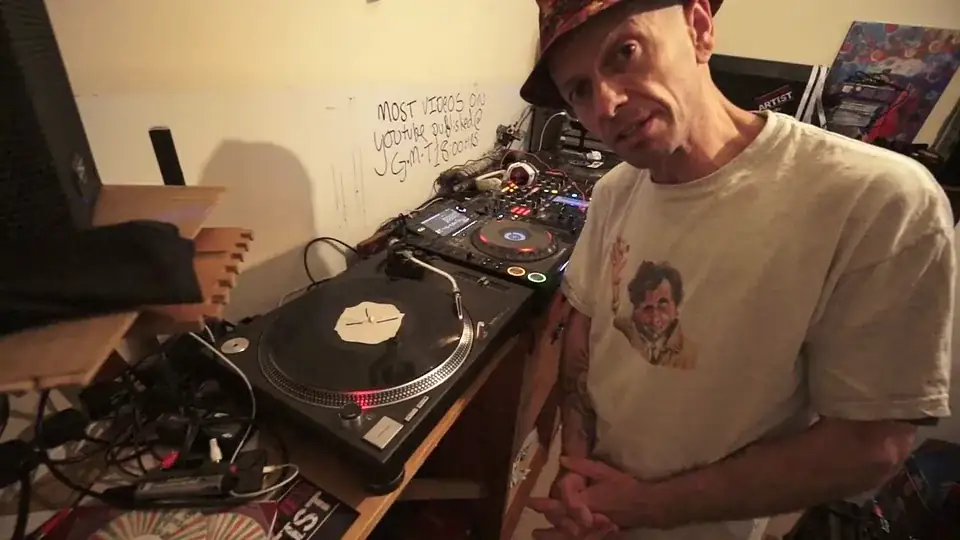
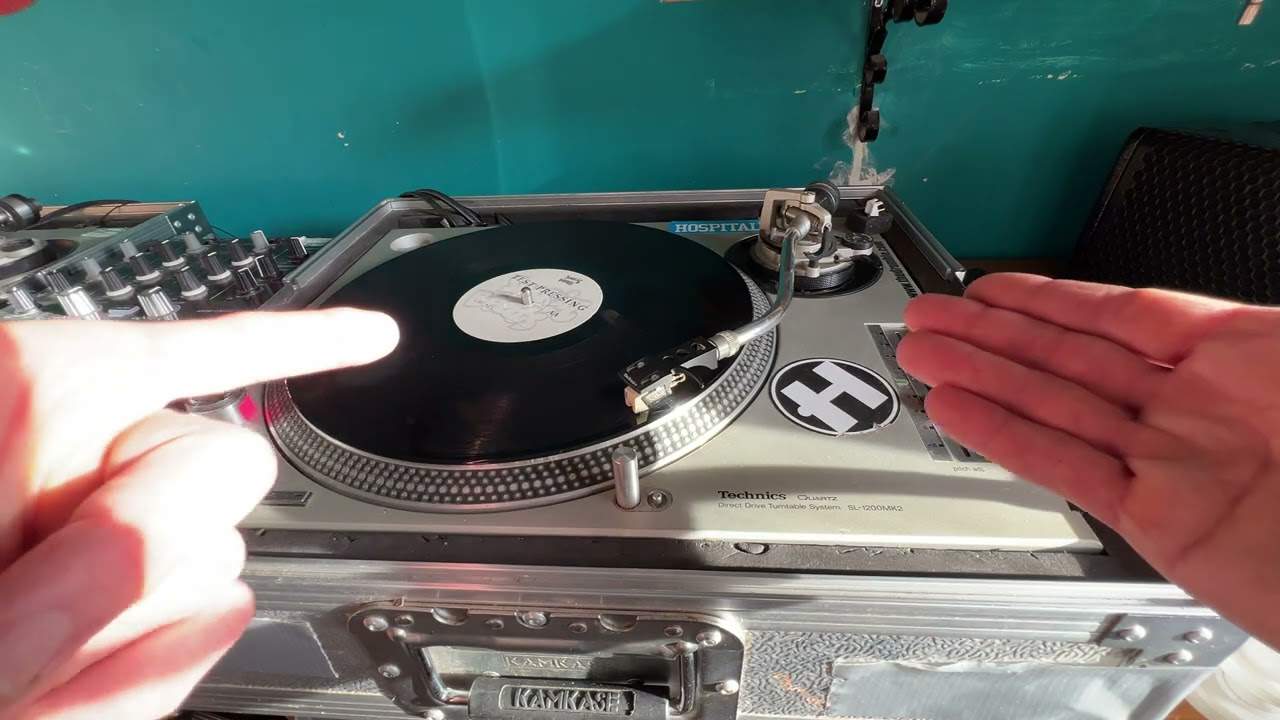
Alright guys, some rather large tips on learning how to mix using vinyl. First of all, a bunch of demonstrations and then the explanation, and then the explanation as opposed to why I'm explaining it. Here we go, right, ok. Ok, we're pretty much there. Alright, so what's happening? First of all, I'm making sure I bring in the vinyl record at the count of one. I've also got a loop on the other side just for my timing. I put that piece of paper on the vinyl, so what that proves and what it shows you is that the platter is moving underneath. You probably should be able to see it because we're in HD now anyway with the side of the platter. But it's just another way, another visual way of you seeing when the vinyl isn't moving or is moving.
What I did is, I started the piece of vinyl on at the count of one when I started it the first time and I heard it was going off beat. I then moved the pitch to the minus position and it went off beat again but it actually went off beat quicker. Well that told me that I was moving the pitch in the wrong direction. I then moved the pitch towards me, did it a third time and I listened and I realised that it's still moving. It still went off beat but not as fast, which means I was heading in the right direction. And then I just manually used the pitch to fine tune it, which is a little bit more advanced. But for the beginner out there, what you need to do is simply this. Let's imagine you've got a track playing on your right hand deck and you've got a track on the left hand deck.
2:36 All you have to do is, the turntable is playing on the right
Now also, this is great for people who have got no form of BPM readout whatsoever. You've got zero nothing squat data. All you have to do is, the turntable is playing on the right. The one on the left, for example let's say, and let's say you know you've got some house tunes and you know they're going to be around about the same BPM. Anyone who's a vinyl DJ, you're not going to start hopefully, please don't, start mixing hip hop with house music because that's going to be really really difficult. Make sure you've got similar genres of tunes. Make sure as well, if you can, again I'm digressing slightly but this is really important. How do you find the BPM of a vinyl record? Some may have written down. You may be able to go online and find it.
But another very quick and easy way of finding your BPM of your piece of vinyl or a rough BPM is just a stopwatch. Use your phone, it's got a stopwatch on it. Start the piece of vinyl off. Make sure it's at the centre point. And when you hear a kick, it doesn't even have to be the kick of number one. It could be anywhere. Beginning end of a phrase, half way through it where someone's going Doesn't matter. All you have to do is count down That would actually be quite difficult so long as they're doing that in time. Forget that bit. Just rewind there a minute. Right, okay, you've done it, well done. Jolly good. So all you do is you start your stopwatch and you wait for 30 seconds to go past. If you've got 62 BPM, that means it's 124 BPM, beats per minute
4:33 They live in the Indian or the companies
Because you only counted half. So that will give you a rough idea. Remember this isn't the machine doing it. It's your brain so it's not going to be as precise. Yes, all right, some people are saying your brain is more intelligent than a machine. It is actually. There's more connections in your brain than there is in BT Telecom. What a waste of time that is, isn't it? They live in blinking China or something. They live in the Indian or the companies. Sorry, anyway, sorry, so right. So what you're doing then is you've got a couple of tracks. You've worked out the BPM. What you do then, you've got your track playing on one turntable and then on the other one, you've got the track ready here and make sure the turntable's moving as follows like this.
You can see it's moving because I've got that at the top and if you've got your vinyl turntable facing towards you like this, it's always a good idea to hold the vinyl here at the 9 o'clock position, not here and not up there. Here. Now think about it. All right, with your arm here, you've got... It's going to be very awkward to push it off. Here, at the front, at the 6 o'clock position, you're very close to the styli, the needle and you don't want to knock that. At the 9 o'clock position, you have got from 6 o'clock to 12 o'clock or in fact 6 o'clock, actually 5.32 up to around about 2.28 and 30 seconds there a pure and utter nothingness. So you're not going to knock anything. So the next stage is of course while that piece of vinyl is playing
To drop this one in at the count of 1. So you'll be counting one, two, three, four. One, two, three, four. Now also you'll notice you can hear the forward and back motion. It's great for a beginner because what this will do, this will help you with your timing. So for example, here we go. One, two, three, four. Something like that. Okay, I hope that's been a help and don't forget I am still doing Skype DJ lessons one-to-one so if you're interested in having Skype lessons by myself, Jonathan, the DJ tutor, then check out the email in the description and practice and enjoy. Thank you very much.
This transcript was produced automatically from the audio of the video and may contain mistakes.