 9:18
DJ Mixing Skills to Improve Your Muscle Memory with Riding the Pitch and Loops
Contents of the video
0:00 Let's go back in time to when people started DJing
All right, so let's go back in time to when people started DJing. You had a couple of turntables, if you were lucky, and you put one track into the other. Slowly over time, through the late 60s and 70s, you started having certain sort of blending where one track would phase out, the other one would come in, and then towards the middle of the 70s maybe, yeah, middle of the 70s really, people then started really doing transitions, forming one track over to the other. No software, nothing like that, just hardcore direct drive or belt-driven turntables. Of course, now we've got the technology to do everything, but a lot of people today are misusing that technology. They're abusing it, and they're just using everything and anything about it.
Now let me give you an analogy here. Let's imagine you go to an event, you take a whole bunch of kit, lights, deck, you know, you take everything. It takes hours to set up, only to find 50 people turn up and 10 of them dance. Job satisfaction, eh? It's like it's gone out the window. It's like you think, you still get paid, but you think, well, I didn't enjoy it because I wanted the people there, I wanted them to dance to see me and hear me and get that vibe and energy. Well, it's sort of similar with the kit that you've got, because your kit, if you think about it, is the setup. And when you form that mix with the two tracks, that's like... The people, in a way, it's sort of like the analogy how it may work, may not. Some people may agree or disagree.
But you see, if you're abusing the technology and forming a mix, a transition, what part of that transition are you actually doing? Are you just doing track selection? Are you dropping it at the right place? Are you key-matching it? Are you beat-matching it? Or are you just pressing sync, hoping for the best, and looking at wave formats all day?
So... Really, even if you do a great mix... Are you pleased with it? Are you happy with yourself? That's the question, because you need to be happy with yourself. If you're happy with yourself, then it's an explosion of only good, not bad. So this sort of demonstration will help you. It's called riding the pitch, where you need to use the pitch, you don't look at anything else... Yeah, I'll cover the screen, I mean, I don't think it matters anyway. But if I cover the screen, then no-one can say that I'm looking at the beat. I'll just... I'll just do that. I'll put the camera over there, so you can see it better. There you go, so I can't see it at all. Right! OK, so what I've done is... It doesn't matter about the tracks because it's just basic loops.
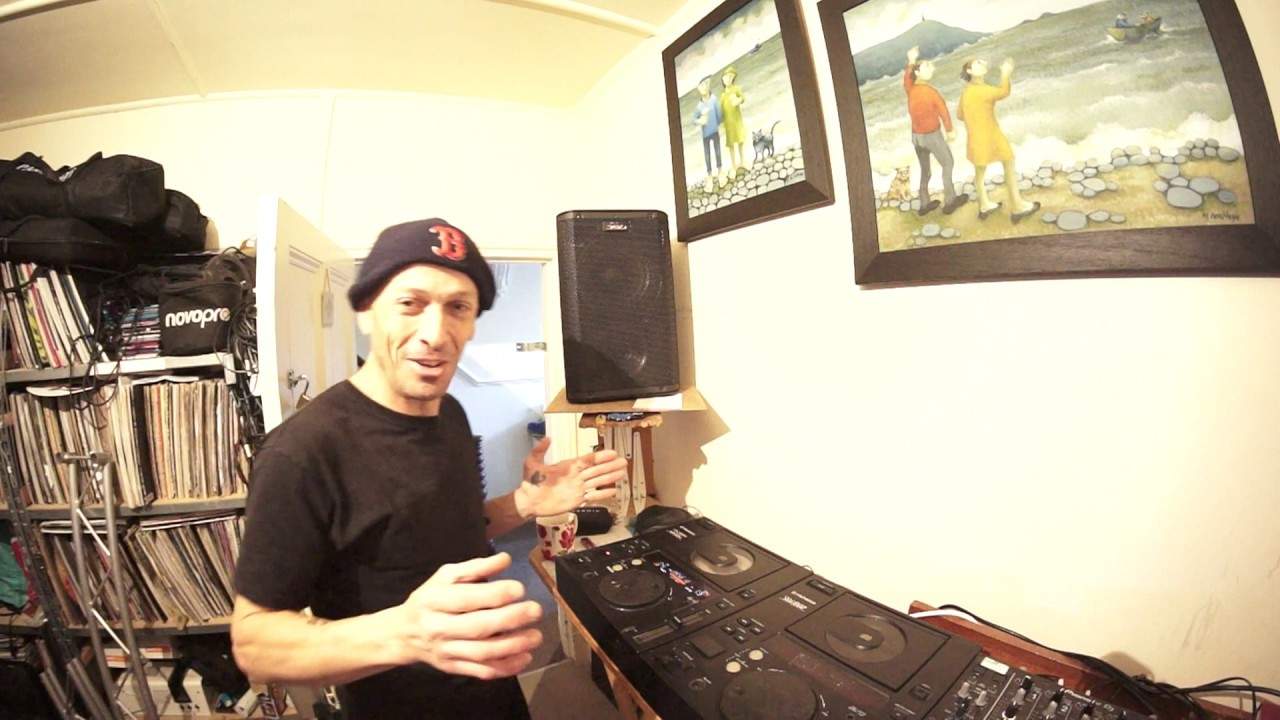
I've actually got the original CDJ-500 Mk II Limited Professional over here with a loop that could be a little bit out, not sure. And over here, a loop that's definitely out. Have a listen.
2:50 The objective is to mix these two together
There. OK, so the objective is to mix these two together. So first of all, I'm going to let them play together. Try and get them in beat-to-beat. As fast as I can, then leave them to it. And you will see... Over time, they'll start to go off. I think you get the idea. All right. Let's take the headphones out. Now, you may see me do some big moves. I'll explain that in a bit. So what I'm doing here is even though the loops are off, I'm trying to keep it in beat. It's a little bit like keep fit, you know? Keep your body fit by running or cycling or exercise. Here, I'm trying to keep my brain fit. OK, so let's turn that off now. Right, let me give you another analogy. I think it was... I was the first person in the world...
In fact, yeah, I was the first person in the world to give the analogy about the cars. Two cars, Audi and BMW, both traveling at the same speed. All of a sudden, the Audi starts to go 10 miles an hour faster and then stops after 10 seconds. Now... The BMW then thinks, oh, you're in front of me now. Well, the only way that BMW is going to catch up with the Audi is to go 10 miles an hour faster for 10 seconds and then stop. Well, not stop, but then continue at its original speed. So what I was doing there, I was almost doing the equivalent. The one car had gone faster. And I needed to increase the speed quite considerably to catch up and then slow back down. So my moves, you saw where my pitch... Where my fingers were on the pitch at that point, where it was sort of in time when it went out of time.
I moved the pitch very abruptly to sort of like put that foot on the gas, move it forward really quickly, but then slow it back down to where it originally was. Now again, you can look at the BPM. To get an idea. And it's probably there, it is a good idea to look at the BPM because if you're looking at the BPM and you can see at the point where the pitch is your 121 BPM, for example, and you bring it forward when you put it back, you need to be at 121 again. But you don't. Because if you were at 121 and it was off and you go back to 121, you're going to have to repeat the process again because that wasn't the correct speed. Because you had to make it go faster, if that makes sense. But then again, to add to that, because we're mixing loops, then it might be the right speed.
6:58 To elaborate on that, let's imagine
But because the loop is out of time, it means that the BPMs may be exactly the same. But because that loop may have been too short or too long, there's a tiny little gap where there will be a fluctuation. But then it'll get back to said original time. So, to elaborate on that, let's imagine. And here's a good way of looking at it. Let's imagine we've got a farmer and he sticks a post in the ground there. And the next post he sticks in 100 centimetres along there. And the next post 100 centimetres along there. And the next post 99 centimetres there. And then... We go back to the first one. So, in a way, imagine that those posts are a circle. And inside there's a little sapling. A tiny little oak sapling growing.
How beautiful! OK. So if you think about it, the first beat, the first post is in time with the second one. The second's in time with the third. And the third one is not in time with the fourth because there's a fluctuation. But then the fourth one is in time with the first one. So it's actually in time if you have a loop that's sort of out of time... Another loop that's out of time. So, for example, the second loop... The second line of posts may be the first one is at the first position. The second post is 100 centimetres. The third post is 100 centimetres. But the fourth post is, say, 98. So by definition, both of the tracks... Both of the tracks, the loops, are at the same time. But the last beat is out of time.
Now I hope that really does make sense. It's sort of logical but at the same time it may make your brain explode and blood all over the ceiling and guts flying everywhere. Actually brains... Guts are down there. Sorry. Yeah. So I hope you get it. Alright now this is really good practice again. This is something... This is what we call muscle memory. And it's about DJ satisfaction. I can't... Oh no, I don't want to do that otherwise I'll get caught for playing music. I can't get no satisfaction. But I... Which I tried. I can't get no satisfaction. Sorry! Anyway, I hope that's a help. Thank you very much for watching. Practice and enjoy. Yeah.
This transcript was produced automatically from the audio of the video and may contain mistakes.