 19:30
Finding the timing and counting bars in drum and bass
On YouTube this video is called DJ Tutorial on Mixing Drum and bass Finding the Timing and Counting Bars BY Ellaskins
What this lesson teaches
The longest lesson in this course, and it earns its length because drum and bass is where the standard counting method stops working.
Why it is hard
His description of hearing it unprepared is accurate and funny: it sounds like somebody put a drum machine in a tumble dryer.
The real reason is structural. House hands you the pulse - a kick on every beat, four to the floor, impossible to miss. Drum and bass does not. The kick moves around, the snare carries the backbone, and the spaces between are filled with programmed detail that is doing rhythmic work of its own.
So the landmark you have relied on for the whole curriculum is absent, and the music sounds like it has no timing rather than like it has unfamiliar timing.
But it does have timing
His insistence is the right one: there is timing and it can be counted. Drum and bass is as rigidly structured as anything else - more so than most, because it is almost entirely programmed.
What has to change is what you count and at what rate, which is the subject of the next three lessons in this course.
Dropping in at the right point
The technique he demonstrates is the same phrase mixing as everywhere else, with one practical difference: at this tempo you have half the time to react.
A 174 BPM track moves through a bar in under a second and a half. A four-bar window that felt generous in house is gone before you have decided anything. So the preparation matters more - knowing in advance where the drop is, having the cue set, having counted the phrase lengths before the record is playing.
The reason drum and bass DJs look so busy is not showmanship. There is genuinely less time.
The digression
He spends two minutes on a trade show and a pair of wireless headphones, as he does. Skip it if you want - though it is worth knowing that these videos were made by somebody who went to the shows, used the equipment and had the conversations, which is where the rest of it comes from.
Contents of the video
0:00 DJ stands and of course CD pool
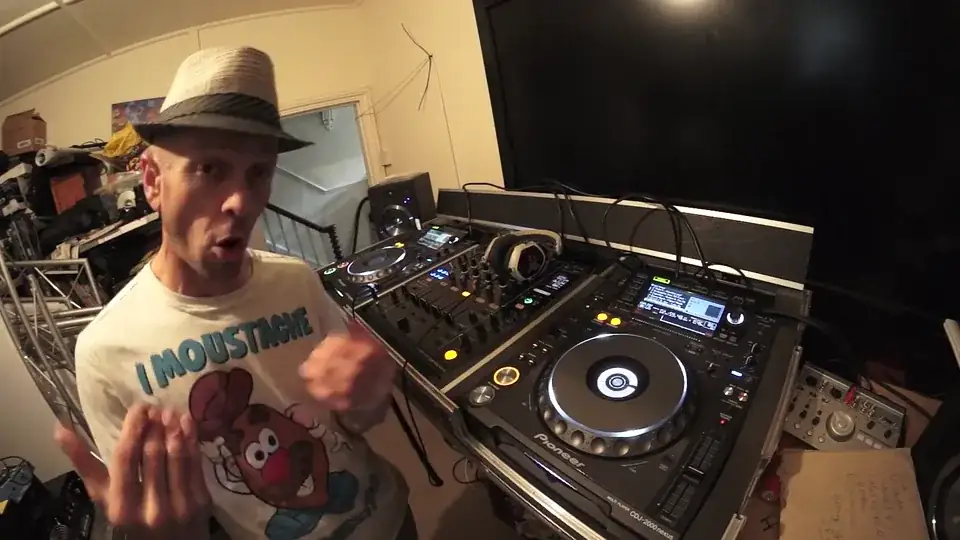
Alright ladies and gentlemen, in this video we're going to do a bit of dropping in drum and bass tunes at exactly the right point. Also I want to tell you a little bit about the BPM show that's happening in the NEC this September. It's the 12th, 13th and 14th of September so it's like just sort of about a week away. DJ stands and of course CD pool. Now I'm also going to be doing a seminar in the orange space on Monday at 2 o'clock, talking about what kit to buy, bit of mixing skills and the like. So if you want to play a part and come along and get some very basics on the beginnings of DJing, what to do, what not to do, then come and see me in the orange space. Pretty much anything and everything to do with DJing and the music industry. Now, when the BPM started many, many years ago, it was pretty much designed for mobile DJs. But the guys that organised the BPM realised very quickly that there was need for a bigger, not better, because he's always been very good.
2:17 I will put the names of the tracks in the description
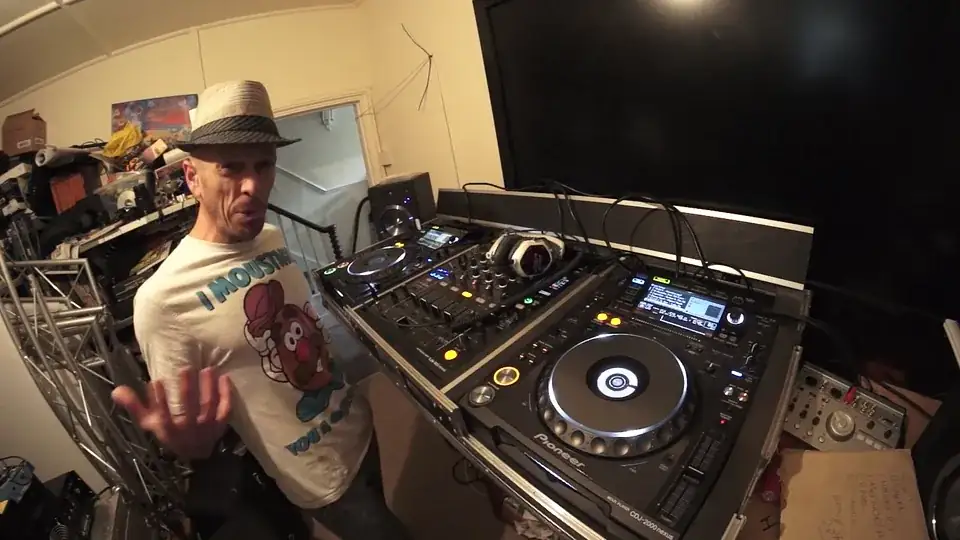
Need for a bigger show. So it grew and grew. It ended up going to the NEC, and it is now pretty much the premier DJ style show in the whole of Europe. So if you are a DJ, and if you're not there, then you're going to miss out big time. Because there's pro stuff there as well now. It's not just about mixers and CD players. It's about high-end lighting. High-end kit, high-end conversations and high-end top quality DJs, producers, schools, you name it, they're going to be there. Drum and bass. Right, now then, a lot of people find it very difficult to mix drum and bass because there's so much going on. You haven't got that 4-4 kick, 1, 2, 3, 4. If you're not familiar with drum and bass... And you hear it for the first time or you're not used to mixing it. It pretty much sounds as though someone's got a drum machine, stuck it in a tumble dryer or dishwasher and go like that. So all the beats are like... It's mad. It's insane. But there is timing and it can be done. You can count. Right, so I've set up two tracks. I will put the names of the tracks in the description. Also, I will put...
Information on the BPM show. And also, I'll be showing for possibly the maybe second time, the new wireless headphones from Vmoda. Now one beauty about those is yet they're Bluetooth enabled and this and the other. But what some people find with wireless is that you lose certain parts of the clarity and certain oomph of the music. You lose that kind of like Big feel, because of course they're powered. Well what V-Moder have done with their new wireless is they've given you the option of having them wireless or if you want to you can plug in from your mixer into your headphones and it bypasses all of the gubbins that gives you the wireless feature and you just get a pretty much what you do you get a straightforward set of headphones
Wonderful, alright? So come and check them out. V-Moda will be on my stand on A106 at the BPM show this year, drum and bass. Let's have a listen to this cut here, okay. Right. Now I like to get people to dive in at the deep end and work really hard. Now, again, here's an analogy for you, alright? Of course, when you're a child, a baby, you have to learn to crawl or sort of like jump around and your ass going and shitting yourself all over the place. Okay. Not a very nice thought, is it? No. So you'd, you know, you crawl, then eventually you stand up and you fall over and break your arm, which you shouldn't really do. And then eventually you sort of potter about and you start to walk and run. And then like, you see him bolt. What I want you to try and do first is to run first.
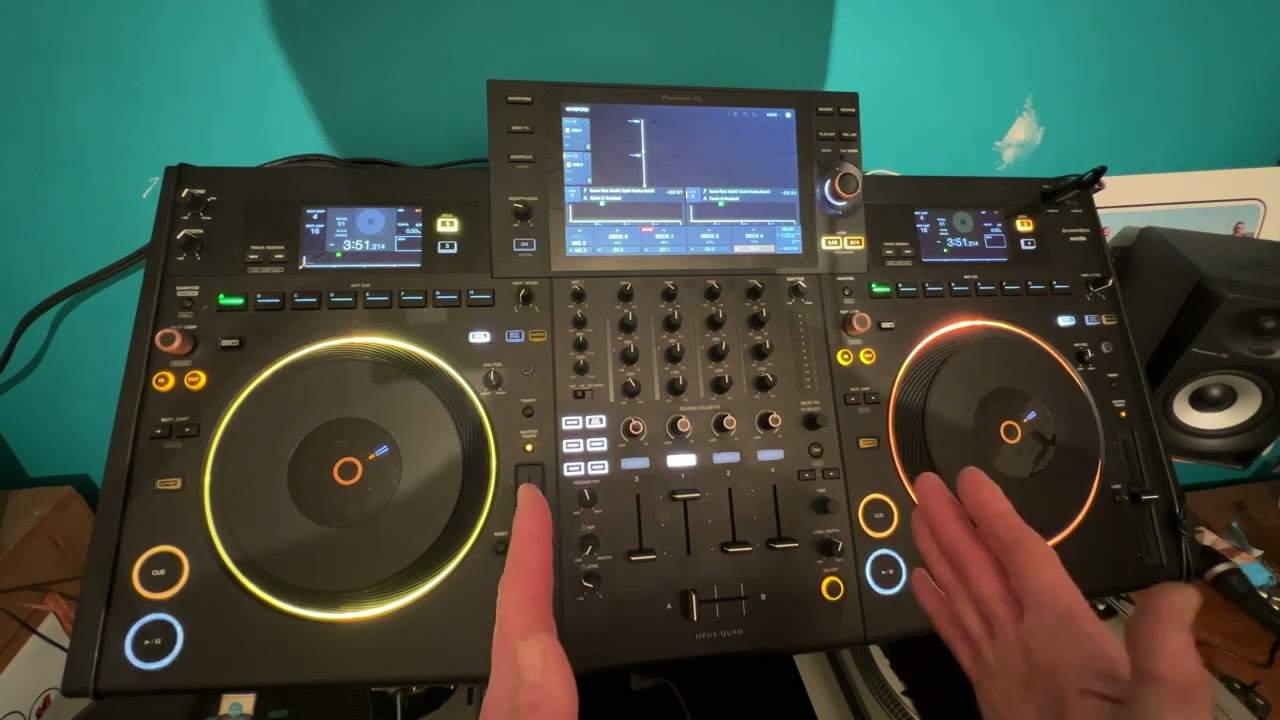
Try and run as hard as you can, then walking is easy. So in this demonstration what we're going to be doing, we're going to be trying to find the counting and timing in a drum and bass tune inside the break where there's not much going on. But I'm going to give you a good way of learning how to do that. It's a little bit easier, it's still difficult, still slightly technical, but it will help. I have two tracks. This one here is set at the break. Have a listen.
5:21 Again with drum and bass, you could be counting like this
This one here I've set to point where we have exactly the same amount of time from the point that I've set it to, to where the kick comes in. Now the exact amount of time corresponds to the exact amount of time of the break over there as well. So we're going to be doing a lot of things. Really I suppose this could be more of a demonstration and I want you to take tips from this demonstration. And that point is here. Now again with drum and bass, you could be counting like this. 1, 2, 3, 4, 1, 2, 3, 4, 1, 2, 3, 4, 1, 2, 3, 4, 1, 2, 3, 4, 1, 2, 3, 4, 1, 2, 3, 4, which is ridiculous. You need to be counting like this. 1, 2, 3, 4. 1, 2, 3, 4. Now you'll notice there as well, exactly the same with the break. There's a lot of percussion.
7:31 One, two, three, four
But you haven't really got a defined kick, a constant kick that you can listen to. It's not there. What do you have to do? You have to try, and this is where your ears come in, this is where practice comes in, and this is where listening to loads of different tunes will help immensely. You have to listen to parts of the track that seem to be at the same point during the track. They seem to have a similar point. Where they're playing. Now, what does that mean? Let's have a listen. Now can you hear that? It's an 808 I think. Now that bass sound. Now, their structure in that bass sound. Now that could help you to count first of all. So let's have a listen again. 1, 2, 3, 4, 1, 2, 3. One, two, three, four. Not there. Now again, let's have another listen. Let's try and find something else that's got timing. Right. Now later on, there's a... Like a cymbal. Not there.
Now also what you'll find with drum and bass is that there are sections, there's groups of parts of the track that seem to have a lot of the same sounds. So one key factor with drum and bass when mixing is to try and make sure that you are definitely in phrase. That's paramount, really. If you're not in phrase, then you could be in time and key. If you're not in phrase, then you can get clashing of vocals, clashing of melody. And of course, if you are in phrase, that's when you get perfect transitions, perfect double drops, and perfect crowds like creaming their knickers. I'm trying to visualise if that's a good or a bad sight, but there you go. Alright, so... The next part of this tutorial or this demonstration is trying to work out the timing in a break. Now, in a lot of drum and bass breaks, it's very airy and floaty and there's very little going on that will tell you that there is some form of structure there that you can actually physically count 1, 2, 3, 4. So, this one here, B-Complex featuring MC Flavor. So, at this point here, B is the beginning of the break, so...
9:59 What I'm listening for here is the melody
Let's just go back a little bit. About there. Now, what I'm listening for here is the melody. Now, if we go back slightly, so let it be again. Let's go back a bit more. See, there are strings in the background, but they're not too defined really. So, one, four, two, three, four, two, two, three.
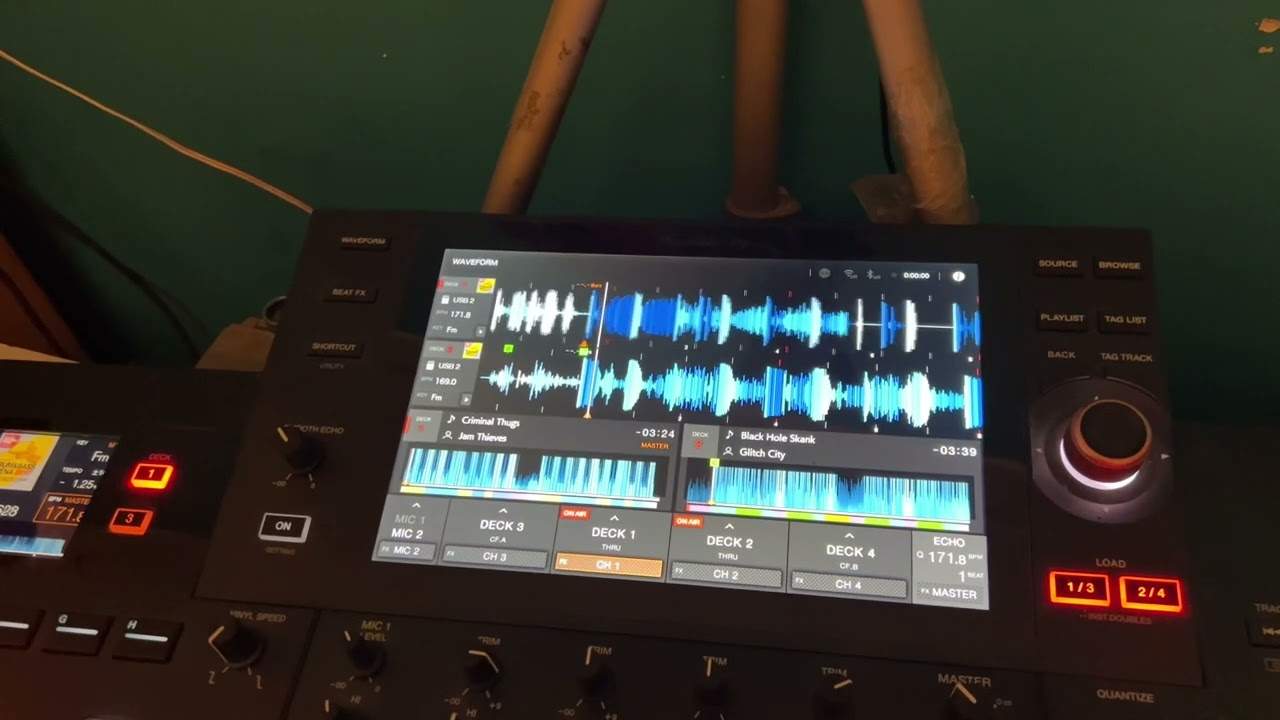
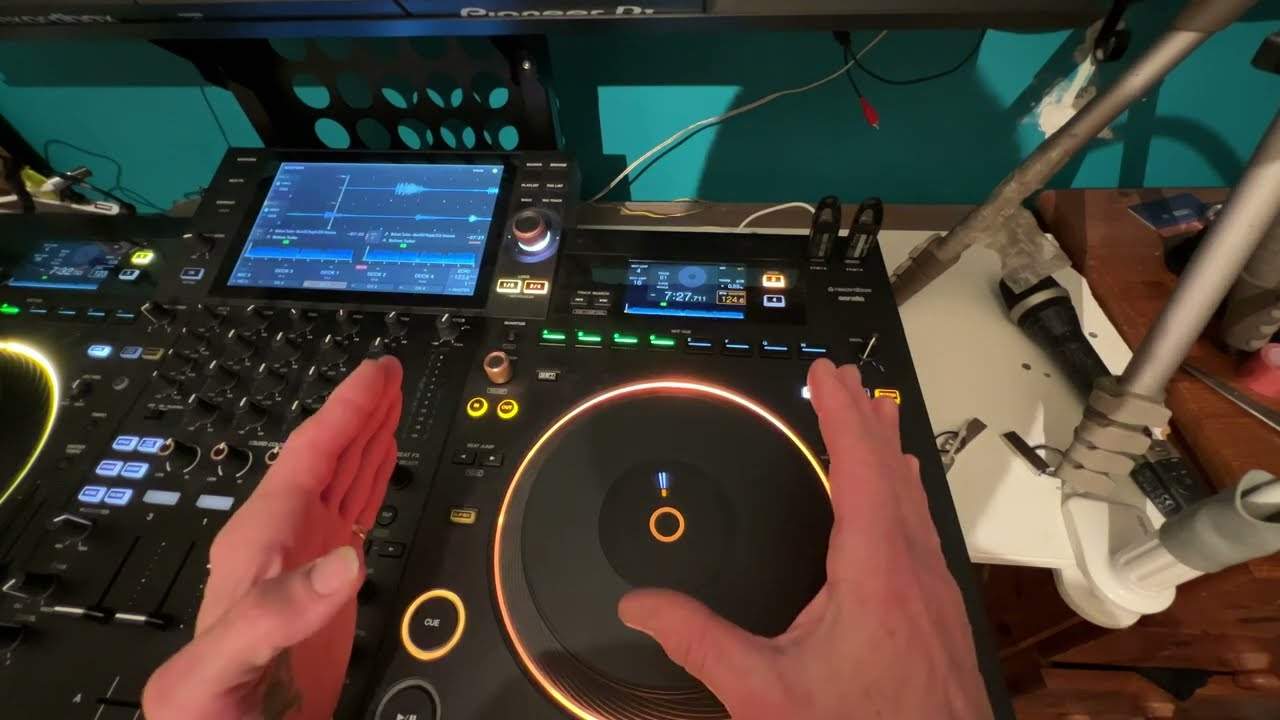
Slightly off there. Okay, so what we've got is we've actually got a change in the strings but the change is in time with the timing of the bars, so the counting. Now, if at all you ever get lost halfway through a break, what you've got to do really is just try and find a point where you can hear a definite sort of change. It's almost as though there's an... We're not really like that, but you know what I mean. Okay, so let's just wang it forward a bit, sort of to about there. Alright, there. Now that is a definite change. Now also, I'm now looking at the readout here, so I'm just going to wang the camera over there and hopefully you can see it there as well. So if you can see, I've got B, C and A. B is the beginning of the break, A is the end of the break, C is the middle.
12:03 I'd say it's sort of close-ish to the middle
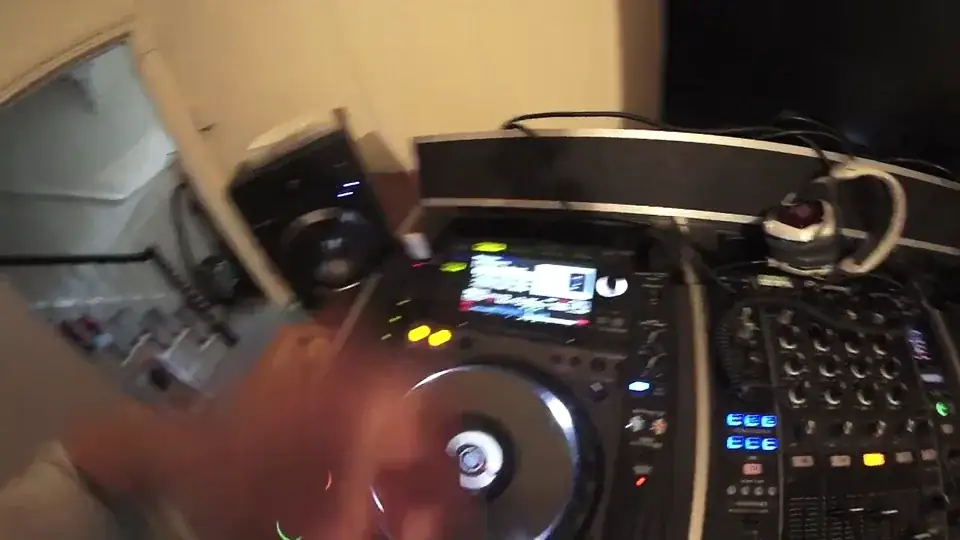
So, alright, it's close. I'd say it's sort of close-ish to the middle. Now, that's telling me that we're either at the middle because that could be slightly off or we're getting close to the middle but the break itself changed so that is telling me now that we're in the middle of a phrase so we're possibly at the time where the middle of the phrase is starting to build up so let's have a listen to... From C again, and see if we can hear the change in... Sorry, I'll start again. Let's see if we can count the bars from here, so... I might have been off there. Let's try that again. Yeah, yeah, we're alright. One, two, three, four. Yeah, there we go. Okay. Slightly, slightly off but we're pretty much bang on the nail there. Okay, so what I've done here now is from point B, point B to where...
13:55 The actual kick comes in on this track
The actual kick comes in on this track. It's exactly the same time from the beginning of the break to the end of the break there. So what I could do if I wanted to, I could start from point B there, start from point B here which is the beginning of the break, let that break play through, have this track on my headphones and then instead of that track This is where you decide what you want to do 100 DJs, the same tracks. And you asked 100 DJs to mix those two tracks in at exactly the same point. It's highly unlikely that they would all do exactly the same mix. In fact, it's more than likely that every single mix those 100 DJs do would be very, very slightly different. So don't worry if you think you're going to be doing something the same because you're not. Because whatever you do will have a slight colour variation to the other DJs.
I'm going to put my earwog on there from B. This time, I've just got it in the background. Now again, I'm listening to the timing, trying to find those key points in the beginning of the bars. At the moment, they're still in time. Okay, maybe... Again, if I was really... Really really critical, you know I went that over a little bit too soon and then I brought it back and then maybe I then the first time I put the crossfade over then the second time again was a little bit too soon but I'm being really critical. Now this time let's do exactly the same mix but what I'm going to do I'm gonna use the filter on this track and have that filtered in the background over the break but I don't want to lose the feel of the break I still want to have that there
17:17 Let's go over and I'll put them two together straight
I want the break to be dominant over the whole mix. I just want to add tiny little kind of elements of the DMNZ by your side track, over the break. So I'm going to already set the filter to about 9 o'clock. Let's take the bass away as well because taking the filter to the low position does give you more bass and I don't want to over-exaggerate the bass because I want the bass to be more prominent on the break here. Yeah, that's better. Okay, so let's go over and I'll put them two together straight. I'll put them both...
What is so funny about doing this is you're talking to yourself, you're like sort of in the middle of a room, no one else and you're just talking to like a camera, but there you go. I hope that's been a help. I will put the names of the tracks in the description. I'll also put a link, ah, it's half me breakfast. I'll also put a link to visitbpm.com. Hope to see you there. If you're not there, then you're square. Practice and enjoy. Thank you.
This transcript was produced automatically from the audio of the video and may contain mistakes.