 17:32
Step by step, pure vinyl mixing
On YouTube this video is called Step BY Step Pure Vinyl Mixing Lesson for the New DJ
What this lesson teaches
Seventeen minutes going through a vinyl mix in sequence, with nothing skipped. What makes it valuable is the order, because on vinyl the order is not optional.
Before anything
A record is playing to the room. You are about to prepare the next one.
Channel fader down first. Before the needle touches anything. He is specific about why: even a fader slightly up will let some of the new record bleed into what the room is hearing, and the first thing they will hear of your next track is the thump of a stylus landing.
Cue button on, so that channel goes to your headphones and nowhere else.
Only then does the needle go on the record.
That sequence - fader, cue, needle - is the one to build into your hands, because the consequence of getting it wrong is immediate and public in a way that it is not on a CD player.
What you are hearing
With the fader down and cue up, you have the incoming record in your headphones and the room has the outgoing one. He demonstrates exactly what that sounds like from inside the headphones, which is the thing a video cannot normally show.
Then the work
Find the start of the track by hand. Get it running, listen against what is playing, and adjust - and on vinyl that means the pitch fader and the platter, with no readout, no waveform and no grid.
The thing that strikes you watching it done properly is how much of the job is physical preparation rather than listening: getting the sleeve off, the record on, the needle down, the fader and cue set, the start point found. The beatmatching is the last part and the shortest.
Why learn this way
There is nothing here you cannot do faster on a CD player, and that is the argument for it.
Everything on vinyl is manual, so everything is honest. There is no stored cue point that remembers the start for you, no display that tells you which deck is faster, and no sync. Whatever the mix sounds like is what you did.
Which is why DJs who learned this way tend to be good at the parts that transfer - and why the three lessons in this course are worth doing even if you never intend to buy records.
Contents of the video
0:00 I mean really, don't stop
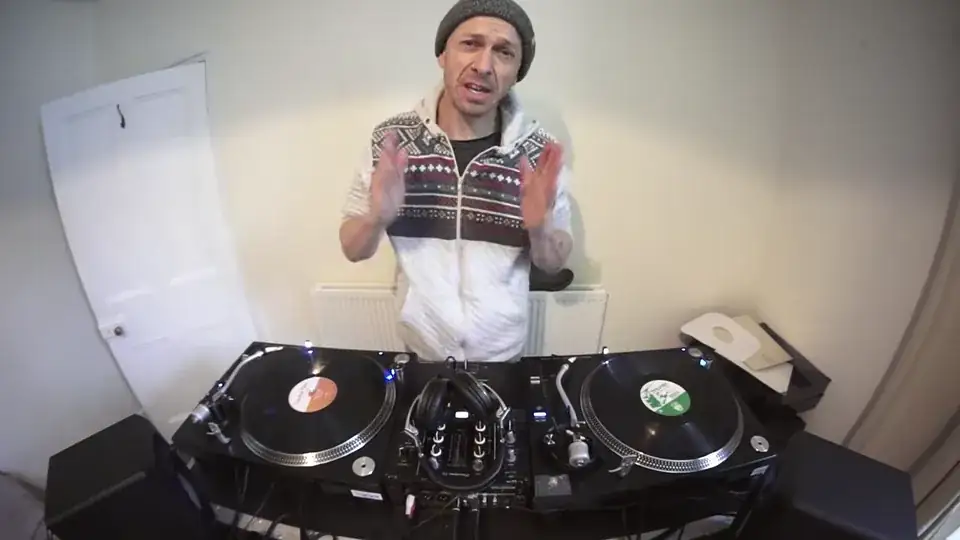
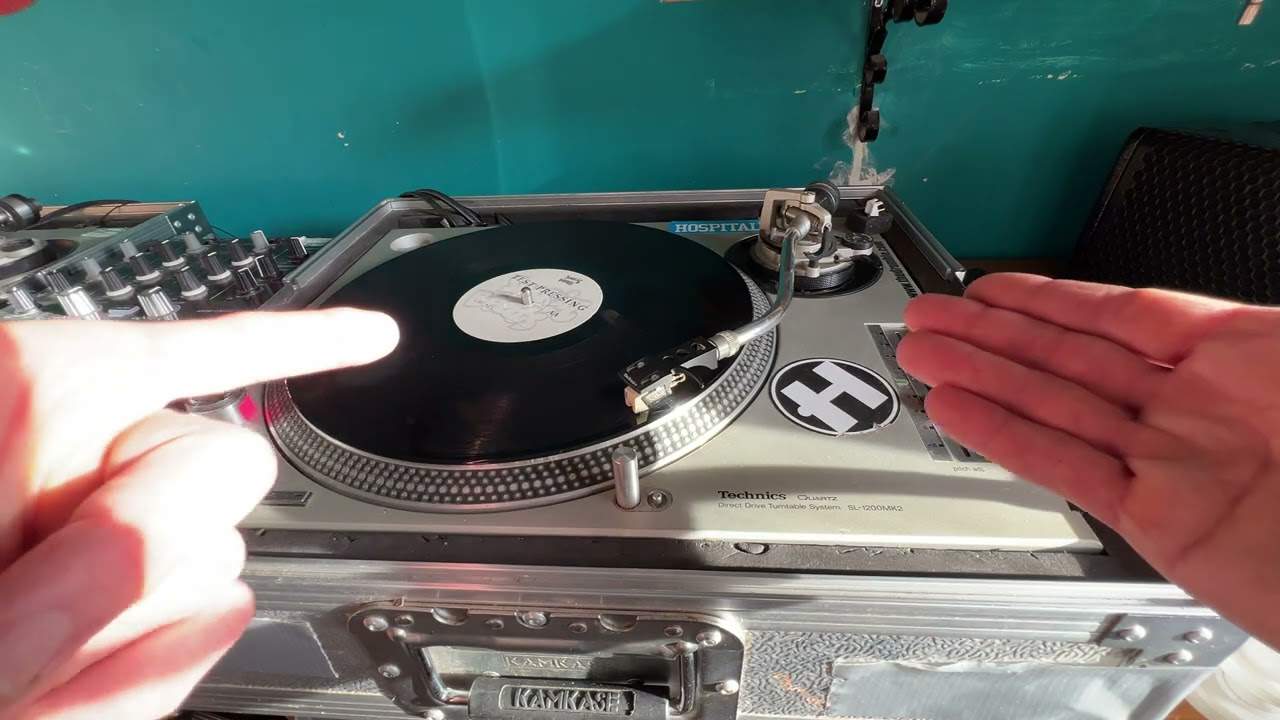
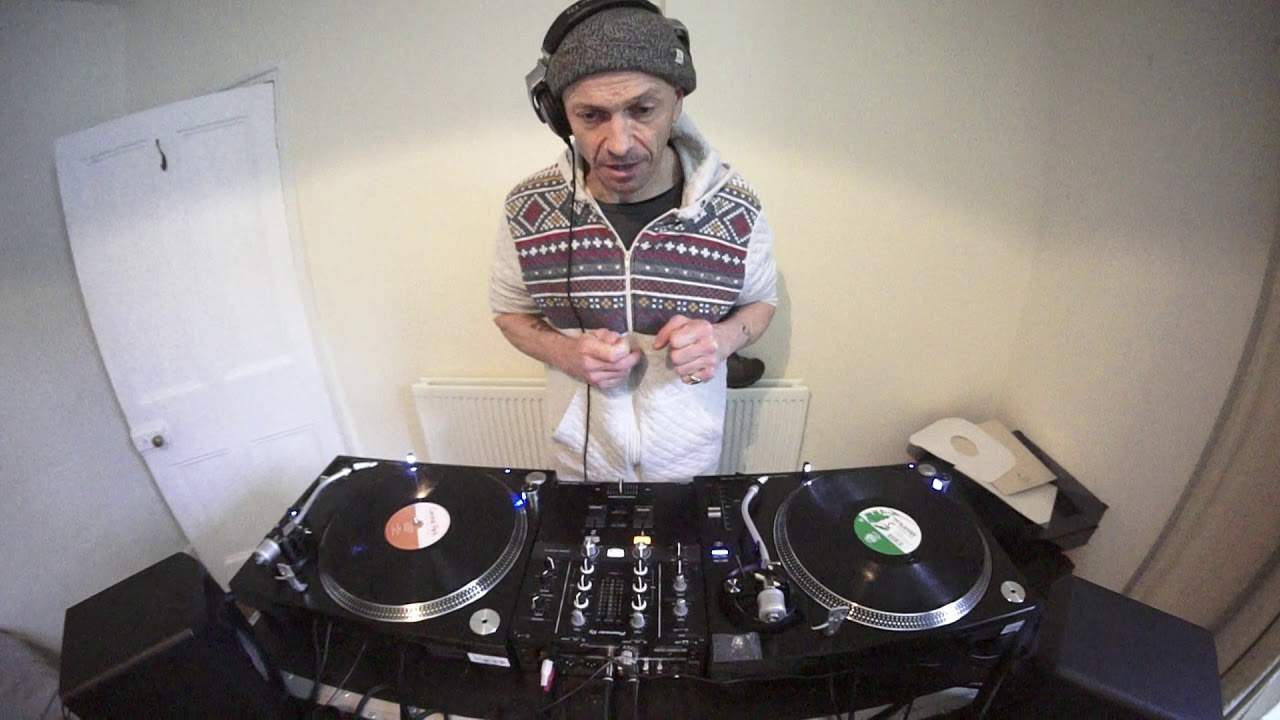
Alright ladies and gentlemen, we're going to go through step by step, I mean literally, hopefully to the micron on how to do a mix using vinyl turntables. Decks I've got are the PLX-1000 from Pioneer DJ, we have the DJM250 Mark II and I've got the headphones as well. Okay, so what can we do? I'll show you. Okay, so I've got here a track, Central Park Recordings, Daddy J featuring Face Electric City Part 1, and over here Martin Venutogjug, something like that, featuring Derek Conyer, the track entitled Really Don't Stop. I mean really, don't stop. Okay, so I'm going to play this first, so let's put the needle on the record, and also if I put that centre... And that's centre, so you know, you can tell I haven't already gotten beatmatched. So if I just put this on here, this isn't step by step, this is just showing, there you go, you can hear they're off.
Okay? Alright, so let's imagine that this track here is playing, alright? So that's playing now, so I'm just going to put the needle off the record and just imagine that's playing, alright? So my first, the first procedure I need to do, or what I need to do again first is get the other record ready. Of course, so taking out the cover, I'd put it on. I would then put the needle on the record like that. Now, I would now press my Q button on the left hand side because I want to hear this track through my headphones and not through the PA. Because if I put the needle on the record... Put the volume up and started to play it, you would indeed hear that track over that track. We don't want that to happen.
2:33 Now is what you would hear
So what I'm about to show you now is the procedure on what you would hear if you had your headphones on and you were listening to this track. So again, that one's playing. Imagine that track is playing, people are dancing to it and they're having a good time and you're now ready to put this track on. So of course, needle on the record. The volume is down. You want to make sure that the volume, of course, on your mixer is down because if it's up, the sound, however far it's up or down or however far it's up, the sound or some of it may bleed through into the other sound that's playing that people are listening to. So what I'm about to show you now is what you would hear if you had your headphones on and to do that, of course, I need to just put the volume up.
So what you're about to hear now... would not be what the public are listening to. It would be what you could hear on your headphones. So needle on the record, press play and what I'm going to do now is split it forward. There. I'm getting my first beat and now I have cued that up. All right? I've got that ready. So now what we need to do is we need to make sure that that track is in beat with that track. So the way to do that... of course, is to play them together. Now I'm going to play them together twice. The first time I'm going to play them together is with this track playing so you can hear it and I can hear this track on my headphones. But you can't hear this track. And then I'll match the beats and then just bring this track in very quickly.
The second time I do it, I will play this track over this track. That track. So you can hear the two tracks together. And for... I mean, so we know where we are at the moment, I've got the pitches dead center and as you heard earlier, they're off beat. So let me do that first. So I'm going to first use my headphones. Bring that one up. Put that on there.
4:27 Wait for the beginning of a new phrase
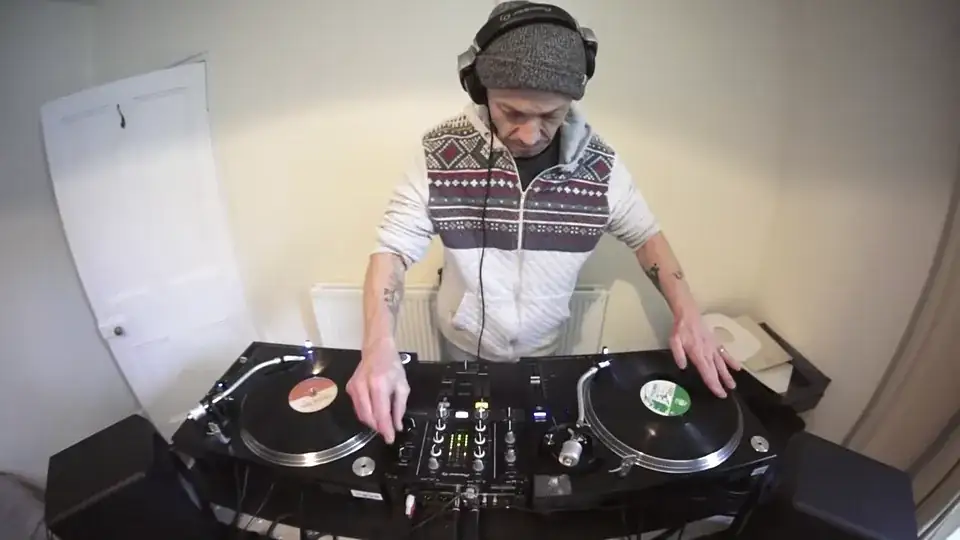
Headphones. Now again, I'm going to try and cover as much as I can. Now when you are beat matching using vinyl, the same with MP3 or CDs or anything, quite often what you'll see the DJ do is when he or she is getting it in beat, they won't wait for the end of the phrase. Wait for the beginning of a new phrase. They'll just start beat matching it any place because when you're beat matching a track, you're not trying to find the beginning of a phrase or the beginning of the vocals, the end of the vocals. You just want to match it. You just want to make sure it's in time and you can do that. Anywhere in the track. So long as you start, the track you're mixing in on the count of one in a bar and you match that on the track that's playing.
Now I'm going to show you now exactly what I did with the volumes both up. So let's put that back to the center and let's get the beginning of this one again. So remember needle on the record. Put it forward. There it is. Actually, that record needs a bit of a clean. I'm just going to give it a wipe. All right. So the next thing we need to do is once we've got it in beat, we then need to make sure we bring it in at the right time. So the first procedure is, of course, make sure it's in beat. The next one is bring it in beat but at the right time. Now with vinyl, vinyl is difficult because unless you've got two copies of the same track, you can't say, excuse me, ladies and gentlemen. I do apologize. I did a really crap mix there.
I didn't match it in beat properly. One second or something like this. You can't do this. Here we go. So you're trying to get it in beat. You can't. You've gone past your cue point. Oh, sorry, ladies and gentlemen. I do apologize. I got that out of beat. I'm just going to start it again. So I'm going to rewind the track. I'm going to just put it back a bit.
7:20 There is very little room for error when using vinyl
You can't do that, all right? So there is very little room for error when using vinyl. All right. So I've explained about getting it in beat. Also something that is quite important is your headphones. Now you'll notice that I have one ear over... I have one ear cup over one ear and the other ear is left open. Now this is how I monitor. I like to use my right ear for monitoring the track I'm listening to before it comes into the mix and my left ear is there to monitor and listen to the main PA. Also, what I'm always making sure I do is that my headphone volume audio, the actual amount of volume I can hear on my headphone is equivalent to the volume I can hear on the main PA. Now this is a lot to do with SPL, sound pressure level.
Because my headphone is a lot closer to my ear, it means that that doesn't have to be as loud as the PA system. If my headphone was as loud as the PA system, I would never DJ again because I would be deaf. Pardon? So you don't want that to happen. So very quickly, it's a little bit like a weighing scales. If you look at it logically, you've got a pair of weighing scales. You put flour on one side, cocaine on the other. You want to match them up and you just make sure they're equal and make sure you take the cocaine with you because it's probably worth a lot more than the flour unless of course it's an orchid. In that case, it's probably worth more than the cocaine. Right. So I've done that. Now what I want to do is make sure that I know where I'm going to start my track in
Phrase and time with the other one. Now. You may see a lot of DJs that are doing this all the time, back and forwards, back and forwards. And then they drop it in. Now that's fine if your turntable is set correctly and you know 110%, sorry, beg your pardon, 111% that your piece of vinyl, the needle isn't going to jump off that groove. And just that split second before you want to bring it in, it jumps off and you've lost your cue point. And that happens so many times. It's happened to me a million and one times. So the best thing to do is once you've set that piece of vinyl at the beginning of the beat, just leave it. Just don't touch it. Leave it alone until of course maybe two or so bars before you want to bring it in and
10:04 Just in case you do make a mistake, don't worry about it
Then get it ready. Make sure it's in beat. Throw it in. All right. Now also towards the end of this video, I'm going to explain how you can get out of jail free. So just in case you do make a mistake, don't worry about it. And I'll show you while we're doing the mix as well. So let's just play this. So I've got that in beat. Bring the volume down. I've got my cue on this side here. It did slightly go off beat a little bit but what I did do is I brought it in phrase with this track over here. Okay. So what happens then? If we miss our cue point with vinyl. Now if you are, and this is something I advise you not to do if you're a beginner DJ just using vinyl and real vinyl, not virtual vinyl because you can of course flip it back and
12:34 I'm waiting for the next phrase
Start again or set cue points. But what I would advise you definitely 111, not 10, 11% not to do is wait till the end of the track. In other words, the very last phrase and bring your next one in simply because as I said earlier, if that track finishes, it's finished. And then you've got to like have a bit of a silence and start the track. So what I recommend you do is if you're going to bring your next track in at the beginning end of a set phrase where you know you want to bring it in, have a contingency plan of the next phrase or the next one. So in other words, if you want to start the track say on this side on my left and I wanted to start it at the beginning of the chorus, but I missed the beginning of the chorus,
I need to make sure that I can still bring that track in say at the end of the chorus or at the beginning of a verse or the end of the verse. So let's do that right now. So here we go. So this is where I would have been in the mix now. And all right, I lost my cue point. So I'm waiting for the next phrase. Right? No, I was out of phrase there. Okay, I'm not going to repeat this video. I was actually out of phrase there. So let me bring it back where that baseline started. Okay. Now. All right. So I was slightly out of phrase there. The baseline started. Now, let's imagine. All right. I'm just trying to think out loud here that first of all, I brought it in at the wrong place. Secondly, when that baseline started, it was like, oh, that's the beginning of a new phrase.
What I can do then is start counting from there and then sure enough again dance music we have 4s, 8s, 16s, 24s, 32s. Just wait for the next phrase. So let's go back.
14:28 Let's wait for that baseline
So let's wait for that baseline. So imagine I'd have brought it in, it's the wrong place and then that baseline starts. So you know, let's pretend it's still playing and I'm like thinking great. And I'm thinking yeah this is great and I'm going like oh that's where it was. So that's where it was because it jumped. Slight change there that tells me it's not so much a new phrase but that was definitely an even number. An even number, probably an 8. Here we go. De-start it. Okay so what I tried to do there and what I did do is make sure that when I did indeed bring that track in, I brought it in at a new phrase. So again for the complete beginner, what is a new phrase? It's like uh. A new phrase can be the beginning of the vocals.
It could be the end of the vocals. It could be the beginning of the chorus. The verse. The instrumental break. The end of the instrumental break. It could even be, it is, right at the beginning of the track. If you listen to your tracks you will find that it's always an even number unless of course the producer was onk okay. Right so it's either going to be at the beginning of the track, maybe where the baseline starts, maybe where the baseline ends, the vocals start, the vocal ends, the melody starts, the melody ends. Even if that is not the beginning of the track. Even if that is not the beginning of a phrase. It will be inside that phrase. So what I want you to do, a bit of homework here, is listen to your tracks and maybe listen
To where the melody starts. Count how many bars there are before that melody finishes. And I guarantee you it's going to be, if it's a radio version, two or four bars. If it's an extended version more likely it's going to be eight, sixteen, twenty-five bars. If it's an extended version more likely it's going to be thirty-four, thirty-two. Practice and enjoy. Thank you.
This transcript was produced automatically from the audio of the video and may contain mistakes.