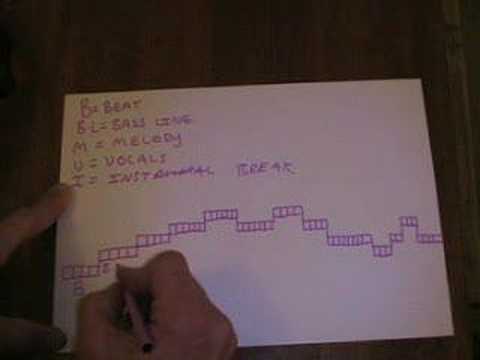
 8:11
The structure of dance music
On YouTube this video is called The structure of Dance music , for the New DJ.
What this lesson teaches
He asks viewers to rate this one, which he says he has never done in seven hundred videos. It is the one he thinks is his best explanation, and he may be right.
The notation
Five letters, and everything else is built from them:
- B - beat
- BL - bassline
- M - melody
- V - vocals
- I - instrumental break
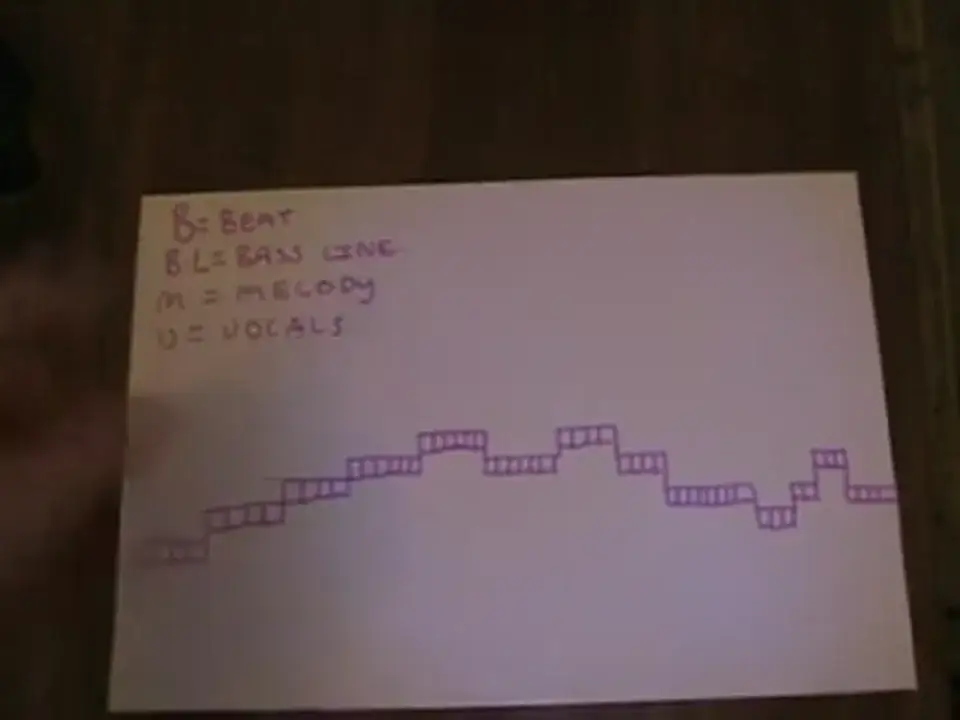
The shape of a record
Drawn out, a typical dance track steps up and then down:
B alone to start - just drums, which is what the DJ mixes over.
Then B + BL - the bassline joins.
Then B + BL + M - the melody arrives.
Then everything plus V - the vocal, the fullest the track gets.
Then pieces come away: the vocal drops, an I section arrives, everything returns, a stretch of B alone, another I, perhaps B + M, and finally back down to B alone so the next DJ has something to mix into.
Each of those is some number of phrases long, and which number is what differs between records.
The prison bars
His analogy for why this works at all: you would not build a prison with the bars at random spacings. They are evenly spaced, and so are the segments of a dance record.
That regularity is the whole reason counting is useful. Irregular music can be counted and tells you nothing about what is coming.
The last two minutes, which are the real content
Here is the idea worth taking away, and it reframes what mixing is.
A beginner mixes the end of one record into the start of another, because those are the two places with just a beat.
A good DJ, he says, can take any section of one record and find a section of another that fits it. An instrumental break in the middle of track one is a hole shaped like a beat - so bring track two's intro in there, knowing its bassline will land against what is underneath, and the rest of it will carry on from there.
Once you see records as stacks of sections rather than as songs with a beginning and an end, the number of places two records can meet multiplies enormously.
The exercise
Take any record - house, soul, hip-hop, reggae, funk, techno, trance, he does not mind - and count. Mark each block. Start a new line when you hear a change, and note what came in or went out.
Do that half a dozen times and you will have the diagram in your head rather than on paper.
Contents of the video
0:00 This is my interpretation of the structure of dance music
Alright folks, my name's Jonathan. For the people who don't know me out there, I'm known as The DJ Tutor. Now then, this is my interpretation of the structure of dance music. I found a way in which I can actually break it down and show everyone out there how dance music is all fitted together. Now then, I've made over 700 videos on YouTube and not once have I ever, ever asked anyone to rate videos. I would like you to rate this video according to how well you think I have explained the structure of dance music. There are stars, you can either give me one if you think it's crap, or two if you think it's not bad, up to five, it's entirely up to you. If you don't want to, no problem. Right, I'm going to stop the camera and I'm going to show you my interpretation. Hold tight. Alright folks, here we go. This is The Structure of Dance Music by Jonathan, The DJ Tutor. Right, OK. Now then, what is dance music? How do we structure it?
Okay, a real bar in music is 1-2-3-4. So you continue doing that, 1-2-3-4, 1-2-3-4. Now then, what I'd like to do, I'd like to just make that a little bit bigger and longer. How we're going to count it is this, 1-1-2-3, 2-1-2-3, 3-1-2-3, 4-1-2-3. But we're going to count it... Actually in time. 1, 1, 2, 3, 2, 1, 2, 3, 3, 1, 2, 3, 4, 1, 2, 3. Alright, now then, let's say we class that as a bar. Now then, alright, what are bars? If you imagine a prison, would you have bars like that all over the place? Well, I doubt it very much. Or would you have them, now bear in mind, you know, I haven't used any rules or anything like that, would you have them equal spaced? Probably yes, in fact you definitely would. Now that in essence is the way you should treat bars. They are equally spaced in dance music and they're in time and logically they're in beat. Now a record, a tune, whatever you want to call it in dance music, it's got a start and a finish and it's got a middle bit. Right, now what I want you to consider is this, okay? If we took that timing as a block
2:49 B-L as the bass line, M as the melody, V as the vocals
1-1-2-3, 2-1-2-3, 3-1-2-3, 4-1-2-3. Alright? Now and then what we do, if you imagine tiny segments in there like a prison, like the bars. And then what we do, we look at this one step further, one step closer. Now then what I want you to bear in mind here, I'm going to start writing things down here as well. Where's my pen gone? There it is. Right. I want you to class B as the beat. B-L as the bass line, M as the melody, V as the vocals. I forgot one here, didn't I? I equals instrumental. OK, right, now then, what is a tune? How does it start? How do a lot of, when I say modern day dance music, but you know, house, that sort of music, how does it start? It normally starts just with a beat. But if you class, like I put over here, if you class these bars, that big square and all of a sudden that square is reduced to this tiny segment here, that is a bar. And in that we're counting 1-1-2-3, 2-1-2-3, 3-1-2-3, 4-1-2-3. And we're doing that one, two, three, four times. So at that point we've got the B, which is just the beat.
After those four times, we're going to have another section here. We're going to have B, which is the beat, plus we're going to have the B and the L, which is the beat and the bassline. And then we're going to go to another section. Here we're going to have the B, which is the beat, plus the BL, which is the bassline, plus we could have M, which is melody. And then at this point we could have all of those, and if I put a cross there and a circle you'll know that all of those is that. Plus we can have V, which is the vocals. And then at this point here we could just have all of that and not the vocals. And then at this point here we could have the I, the instrumental break. At this point here we could have all of those, which was here.
5:26 This isn't a certain record
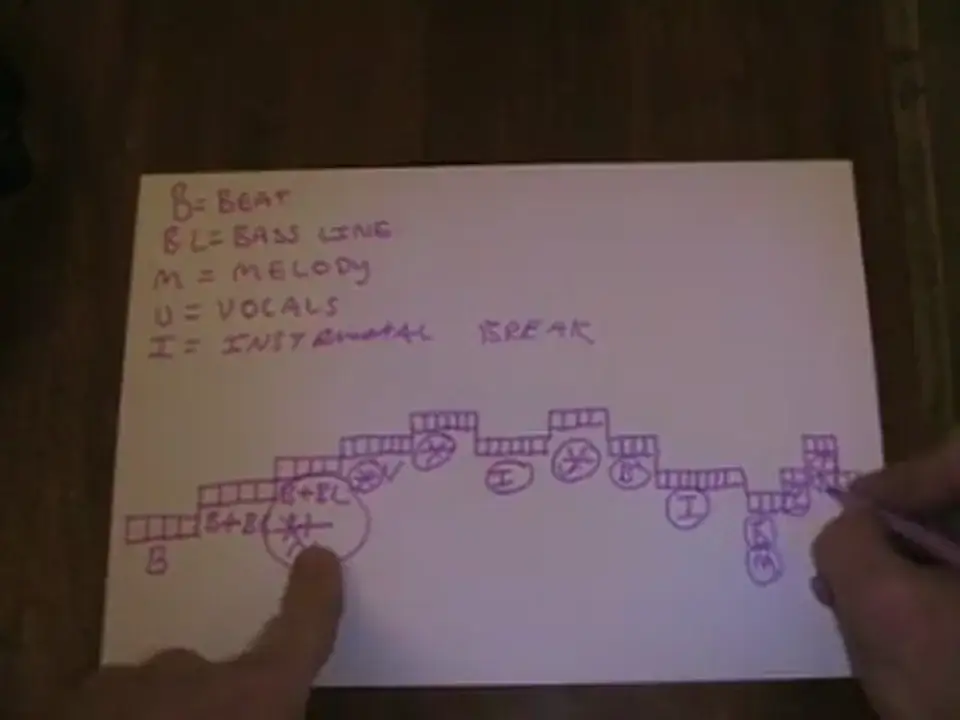
Which was the beat, the beat and the bass line, and the melody, and let's say we could have V again, the vocals. At this point here, we could just have the B. At this point here, we could have maybe I again, instrumental break. At this point here, we could have B, and maybe we could have M, just the beat and the melody. We could have all of those from this point here and then back down here we're finishing off with just beat. Now then, this isn't a certain record. This is in no way any record. This is just an interpretation of the structure of dance music. Consider this. Now I've always said when people mix what they tend to do Not most of the time, but when you start to mix, it's a good idea to just mix in from this point and this point. But a good DJ can interpret any individual section along a different tune. And he can find different sections in other tunes and put them together. So for example here, I, instrumental break, in the middle of this particular record. He can possibly bring B, the beat.
He knows that the bass line of the second tune, when that starts, will work with all of this from the first tune. And he knows that the rest of the second tune will work along here. This is the way I look at dance music, how it's structured. I don't think I've got anything else there but I hope you get the sort of general idea. This really is the structure, the way dance music is put together and it's all about these small tiny segments. Now I want you now to get any dance music, any particular house record you've got or soul record, R&B, hip hop, jazz, reggae, funk. Techno, trance and just count. 1-1-2-3, 2-1-2-3, 3-1-2-3, 4-1-2-3, 1-1-2-3, 2-1-2-3, 3-1-2-3, 4-1-2-3, 1-1-2-3 and so on. And I want you, every time you get a little block, I want you to put a mark. And then another mark. But when you hear a change, then go to another separate line and another mark. And another mark. So here you can have two marks and just the beat. Here you could have beat.
Plus bassline. And see what you think. Let's see if you can find a structure in the music you've got. Thanks for watching, it's my interpretation and I hope somewhere down the line this will help someone. Thank you for watching, practice and enjoy.
This transcript was produced automatically from the audio of the video and may contain mistakes.